




What type of wavefront will emerge from a
A. Point source
B. Distant light source
Answer
 Verified
574.8k+ views
Hint: Wavefront is an imaginary surface that represents the locus of all the points in an optical field having the same phase at a given instant.
General properties of a wavefront are:
A wavefront is dependent on the shape of the source of disturbance
A wavefront does not travel backwards.
A wavefront is normal to the light rays.
Types of wavefronts:
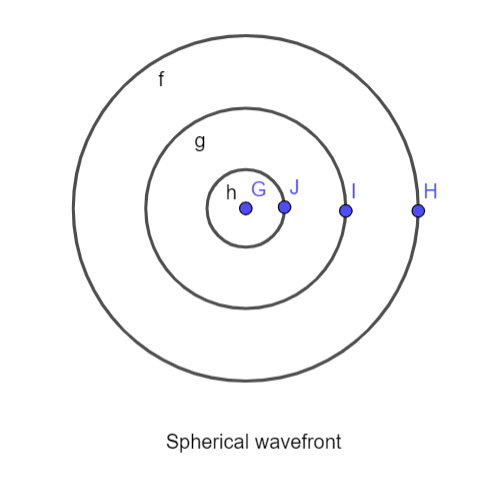
Spherical wavefront: Very similar to ripples in water, this wavefront is produced by a point source.
Plane wavefront: Rays coming from a distant source generate a plane wavefront.
Cylindrical wavefront: When the light rays converge or diverge from a lens a cylindrical wavefront is formed.
Complete step by step solution:
Point source is that source which is so small that it is considered as a single point. Such sources are dimensionless.
The wavefront emerging from a point source is the spherical wavefront since the waves travel radially outwards from the source.
Hence the wavefront for a point source is spherical.
A distant source is so far away that it is considered to be at infinity, the rays travelling from a distant light source are taken as planes moving in the direction of propagation of waves. And hence the wavefront is a plane wavefront.
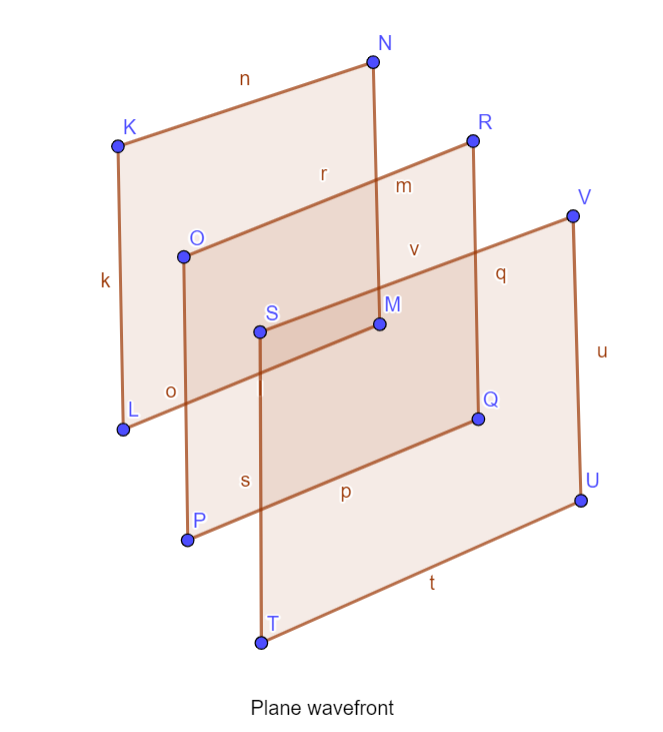
Hence the wavefront emerging from a distant source is a plane wavefront.
Note:
Wavefront is the locus of all the points in the field which have the same phase at a given instant. This means that even if the phase is the same at different points in time, the two points may or may not be considered as a part of the wavefront. Also, we must keep in mind that the direction of propagation of the wavefront is the direction of propagation of the wave.
General properties of a wavefront are:
A wavefront is dependent on the shape of the source of disturbance
A wavefront does not travel backwards.
A wavefront is normal to the light rays.
Types of wavefronts:
Spherical wavefront: Very similar to ripples in water, this wavefront is produced by a point source.
Plane wavefront: Rays coming from a distant source generate a plane wavefront.
Cylindrical wavefront: When the light rays converge or diverge from a lens a cylindrical wavefront is formed.
Complete step by step solution:
Point source is that source which is so small that it is considered as a single point. Such sources are dimensionless.
The wavefront emerging from a point source is the spherical wavefront since the waves travel radially outwards from the source.
Hence the wavefront for a point source is spherical.
A distant source is so far away that it is considered to be at infinity, the rays travelling from a distant light source are taken as planes moving in the direction of propagation of waves. And hence the wavefront is a plane wavefront.
Hence the wavefront emerging from a distant source is a plane wavefront.
Note:
Wavefront is the locus of all the points in the field which have the same phase at a given instant. This means that even if the phase is the same at different points in time, the two points may or may not be considered as a part of the wavefront. Also, we must keep in mind that the direction of propagation of the wavefront is the direction of propagation of the wave.
Recently Updated Pages
Explain the structure of megasporangium class 12 biology CBSE

Why is chloroform kept in dark coloured bottles class 12 chemistry CBSE
Derive the balancing condition of a Wheatstone bri class 12 physics CBSE
Draw VI characteristics of a pn junction diode Explain class 12 physics CBSE
Is it possible to carry pride in ones language too class 12 english CBSE
In a population at Hardy Weinberg equilibrium the allele class 12 biology CBSE
Trending doubts
One megawatt is equal to how many units of electri class 12 physics CBSE
What is the Full Form of PVC, PET, HDPE, LDPE, PP and PS ?
Draw a well labelled diagram of the human brain class 12 biology CBSE
Differentiate between homogeneous and heterogeneous class 12 chemistry CBSE
What is the structural formula of Aspirin A B C D class 12 chemistry CBSE
Draw a labelled diagram of a female reproductive s class 12 biology CBSE