




What type of quadrilateral has four congruent sides and two obtuse angles?
Answer
 Verified
566.1k+ views
Hint: Here, we have to determine which quadrilateral has four congruent sides and two obtuse angles. Out of all quadrilaterals, only 2 of them have four congruent sides: Square and rhombus. Now, square has all angles right angles and rhombus has one opposite pair of obtuse angles. Hence, rhombus is our answer.
Complete step-by-step answer:
A quadrilateral is a polygon with four sides.
There are many types of quadrilaterals and each quadrilateral have its own special properties.
In this question, we are supposed to find which quadrilateral has four congruent sides and two obtuse angles.
Let us discuss some quadrilaterals and their properties to find out which one has four congruent sides and two obtuse angles.
Parallelogram: A parallelogram is a quadrilateral with four sides in which two pairs are parallel.
A parallelogram has the following properties.
$ \Rightarrow $ Congruent opposite angles
$ \Rightarrow $ Congruent opposite sides
$ \Rightarrow $ Diagonals bisect each other
$ \Rightarrow $ Adjacent angles are supplementary.
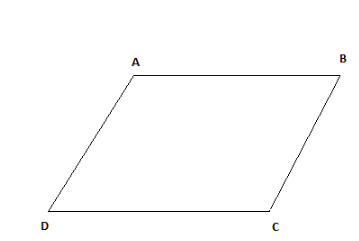
So, parallelogram is not the answer we are looking for.
Square: A square is a quadrilateral with all four sides congruent and all four angles congruent.
A square has the following properties.
$ \Rightarrow $ All four sides congruent.
$ \Rightarrow $ All angles right angles.
$ \Rightarrow $ Diagonals bisect each other.
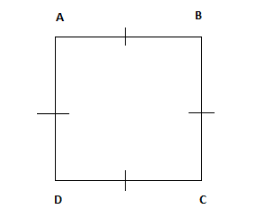
Here, square has all four sides congruent but it does not have obtuse angles. So, square is also not our answer.
Rhombus: A rhombus is a quadrilateral with all four sides congruent. A rhombus differs from a square as the angles of the rhombus do not need to be right angles.
A rhombus has the following properties.
$ \Rightarrow $ All four sides congruent.
$ \Rightarrow $ Two pairs of equal angles- one pair acute and one pair obtuse.
$ \Rightarrow $ Diagonals intersect each other perpendicularly.
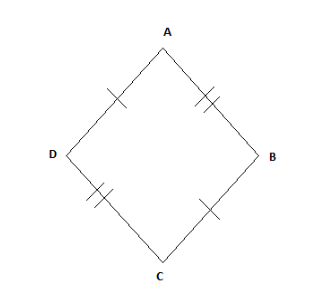
Hence, rhombus is our answer.
So, the correct answer is “rhombus”.
Note: Do not confuse a rhombus with a square. As a rhombus does not have all the properties of a square, a rhombus cannot be a square. But as a square has all the properties of a rhombus, a square can be a rhombus. The area and the perimeter of a rhombus are given by the formula below:
Area of rhombus $ = \dfrac{{{d_1} \times {d_2}}}{2} $
Perimeter of rhombus $ = 4a $
Complete step-by-step answer:
A quadrilateral is a polygon with four sides.
There are many types of quadrilaterals and each quadrilateral have its own special properties.
In this question, we are supposed to find which quadrilateral has four congruent sides and two obtuse angles.
Let us discuss some quadrilaterals and their properties to find out which one has four congruent sides and two obtuse angles.
Parallelogram: A parallelogram is a quadrilateral with four sides in which two pairs are parallel.
A parallelogram has the following properties.
$ \Rightarrow $ Congruent opposite angles
$ \Rightarrow $ Congruent opposite sides
$ \Rightarrow $ Diagonals bisect each other
$ \Rightarrow $ Adjacent angles are supplementary.
So, parallelogram is not the answer we are looking for.
Square: A square is a quadrilateral with all four sides congruent and all four angles congruent.
A square has the following properties.
$ \Rightarrow $ All four sides congruent.
$ \Rightarrow $ All angles right angles.
$ \Rightarrow $ Diagonals bisect each other.
Here, square has all four sides congruent but it does not have obtuse angles. So, square is also not our answer.
Rhombus: A rhombus is a quadrilateral with all four sides congruent. A rhombus differs from a square as the angles of the rhombus do not need to be right angles.
A rhombus has the following properties.
$ \Rightarrow $ All four sides congruent.
$ \Rightarrow $ Two pairs of equal angles- one pair acute and one pair obtuse.
$ \Rightarrow $ Diagonals intersect each other perpendicularly.
Hence, rhombus is our answer.
So, the correct answer is “rhombus”.
Note: Do not confuse a rhombus with a square. As a rhombus does not have all the properties of a square, a rhombus cannot be a square. But as a square has all the properties of a rhombus, a square can be a rhombus. The area and the perimeter of a rhombus are given by the formula below:
Area of rhombus $ = \dfrac{{{d_1} \times {d_2}}}{2} $
Perimeter of rhombus $ = 4a $
Recently Updated Pages
Master Class 11 English: Engaging Questions & Answers for Success

Master Class 11 Social Science: Engaging Questions & Answers for Success
Master Class 11 Maths: Engaging Questions & Answers for Success
Master Class 11 Biology: Engaging Questions & Answers for Success
Master Class 11 Physics: Engaging Questions & Answers for Success
Master Class 11 Chemistry: Engaging Questions & Answers for Success
Trending doubts