




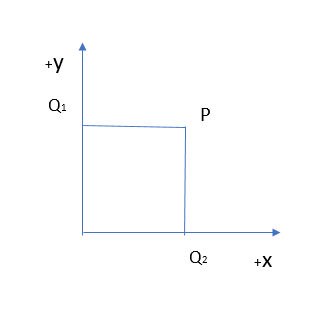
Two-point charges $Q_1=2\mu C$ and $Q_2=1\mu C$ are placed as shown. The coordinates of the point P are (2cm,1cm). The electric intensity at P subtends an angle $\theta$ with the positive X axis. The value of $\theta$ is given by:
$A.\tan\theta=1$
$B. \tan\theta=2$
$C.\tan\theta=3$
$D. \tan\theta=4$
Answer
 Verified
640.2k+ views
Hint: The electric field at a point due to a point charge separated at a particular distance. Then, after calculating the fields for two different charges, we can find the direction of the resultant electric field. So, the value of $\theta$ can be found.
Formula used: $E=\dfrac{1}{4\pi \epsilon_0}.\dfrac{q}{r^2}$
Complete step by step solution:
The electric field due to charge q at a distance of r is given by,
$E=\dfrac{1}{4\pi \epsilon_0}.\dfrac{q}{r^2}$
Now, we will find the electric field for the charge $Q_1$ and then the field for the charge $Q_2$. The first field will be denoted by $E_1$ whereas the second one will be denoted by $E_2$. Now, if $\theta$ be the angle as shown in the picture, then the value of $\tan\theta$ is given by $\dfrac{E_2}{E_1}$ .
The point P has the coordinates (2cm, 1cm). So, it is at a distance of 2 cm from $Q_1$ and at a distance of 1 cm from the charge $Q_2$.
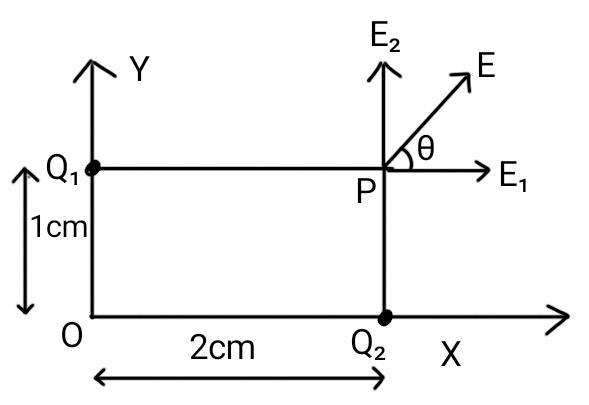
For the first field, we can see that the charge is $Q_1=2\mu C$. And the distance from charge $Q_1$ is 2 cm. So, the electric field is given by,
$E=\dfrac{1}{4\pi \epsilon_0}.\dfrac{Q_1}{2^2}=\dfrac{1}{4\pi \epsilon_0}.\dfrac{2}{4}$
Similarly, for the second field, the charge is $Q_2=1 \mu C$. And the corresponding distance is 1cm. So, the field is,
$E=\dfrac{1}{4\pi \epsilon_0}.\dfrac{1}{1^2}$
After making $\dfrac{E_2}{E_1}$ we find that,
$\tan \theta =\dfrac{{{E}_{2}}}{{{E}_{1}}}=2$
So, option B is the correct answer.
Additional information:
The electric field intensity is defined as the force felt by a unit positive charge placed at the point of interest. It is actually the number of lines of force per unit area. The unit of the electric field is volt per meter. In the used formula, $\epsilon_0$ is called the permittivity of free space.
Note: If the angle were not with x axis but with the y axis, then the value of $\tan \theta $ would be $\dfrac{E_1}{E_2}$. Put the correct charge with the corresponding distance in the formula. While taking the ratio of two same quantities, make sure to keep them in the same unit.
Formula used: $E=\dfrac{1}{4\pi \epsilon_0}.\dfrac{q}{r^2}$
Complete step by step solution:
The electric field due to charge q at a distance of r is given by,
$E=\dfrac{1}{4\pi \epsilon_0}.\dfrac{q}{r^2}$
Now, we will find the electric field for the charge $Q_1$ and then the field for the charge $Q_2$. The first field will be denoted by $E_1$ whereas the second one will be denoted by $E_2$. Now, if $\theta$ be the angle as shown in the picture, then the value of $\tan\theta$ is given by $\dfrac{E_2}{E_1}$ .
The point P has the coordinates (2cm, 1cm). So, it is at a distance of 2 cm from $Q_1$ and at a distance of 1 cm from the charge $Q_2$.
For the first field, we can see that the charge is $Q_1=2\mu C$. And the distance from charge $Q_1$ is 2 cm. So, the electric field is given by,
$E=\dfrac{1}{4\pi \epsilon_0}.\dfrac{Q_1}{2^2}=\dfrac{1}{4\pi \epsilon_0}.\dfrac{2}{4}$
Similarly, for the second field, the charge is $Q_2=1 \mu C$. And the corresponding distance is 1cm. So, the field is,
$E=\dfrac{1}{4\pi \epsilon_0}.\dfrac{1}{1^2}$
After making $\dfrac{E_2}{E_1}$ we find that,
$\tan \theta =\dfrac{{{E}_{2}}}{{{E}_{1}}}=2$
So, option B is the correct answer.
Additional information:
The electric field intensity is defined as the force felt by a unit positive charge placed at the point of interest. It is actually the number of lines of force per unit area. The unit of the electric field is volt per meter. In the used formula, $\epsilon_0$ is called the permittivity of free space.
Note: If the angle were not with x axis but with the y axis, then the value of $\tan \theta $ would be $\dfrac{E_1}{E_2}$. Put the correct charge with the corresponding distance in the formula. While taking the ratio of two same quantities, make sure to keep them in the same unit.
Recently Updated Pages
Master Class 12 Business Studies: Engaging Questions & Answers for Success

Master Class 12 Chemistry: Engaging Questions & Answers for Success
Master Class 12 Biology: Engaging Questions & Answers for Success
Class 12 Question and Answer - Your Ultimate Solutions Guide
Master Class 11 English: Engaging Questions & Answers for Success
Master Class 11 Social Science: Engaging Questions & Answers for Success
Trending doubts
Which are the Top 10 Largest Countries of the World?
Draw a labelled sketch of the human eye class 12 physics CBSE
Differentiate between homogeneous and heterogeneous class 12 chemistry CBSE
Differentiate between Pyramid of energy and pyramid class 12 biology CBSE
Why is the cell called the structural and functional class 12 biology CBSE
Draw the diagram of the pyramid of energy Explain In class 12 biology CBSE