




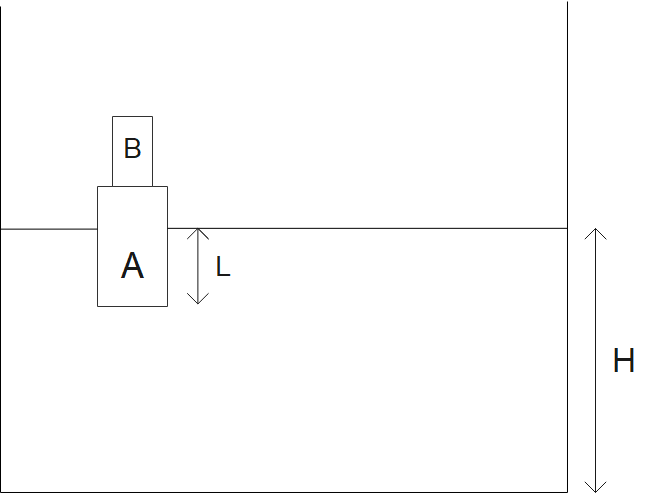
Two wooden blocks A and B float in a liquid of density ${{\rho }_{L}}$ as shown. The distance L and H are shown. After some time, block B falls into the liquid, so that L decreases and H increases. If density of block B is ${{\rho }_{B}}$, find the correct option
a.) ${{\rho }_{B}}={{\rho }_{L}}$
b.) ${{\rho }_{L}}>{{\rho }_{B}}$
c.) ${{\rho }_{L}}<{{\rho }_{B}}$
d.) Unpredictable
Answer
 Verified
563.1k+ views
Hint: The given situation in the question is such that two blocks “A” and “B” are floating on water. After some time, the upper block falls in the water and the lever of water in the container rises because more volume (volume of block) is added into the volume of water. When the density of object is more than that of water then the object sinks in water and if the density of object is less than that of water then the object will float in water.
Complete step by step solution:
In first situation, when the block “B” is placed above Block “A” then the weight of B will be
$B={{\rho }_{B}}{{V}_{g}}$
When Block B falls down from block A
Loss in weight = Weight in air – Weight in water
$Loss={{\rho }_{B}}{{V}_{g}}-{{\rho }_{L}}{{V}_{g}}$
We have been given a condition that the height “H” of water increases and the height “L” decreases
This states that the loss in weight should be negative as both the heights are not being displaced or moved with the same height.
This shows that the density of water should be more than the density of block B.
This gives the condition that ${{\rho }_{B}}<{{\rho }_{L}}$
Hence, we can conclude that option (B) is the correct answer for this question.
Note: The question talks about the density of water and the block, and it also states that the height “H” increases and “L” decreases. This means that the block is not completely submerged in water. If the block is completely immersed in water then the height would be changed equally. This shows that the density of blocks is less than that of water.
Complete step by step solution:
In first situation, when the block “B” is placed above Block “A” then the weight of B will be
$B={{\rho }_{B}}{{V}_{g}}$
When Block B falls down from block A
Loss in weight = Weight in air – Weight in water
$Loss={{\rho }_{B}}{{V}_{g}}-{{\rho }_{L}}{{V}_{g}}$
We have been given a condition that the height “H” of water increases and the height “L” decreases
This states that the loss in weight should be negative as both the heights are not being displaced or moved with the same height.
This shows that the density of water should be more than the density of block B.
This gives the condition that ${{\rho }_{B}}<{{\rho }_{L}}$
Hence, we can conclude that option (B) is the correct answer for this question.
Note: The question talks about the density of water and the block, and it also states that the height “H” increases and “L” decreases. This means that the block is not completely submerged in water. If the block is completely immersed in water then the height would be changed equally. This shows that the density of blocks is less than that of water.
Recently Updated Pages
Three beakers labelled as A B and C each containing 25 mL of water were taken A small amount of NaOH anhydrous CuSO4 and NaCl were added to the beakers A B and C respectively It was observed that there was an increase in the temperature of the solutions contained in beakers A and B whereas in case of beaker C the temperature of the solution falls Which one of the following statements isarecorrect i In beakers A and B exothermic process has occurred ii In beakers A and B endothermic process has occurred iii In beaker C exothermic process has occurred iv In beaker C endothermic process has occurred

Master Class 11 Social Science: Engaging Questions & Answers for Success
Master Class 11 Physics: Engaging Questions & Answers for Success
Master Class 11 Maths: Engaging Questions & Answers for Success
Master Class 11 Economics: Engaging Questions & Answers for Success
Master Class 11 Computer Science: Engaging Questions & Answers for Success
Three beakers labelled as A B and C each containing 25 mL of water were taken A small amount of NaOH anhydrous CuSO4 and NaCl were added to the beakers A B and C respectively It was observed that there was an increase in the temperature of the solutions contained in beakers A and B whereas in case of beaker C the temperature of the solution falls Which one of the following statements isarecorrect i In beakers A and B exothermic process has occurred ii In beakers A and B endothermic process has occurred iii In beaker C exothermic process has occurred iv In beaker C endothermic process has occurred
Master Class 11 Social Science: Engaging Questions & Answers for Success
Master Class 11 Physics: Engaging Questions & Answers for Success
Trending doubts
One Metric ton is equal to kg A 10000 B 1000 C 100 class 11 physics CBSE
There are 720 permutations of the digits 1 2 3 4 5 class 11 maths CBSE
State and prove Bernoullis theorem class 11 physics CBSE
Draw a diagram of a plant cell and label at least eight class 11 biology CBSE
Difference Between Prokaryotic Cells and Eukaryotic Cells
Discuss the various forms of bacteria class 11 biology CBSE