




Two stars are \[10\] light years away from the earth. They are seen through a telescope of objective diameter \[30\,{\text{cm}}\] . The wavelength of light is \[600\,{\text{nm}}\] . To see the stars just resolved by the telescope, the minimum distance between them should be ( \[1\] light year equals \[9.46 \times {10^{15}}\,{\text{m}}\] ) of the order of:
A. \[{10^8}\,{\text{km}}\]
B. \[{10^{10}}\,{\text{km}}\]
C. \[{10^{11}}\,{\text{km}}\]
D. \[{10^6}\,{\text{km}}\]
Answer
 Verified
608.4k+ views
Hint:First of all, we will draw the schematic diagram of the scenario. After that we will apply the formula of the resolution of the telescope. We will replace the angular separation by distance between the stars and distance from the earth in a correct way. We will substitute the required values and obtain the answer.
Formula used:
The resolution of a telescope can be related with the formula as given below:
\[\theta = \dfrac{{1.22 \times \lambda }}{D}\] …… (1)
Where,
\[\theta \] indicates the angular separation.
\[\lambda \] indicates the wavelength of the light.
\[D\] indicates the diameter of the objective lens.
Complete step by step answer:
In the given question, we are supplied with the following data:
There are two stars which are at a distance of \[10\] light years away from the earth.They are seen through a telescope whose objective is of diameter \[30\,{\text{cm}}\] .We are asked to find the minimum distance between the two stars so that they are just resolved by the telescope.We are also given that \[1\] light year equals \[9.46 \times {10^{15}}\,{\text{m}}\] .
To begin with, we need to draw a simple diagram to depict the scenario, for better understanding.
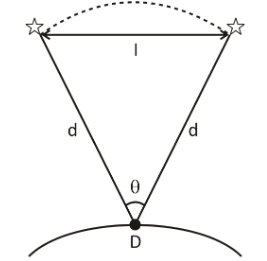
In the given diagram, the angular separation of the two stars as viewed from the earth, through the telescope, is \[\theta \] .
From the diagram the angular separation can be written as given below:
\[\theta = \dfrac{l}{d}\]
Now, we use the equation (1) and we get:
$\theta = \dfrac{{1.22 \times \lambda }}{D} \\
\Rightarrow \dfrac{l}{d} = \dfrac{{1.22 \times \lambda }}{D} \\
\Rightarrow l = \dfrac{{1.22 \times \lambda \times d}}{D} \\
\Rightarrow l = \dfrac{{1.22 \times 600 \times {{10}^{ - 9}} \times 10 \times 9.46 \times {{10}^{15}}}}{{30 \times {{10}^{ - 2}}}} \\
\Rightarrow l = 2.3 \times {10^{11}}\,{\text{m}} \\
\Rightarrow l = 2.3 \times {10^{11}} \times {10^{ - 3}}\,{\text{km}} \\
\Rightarrow l = 2.3 \times {10^8}\,{\text{km}}$
Therefore, the distance between the two stars is found to be \[2.3 \times {10^8}\,{\text{km}}\] .
Hence, the order is \[{10^8}\,{\text{km}}\] .
The correct option is A.
Note:While solving the problem, it is important to draw the diagram, as it reduces most of the chances to get wrong. As the two stars are present at a very large distance, we can assume the distance of separation to be arc. Most of the students get confused at this point. Larger the diameter of the objective is, higher is the resolution of the telescope.
Formula used:
The resolution of a telescope can be related with the formula as given below:
\[\theta = \dfrac{{1.22 \times \lambda }}{D}\] …… (1)
Where,
\[\theta \] indicates the angular separation.
\[\lambda \] indicates the wavelength of the light.
\[D\] indicates the diameter of the objective lens.
Complete step by step answer:
In the given question, we are supplied with the following data:
There are two stars which are at a distance of \[10\] light years away from the earth.They are seen through a telescope whose objective is of diameter \[30\,{\text{cm}}\] .We are asked to find the minimum distance between the two stars so that they are just resolved by the telescope.We are also given that \[1\] light year equals \[9.46 \times {10^{15}}\,{\text{m}}\] .
To begin with, we need to draw a simple diagram to depict the scenario, for better understanding.
In the given diagram, the angular separation of the two stars as viewed from the earth, through the telescope, is \[\theta \] .
From the diagram the angular separation can be written as given below:
\[\theta = \dfrac{l}{d}\]
Now, we use the equation (1) and we get:
$\theta = \dfrac{{1.22 \times \lambda }}{D} \\
\Rightarrow \dfrac{l}{d} = \dfrac{{1.22 \times \lambda }}{D} \\
\Rightarrow l = \dfrac{{1.22 \times \lambda \times d}}{D} \\
\Rightarrow l = \dfrac{{1.22 \times 600 \times {{10}^{ - 9}} \times 10 \times 9.46 \times {{10}^{15}}}}{{30 \times {{10}^{ - 2}}}} \\
\Rightarrow l = 2.3 \times {10^{11}}\,{\text{m}} \\
\Rightarrow l = 2.3 \times {10^{11}} \times {10^{ - 3}}\,{\text{km}} \\
\Rightarrow l = 2.3 \times {10^8}\,{\text{km}}$
Therefore, the distance between the two stars is found to be \[2.3 \times {10^8}\,{\text{km}}\] .
Hence, the order is \[{10^8}\,{\text{km}}\] .
The correct option is A.
Note:While solving the problem, it is important to draw the diagram, as it reduces most of the chances to get wrong. As the two stars are present at a very large distance, we can assume the distance of separation to be arc. Most of the students get confused at this point. Larger the diameter of the objective is, higher is the resolution of the telescope.
Recently Updated Pages
Master Class 12 Business Studies: Engaging Questions & Answers for Success

Master Class 12 Chemistry: Engaging Questions & Answers for Success
Master Class 12 Biology: Engaging Questions & Answers for Success
Class 12 Question and Answer - Your Ultimate Solutions Guide
Master Class 11 English: Engaging Questions & Answers for Success
Master Class 11 Social Science: Engaging Questions & Answers for Success
Trending doubts
Which are the Top 10 Largest Countries of the World?
Draw a labelled sketch of the human eye class 12 physics CBSE
Differentiate between homogeneous and heterogeneous class 12 chemistry CBSE
Differentiate between Pyramid of energy and pyramid class 12 biology CBSE
Why is the cell called the structural and functional class 12 biology CBSE
Draw the diagram of the pyramid of energy Explain In class 12 biology CBSE