




When two spheres having \[2Q\] and \[ - Q\] are placed at a certain distance, the force acting between them is \[F\]. Then they are connected by a conducting wire and again separated from each other. How much force will act between them if the separation now is the same as before?
A. \[F\]
B. \[\dfrac{F}{2}\]
C. \[\dfrac{F}{4}\]
D. \[\dfrac{F}{8}\]
Answer
 Verified
607.5k+ views
Hint: There are three steps taken in the question. First, recall the coulomb’s law and use this law to find the force between the two charges for step one. For the next step a conducting wire is used to connect the charges, so apply the changes that would take place when a conducting wire is used. In the last step the conducting wire is removed and we are asked what will be the force between the charges then, use Coulomb's law to find the force.
Complete step by step answer:
Given, charge on the two spheres are \[2Q\] and \[ - Q\]. Force acting between them is \[F\].Let the distance between the two charges be \[r\]. We draw a diagram to understand better.
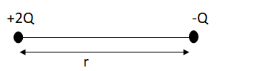
The force between two charges is given by Coulomb’s law which says, the force between two charges is,
\[{F_c} = \dfrac{{k{q_1}{q_2}}}{{{r^2}}}\] (i)
where \[k\] is proportionality constant, \[{q_1}\] and \[{q_2}\] are two charges and \[r\] is the distance between two charges.
There are three steps in the question.
In the first step, the two charges are placed in a certain distance and a force \[F\] acts between them. This force is given by Coulomb's law.
Here \[{q_1} = 2Q\] and \[{q_2} = - Q\].
Applying Coulomb’s law and using equation (i) we have,
\[F = \left| {\dfrac{{k\left( {2Q} \right)\left( { - Q} \right)}}{{{r^2}}}} \right|\] (we take only the magnitude)
\[ \Rightarrow F = \left| {\dfrac{{ - 2k{Q^2}}}{{{r^2}}}} \right|\]
\[ \Rightarrow F = \dfrac{{2k{Q^2}}}{{{r^2}}}\] (ii)
In the second step, the charges are connected by conducting wire. As, the wire is conducting there will be flow of charges along the wire, the total charge that will flow through the wire will be,
\[{Q_t} = 2Q + \left( { - Q} \right)\]
\[ \Rightarrow {Q_t} = 2Q - Q\]
\[ \Rightarrow {Q_t} = Q\]
In the third step, the conducting wire is removed and the charges are kept at the same distance again.
When the conducting wire was there, the total charge was \[Q\] and as the wire is removed then the total charge will get distributed equally that is \[\dfrac{Q}{2}\] each. Therefore, now the force between the two charges will be using coulomb’s law,
\[F' = \left| {\dfrac{{k\left( {\dfrac{Q}{2}} \right)\left( {\dfrac{Q}{2}} \right)}}{{{r^2}}}} \right|\]
\[ \Rightarrow F' = \dfrac{{k{{\left( {\dfrac{Q}{2}} \right)}^2}}}{{{r^2}}}\]
\[ \Rightarrow F' = \dfrac{{k{{\dfrac{Q}{4}}^2}}}{{{r^2}}}\]
\[ \Rightarrow F' = \dfrac{{k{Q^2}}}{{4{r^2}}}\] (iii)
From equation (ii), we have
\[F = \dfrac{{2k{Q^2}}}{{{r^2}}}\]
\[ \Rightarrow \dfrac{F}{2} = \dfrac{{2k{Q^2}}}{{2{r^2}}}\]
\[ \Rightarrow \dfrac{F}{2} = \dfrac{{k{Q^2}}}{{{r^2}}}\] (iv)
Substituting this value in equation (iii), we get
\[F' = \dfrac{1}{4} \times \dfrac{F}{2}\]
\[ \therefore F' = \dfrac{F}{8}\]
Therefore, the correct answer is option D.
Note:From Coulomb’s law which says, force between two charges is \[{F_c} = \dfrac{{k{q_1}{q_2}}}{{{r^2}}}\], we observe that Coulomb force is inversely proportional to the distance between the charges that is, when distance between the charges is increased the force between them decreases and if distance between the charges is reduced, the force between them increases.
Complete step by step answer:
Given, charge on the two spheres are \[2Q\] and \[ - Q\]. Force acting between them is \[F\].Let the distance between the two charges be \[r\]. We draw a diagram to understand better.
The force between two charges is given by Coulomb’s law which says, the force between two charges is,
\[{F_c} = \dfrac{{k{q_1}{q_2}}}{{{r^2}}}\] (i)
where \[k\] is proportionality constant, \[{q_1}\] and \[{q_2}\] are two charges and \[r\] is the distance between two charges.
There are three steps in the question.
In the first step, the two charges are placed in a certain distance and a force \[F\] acts between them. This force is given by Coulomb's law.
Here \[{q_1} = 2Q\] and \[{q_2} = - Q\].
Applying Coulomb’s law and using equation (i) we have,
\[F = \left| {\dfrac{{k\left( {2Q} \right)\left( { - Q} \right)}}{{{r^2}}}} \right|\] (we take only the magnitude)
\[ \Rightarrow F = \left| {\dfrac{{ - 2k{Q^2}}}{{{r^2}}}} \right|\]
\[ \Rightarrow F = \dfrac{{2k{Q^2}}}{{{r^2}}}\] (ii)
In the second step, the charges are connected by conducting wire. As, the wire is conducting there will be flow of charges along the wire, the total charge that will flow through the wire will be,
\[{Q_t} = 2Q + \left( { - Q} \right)\]
\[ \Rightarrow {Q_t} = 2Q - Q\]
\[ \Rightarrow {Q_t} = Q\]
In the third step, the conducting wire is removed and the charges are kept at the same distance again.
When the conducting wire was there, the total charge was \[Q\] and as the wire is removed then the total charge will get distributed equally that is \[\dfrac{Q}{2}\] each. Therefore, now the force between the two charges will be using coulomb’s law,
\[F' = \left| {\dfrac{{k\left( {\dfrac{Q}{2}} \right)\left( {\dfrac{Q}{2}} \right)}}{{{r^2}}}} \right|\]
\[ \Rightarrow F' = \dfrac{{k{{\left( {\dfrac{Q}{2}} \right)}^2}}}{{{r^2}}}\]
\[ \Rightarrow F' = \dfrac{{k{{\dfrac{Q}{4}}^2}}}{{{r^2}}}\]
\[ \Rightarrow F' = \dfrac{{k{Q^2}}}{{4{r^2}}}\] (iii)
From equation (ii), we have
\[F = \dfrac{{2k{Q^2}}}{{{r^2}}}\]
\[ \Rightarrow \dfrac{F}{2} = \dfrac{{2k{Q^2}}}{{2{r^2}}}\]
\[ \Rightarrow \dfrac{F}{2} = \dfrac{{k{Q^2}}}{{{r^2}}}\] (iv)
Substituting this value in equation (iii), we get
\[F' = \dfrac{1}{4} \times \dfrac{F}{2}\]
\[ \therefore F' = \dfrac{F}{8}\]
Therefore, the correct answer is option D.
Note:From Coulomb’s law which says, force between two charges is \[{F_c} = \dfrac{{k{q_1}{q_2}}}{{{r^2}}}\], we observe that Coulomb force is inversely proportional to the distance between the charges that is, when distance between the charges is increased the force between them decreases and if distance between the charges is reduced, the force between them increases.
Recently Updated Pages
Master Class 12 Business Studies: Engaging Questions & Answers for Success

Master Class 12 Chemistry: Engaging Questions & Answers for Success
Master Class 12 Biology: Engaging Questions & Answers for Success
Class 12 Question and Answer - Your Ultimate Solutions Guide
Master Class 11 English: Engaging Questions & Answers for Success
Master Class 11 Social Science: Engaging Questions & Answers for Success
Trending doubts
Which are the Top 10 Largest Countries of the World?
Draw a labelled sketch of the human eye class 12 physics CBSE
Differentiate between homogeneous and heterogeneous class 12 chemistry CBSE
Differentiate between Pyramid of energy and pyramid class 12 biology CBSE
Why is the cell called the structural and functional class 12 biology CBSE
Draw the diagram of the pyramid of energy Explain In class 12 biology CBSE