




Two spheres carrying charges q are hanging from the same point of suspension with the help of threads of length 2m, in space free from gravity. The distance between them will be __m.
A. 0
B. 1.0
C. 4.0
D. 2.0
Answer
 Verified
623.4k+ views
Hint: This is a simple problem, where a proper reasoning on the basis of electrostatics can solve this question. Both the charges are the same, hence repel each other. Since, the system is in space, due to absence of gravity, these 2 charges will be as far away from each other as possible.
Complete step-by-step answer:
Let’s make a diagram of the problem.
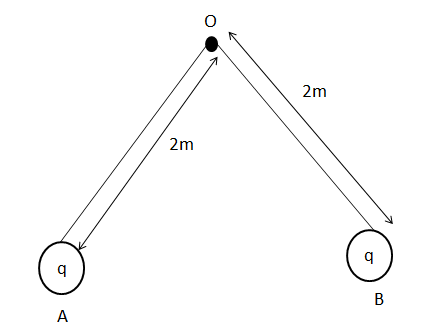
We will consider the point ‘O’ as the point from which, 2 strings of length 2m each are attached. Each of these strings are connected to 2 massless spheres. Each of these spheres carry a charge ‘q’ on them.
This whole setup is placed in space. What this statement means is that, there isn’t any gravity acting on them, as it would on earth.
Hence, here the only force acting in between the 2 spheres is due to the charges residing on them. Both the charges residing on each of the spheres are the same, both on basis of magnitude as well as value (+q and +q).
We very well know the fundamental law of electrostatics that, like charges repel each other. Hence, in this case as well, both the like charges will repel each other.
This is the only kind of force that will act between those two spheres. Since, it is happening in space, there won’t be any kind of resistive force, resisting this action.
The repulsion will cause both the spheres to bound back as far as they can, as there isn’t any other force stopping them. Hence, these 2 spheres will be exactly at the polar opposite ends of each other. That is, if you consider ‘O’ to be the center of a circle inscribed by a sphere attached to the string of length 2m, it’ll be a sphere of radius 2m. The 2 spheres will always be at the diameter ends.
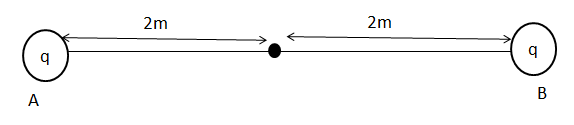
Hence, the distance in between the 2 spheres will be 4m.
Note: Here, we consider both the masses to be massless, to ensure that the two spheres don’t interact with each other via gravitational force as well. Since, any 2 bodies having mass will cause gravitational force of attraction between them.
Complete step-by-step answer:
Let’s make a diagram of the problem.
We will consider the point ‘O’ as the point from which, 2 strings of length 2m each are attached. Each of these strings are connected to 2 massless spheres. Each of these spheres carry a charge ‘q’ on them.
This whole setup is placed in space. What this statement means is that, there isn’t any gravity acting on them, as it would on earth.
Hence, here the only force acting in between the 2 spheres is due to the charges residing on them. Both the charges residing on each of the spheres are the same, both on basis of magnitude as well as value (+q and +q).
We very well know the fundamental law of electrostatics that, like charges repel each other. Hence, in this case as well, both the like charges will repel each other.
This is the only kind of force that will act between those two spheres. Since, it is happening in space, there won’t be any kind of resistive force, resisting this action.
The repulsion will cause both the spheres to bound back as far as they can, as there isn’t any other force stopping them. Hence, these 2 spheres will be exactly at the polar opposite ends of each other. That is, if you consider ‘O’ to be the center of a circle inscribed by a sphere attached to the string of length 2m, it’ll be a sphere of radius 2m. The 2 spheres will always be at the diameter ends.
Hence, the distance in between the 2 spheres will be 4m.
Note: Here, we consider both the masses to be massless, to ensure that the two spheres don’t interact with each other via gravitational force as well. Since, any 2 bodies having mass will cause gravitational force of attraction between them.
Recently Updated Pages
Master Class 12 Business Studies: Engaging Questions & Answers for Success

Master Class 12 Chemistry: Engaging Questions & Answers for Success
Master Class 12 Biology: Engaging Questions & Answers for Success
Class 12 Question and Answer - Your Ultimate Solutions Guide
Master Class 11 English: Engaging Questions & Answers for Success
Master Class 11 Maths: Engaging Questions & Answers for Success
Trending doubts
Which is more stable and why class 12 chemistry CBSE
Which are the Top 10 Largest Countries of the World?
Draw a labelled sketch of the human eye class 12 physics CBSE
Differentiate between homogeneous and heterogeneous class 12 chemistry CBSE
What are the major means of transport Explain each class 12 social science CBSE
Sulphuric acid is known as the king of acids State class 12 chemistry CBSE