




Two solenoids of an equal number of turns having their length and radii in the same ratio 1:2. The ratio of their self-inductance will be:
A) 1:2
B) 2:1
C) 1:1
D) 1:4
Answer
 Verified
583.8k+ views
Hint: Here we have given two solenoids whose number of turns are the same and the length and the radii of both the solenoids are in ratio 1:2. We have to find the ratio of self-inductance for these two solenoids. Hence by using the formula of self-inductance we can find the ratio. We can also draw a simple diagram for better understanding.
Formula used:
\[L=\dfrac{{{\mu }_{0}}{{N}^{2}}A}{l}\]
Complete step-by-step solution
Let us first draw a simple diagram for the given question.
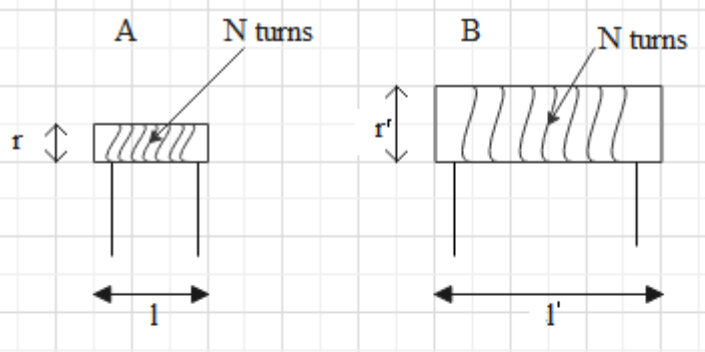
As we can see there are two solenoids A and B. The number of turns of both solenoids is the same. The length of A is l and the length of B is l’. Similarly, the radius of A is r, and the radius of B is r’.
Now we know that self-inductance is a property of a coil by which it opposes the change in the current flowing through it and generates an induced emf. Self-inductance of a solenoid is directly proportional to the number of turns and cross-sectional areas whereas it is inversely proportional to the length. Therefore, its formula can be given as
\[L=\dfrac{{{\mu }_{0}}{{N}^{2}}A}{l}\]
Here A is the cross-sectional area, N is the number of turns, l is the length and \[{{\mu }_{0}}\]is the permeability in free space.
We know the cross-sectional area of solenoid is given as \[4\pi {{r}^{2}}\], substituting this value in above equation, we get
\[L=\dfrac{4\pi {{\mu }_{0}}{{N}^{2}}{{r}^{2}}}{l}\]
So self-inductance for solenoid A can be given by above formula, if number of turns for A is N. Where for solenoid B having same number of turns i.e. N, self-inductance can be given as
\[L'=\dfrac{4\pi {{\mu }_{0}}{{N}^{2}}r{{'}^{2}}}{l'}\]
Now the ration of self-inductance of A to B can be given as
\[\begin{align}
& \dfrac{L}{L'}=\dfrac{\dfrac{4\pi {{\mu }_{0}}{{N}^{2}}{{r}^{2}}}{l}}{\dfrac{4\pi {{\mu }_{0}}{{N}^{2}}r{{'}^{2}}}{l'}} \\
& \Rightarrow \dfrac{L}{L'}=\dfrac{{{r}^{2}}l'}{r{{'}^{2}}l} \\
& \Rightarrow \dfrac{L}{L'}={{\left( \dfrac{r}{r'} \right)}^{2}}\left( \dfrac{l'}{l} \right)\text{ }...........\text{(i)} \\
\end{align}\]
Now according to the question, the ratio of length and radius of solenoid A and B is given as
\[\begin{align}
& \dfrac{l}{l'}=\dfrac{1}{2} \\
&\Rightarrow \dfrac{r}{r'}=\dfrac{1}{2} \\
\end{align}\]
Now substituting value of ratio of length and radius in equation (i), we get
\[\begin{align}
& \dfrac{L}{L'}={{\left( \dfrac{1}{2} \right)}^{2}}\left( \dfrac{2}{1} \right) \\
& \Rightarrow \dfrac{L}{L'}=\left( \dfrac{1}{4} \right)\left( 2 \right) \\
& \Rightarrow \dfrac{L}{L'}=\dfrac{1}{2} \\
\end{align}\]
Hence the ratio of self-inductance is 1:2. So, Option A is correct.
Note: We didn’t use different symbols for the number of turns for A and B because it has the same values. Self-inductance is associated with a single coil or solenoid, when two coils are placed then it will also have mutual inductance. Mutual inductance is basically the induced emf in one coil due to a change in current or change in flux in another coil.
Formula used:
\[L=\dfrac{{{\mu }_{0}}{{N}^{2}}A}{l}\]
Complete step-by-step solution
Let us first draw a simple diagram for the given question.
As we can see there are two solenoids A and B. The number of turns of both solenoids is the same. The length of A is l and the length of B is l’. Similarly, the radius of A is r, and the radius of B is r’.
Now we know that self-inductance is a property of a coil by which it opposes the change in the current flowing through it and generates an induced emf. Self-inductance of a solenoid is directly proportional to the number of turns and cross-sectional areas whereas it is inversely proportional to the length. Therefore, its formula can be given as
\[L=\dfrac{{{\mu }_{0}}{{N}^{2}}A}{l}\]
Here A is the cross-sectional area, N is the number of turns, l is the length and \[{{\mu }_{0}}\]is the permeability in free space.
We know the cross-sectional area of solenoid is given as \[4\pi {{r}^{2}}\], substituting this value in above equation, we get
\[L=\dfrac{4\pi {{\mu }_{0}}{{N}^{2}}{{r}^{2}}}{l}\]
So self-inductance for solenoid A can be given by above formula, if number of turns for A is N. Where for solenoid B having same number of turns i.e. N, self-inductance can be given as
\[L'=\dfrac{4\pi {{\mu }_{0}}{{N}^{2}}r{{'}^{2}}}{l'}\]
Now the ration of self-inductance of A to B can be given as
\[\begin{align}
& \dfrac{L}{L'}=\dfrac{\dfrac{4\pi {{\mu }_{0}}{{N}^{2}}{{r}^{2}}}{l}}{\dfrac{4\pi {{\mu }_{0}}{{N}^{2}}r{{'}^{2}}}{l'}} \\
& \Rightarrow \dfrac{L}{L'}=\dfrac{{{r}^{2}}l'}{r{{'}^{2}}l} \\
& \Rightarrow \dfrac{L}{L'}={{\left( \dfrac{r}{r'} \right)}^{2}}\left( \dfrac{l'}{l} \right)\text{ }...........\text{(i)} \\
\end{align}\]
Now according to the question, the ratio of length and radius of solenoid A and B is given as
\[\begin{align}
& \dfrac{l}{l'}=\dfrac{1}{2} \\
&\Rightarrow \dfrac{r}{r'}=\dfrac{1}{2} \\
\end{align}\]
Now substituting value of ratio of length and radius in equation (i), we get
\[\begin{align}
& \dfrac{L}{L'}={{\left( \dfrac{1}{2} \right)}^{2}}\left( \dfrac{2}{1} \right) \\
& \Rightarrow \dfrac{L}{L'}=\left( \dfrac{1}{4} \right)\left( 2 \right) \\
& \Rightarrow \dfrac{L}{L'}=\dfrac{1}{2} \\
\end{align}\]
Hence the ratio of self-inductance is 1:2. So, Option A is correct.
Note: We didn’t use different symbols for the number of turns for A and B because it has the same values. Self-inductance is associated with a single coil or solenoid, when two coils are placed then it will also have mutual inductance. Mutual inductance is basically the induced emf in one coil due to a change in current or change in flux in another coil.
Recently Updated Pages
Master Class 12 Economics: Engaging Questions & Answers for Success

Master Class 12 Physics: Engaging Questions & Answers for Success
Master Class 12 English: Engaging Questions & Answers for Success
Master Class 12 Social Science: Engaging Questions & Answers for Success
Master Class 12 Maths: Engaging Questions & Answers for Success
Master Class 12 Business Studies: Engaging Questions & Answers for Success
Trending doubts
Which are the Top 10 Largest Countries of the World?
What are the major means of transport Explain each class 12 social science CBSE
Draw a labelled sketch of the human eye class 12 physics CBSE
Why cannot DNA pass through cell membranes class 12 biology CBSE
Differentiate between insitu conservation and exsitu class 12 biology CBSE
Draw a neat and well labeled diagram of TS of ovary class 12 biology CBSE