




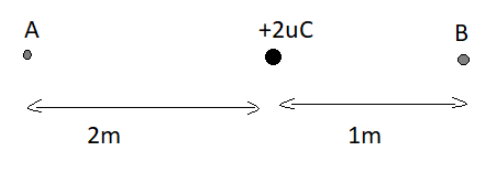
Two points A and B are located in diametrically opposite directions of a point charge of $+2\mu C$ at distances 2 m and 1 m respectively from it. The potential difference between A and B is
A. $3\times {{10}^{3}}V$
B. $6\times {{10}^{4}}V$
C. $-9\times {{10}^{3}}V$
D. $-3\times {{10}^{3}}V$
Answer
 Verified
557.1k+ views
Hint: To solve this problem we will calculate the potential at point A and B due to a point charge of$+2\mu C$charge and take a difference for the required answer. We will also discuss some factors and points regarding potential due to point charges and potential due to multiple charges in the system.
Formula used:
Potential due to point charge Is given by,
$\Rightarrow V=\dfrac{1}{4\pi {{\in }_{{}^\circ }}}\dfrac{q}{r}$
Complete Step by step solution:
Electric potential at some point in the electric field is defined as the amount of work done on a unit positive charge in moving from infinity to that point along any path under the electrostatic force exerted on it.
The electric potential at any point at distance r from a charged particle is given as,
$\Rightarrow V=\dfrac{1}{4\pi {{\in }_{{}^\circ }}}\dfrac{q}{r}$, here q(charge on a source object ), r(position vector of point charge ) and ${{\in }_{{}^\circ }}$(constant)
Unit of potential is Volt, and 1 volt
$\Rightarrow V=\dfrac{joule}{coulomb}=J{{C}^{-1}}$
Now, potential difference between A and B due to point charge of $+2\mu C$ will be given as,
$\Rightarrow V=\dfrac{q}{4\pi {{\in }_{{}^\circ }}}\left[ \dfrac{1}{{{r}_{A}}}-\dfrac{1}{{{r}_{b}}} \right]$
${{r}_{A}}$(distance of A from point charge) and ${{r}_{B}}$(distance of B from point charge )
$\Rightarrow V=2\times {{10}^{-6}}\times 9\times {{10}^{9}}\left[ \dfrac{1}{2}-\dfrac{1}{1} \right]$
$\Rightarrow V=-9\times {{10}^{3}}V$
$\therefore $The potential difference between point A and B due to point charge particle of $+2\mu C$is ,
$\Rightarrow V=-9\times {{10}^{3}}V$, hence option (C) is correct.
Note:
In the above problem we have discussed potential due to a point charge but if we have multiple charges ${{q}_{1}},{{q}_{2}},{{q}_{3}}....{{q}_{n}}$ exerting potential at a point from distance ${{r}_{1}},{{r}_{2}},{{r}_{3}}....{{r}_{n}}$, we can get the electrostatic potential at a point by calculating potential from each charges one by one and by adding them algebraically to calculate total potential at that point, the mathematical expression for the same is given below,
$\Rightarrow V=\dfrac{1}{4\pi {{\in }_{{}^\circ }}}\sum\limits_{i=1}^{n}{\dfrac{{{q}_{i}}}{{{r}_{i}}}}$
Formula used:
Potential due to point charge Is given by,
$\Rightarrow V=\dfrac{1}{4\pi {{\in }_{{}^\circ }}}\dfrac{q}{r}$
Complete Step by step solution:
Electric potential at some point in the electric field is defined as the amount of work done on a unit positive charge in moving from infinity to that point along any path under the electrostatic force exerted on it.
The electric potential at any point at distance r from a charged particle is given as,
$\Rightarrow V=\dfrac{1}{4\pi {{\in }_{{}^\circ }}}\dfrac{q}{r}$, here q(charge on a source object ), r(position vector of point charge ) and ${{\in }_{{}^\circ }}$(constant)
Unit of potential is Volt, and 1 volt
$\Rightarrow V=\dfrac{joule}{coulomb}=J{{C}^{-1}}$
Now, potential difference between A and B due to point charge of $+2\mu C$ will be given as,
$\Rightarrow V=\dfrac{q}{4\pi {{\in }_{{}^\circ }}}\left[ \dfrac{1}{{{r}_{A}}}-\dfrac{1}{{{r}_{b}}} \right]$
${{r}_{A}}$(distance of A from point charge) and ${{r}_{B}}$(distance of B from point charge )
$\Rightarrow V=2\times {{10}^{-6}}\times 9\times {{10}^{9}}\left[ \dfrac{1}{2}-\dfrac{1}{1} \right]$
$\Rightarrow V=-9\times {{10}^{3}}V$
$\therefore $The potential difference between point A and B due to point charge particle of $+2\mu C$is ,
$\Rightarrow V=-9\times {{10}^{3}}V$, hence option (C) is correct.
Note:
In the above problem we have discussed potential due to a point charge but if we have multiple charges ${{q}_{1}},{{q}_{2}},{{q}_{3}}....{{q}_{n}}$ exerting potential at a point from distance ${{r}_{1}},{{r}_{2}},{{r}_{3}}....{{r}_{n}}$, we can get the electrostatic potential at a point by calculating potential from each charges one by one and by adding them algebraically to calculate total potential at that point, the mathematical expression for the same is given below,
$\Rightarrow V=\dfrac{1}{4\pi {{\in }_{{}^\circ }}}\sum\limits_{i=1}^{n}{\dfrac{{{q}_{i}}}{{{r}_{i}}}}$
Recently Updated Pages
Master Class 12 Economics: Engaging Questions & Answers for Success

Master Class 12 Physics: Engaging Questions & Answers for Success
Master Class 12 English: Engaging Questions & Answers for Success
Master Class 12 Social Science: Engaging Questions & Answers for Success
Master Class 12 Maths: Engaging Questions & Answers for Success
Master Class 12 Business Studies: Engaging Questions & Answers for Success
Trending doubts
Which are the Top 10 Largest Countries of the World?
What are the major means of transport Explain each class 12 social science CBSE
Draw a labelled sketch of the human eye class 12 physics CBSE
Why cannot DNA pass through cell membranes class 12 biology CBSE
Differentiate between insitu conservation and exsitu class 12 biology CBSE
Draw a neat and well labeled diagram of TS of ovary class 12 biology CBSE