




Two point electric charges of values q and 2q are kept at a distance d apart from each other in air. A third charge Q is to be kept along the same line in such a way that the net force acting on q and 2q is zero. Find the location of the third charge from charge q.
(a). $\dfrac{d}{1+ \sqrt{2}}$
(b). $\dfrac{d}{1- \sqrt{2}}$
(c). $\dfrac{d}{1+ \sqrt{6}}$
(d). $\dfrac{d}{1- \sqrt{6}}$
Answer
 Verified
638.1k+ views
Hint: Net force on the charge q and 2q should be zero according to the question. So, charge Q should be negative and should be placed in between the charges q and 2q. Then Coulomb’s law can be used to determine the forces on charge q and 2q due to other charges. Then we can compare the equations given to determine the distance of charge Q from the charge q.
Formulae used:
Electrostatic force between two charges ${Q}_{1}$ and ${Q}_{2}$ placed at a distance r using the formula, $F=\dfrac{k{Q}_{1}{Q}_{2}}{r^2}$, where k is the electrostatic constant.
Complete step-by-step answer:
We have been given that the two charges q and 2q are placed at a distance d from each other. And a third charge Q has been placed along their line of joining, such that net force on charges q and 2q is zero.
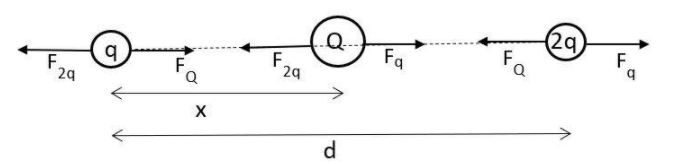
For the given conditions to prevail, the charge Q should be negative and should be placed in between the charges q and 2q. Assume charge Q is placed at a distance x from the charge q.
Using Coulomb’s law, we can express the electrostatic force of attraction or repulsion between two charges ${Q}_{1}$ and ${Q}_{2}$ placed at a distance r using the formula, $F=\dfrac{k{Q}_{1}{Q}_{2}}{r^2}$, where k is the electrostatic constant.
Now, force acting on charge q due to charge Q should be balanced by the force due to the charge 2q.
Therefore, ${F}_{Q}={F}_{2q}$
$\implies \dfrac{kqQ}{x^2}=\dfrac{2kq^2}{d^2}$ ………. (i)
Similarly, forces acting on charge 2q due to charges Q and q should balance each other
Therefore, ${F}_{q}={F}_{Q}$
$\implies \dfrac{2kq^2}{d^2}=\dfrac{2kQq}{(d-x)^2}$ ………. (ii)
Now, from equation (i) and (ii), we can write,
$\dfrac{kqQ}{x^2}=\dfrac{2kQq}{(d-x)^2}$
$\implies \dfrac{1}{x^2}=\dfrac{2}{(d-x)^2}$
$\implies (\dfrac{d-x}{x})^2=2$
$\implies x=\dfrac{d}{\sqrt{2}+1}$
Hence, option a is the correct answer.
Note: One should be careful while placing the charge Q. If we assume the charge to be negative and place it on the line joining the charges q and 2q either on the left of q or in between q and 2q or in the right of 2q, there will only be the repulsion forces, that will disbalance the forces. So we need to consider charge Q as negative.
Formulae used:
Electrostatic force between two charges ${Q}_{1}$ and ${Q}_{2}$ placed at a distance r using the formula, $F=\dfrac{k{Q}_{1}{Q}_{2}}{r^2}$, where k is the electrostatic constant.
Complete step-by-step answer:
We have been given that the two charges q and 2q are placed at a distance d from each other. And a third charge Q has been placed along their line of joining, such that net force on charges q and 2q is zero.
For the given conditions to prevail, the charge Q should be negative and should be placed in between the charges q and 2q. Assume charge Q is placed at a distance x from the charge q.
Using Coulomb’s law, we can express the electrostatic force of attraction or repulsion between two charges ${Q}_{1}$ and ${Q}_{2}$ placed at a distance r using the formula, $F=\dfrac{k{Q}_{1}{Q}_{2}}{r^2}$, where k is the electrostatic constant.
Now, force acting on charge q due to charge Q should be balanced by the force due to the charge 2q.
Therefore, ${F}_{Q}={F}_{2q}$
$\implies \dfrac{kqQ}{x^2}=\dfrac{2kq^2}{d^2}$ ………. (i)
Similarly, forces acting on charge 2q due to charges Q and q should balance each other
Therefore, ${F}_{q}={F}_{Q}$
$\implies \dfrac{2kq^2}{d^2}=\dfrac{2kQq}{(d-x)^2}$ ………. (ii)
Now, from equation (i) and (ii), we can write,
$\dfrac{kqQ}{x^2}=\dfrac{2kQq}{(d-x)^2}$
$\implies \dfrac{1}{x^2}=\dfrac{2}{(d-x)^2}$
$\implies (\dfrac{d-x}{x})^2=2$
$\implies x=\dfrac{d}{\sqrt{2}+1}$
Hence, option a is the correct answer.
Note: One should be careful while placing the charge Q. If we assume the charge to be negative and place it on the line joining the charges q and 2q either on the left of q or in between q and 2q or in the right of 2q, there will only be the repulsion forces, that will disbalance the forces. So we need to consider charge Q as negative.
Recently Updated Pages
Master Class 12 Business Studies: Engaging Questions & Answers for Success

Master Class 12 Chemistry: Engaging Questions & Answers for Success
Master Class 12 Biology: Engaging Questions & Answers for Success
Class 12 Question and Answer - Your Ultimate Solutions Guide
Master Class 11 English: Engaging Questions & Answers for Success
Master Class 11 Social Science: Engaging Questions & Answers for Success
Trending doubts
Which are the Top 10 Largest Countries of the World?
Draw a labelled sketch of the human eye class 12 physics CBSE
The end of compass needle which points towards north class 12 physics CBSE
Differentiate between homogeneous and heterogeneous class 12 chemistry CBSE
In order to find out the different types of gametes class 12 biology NEET_UG
Why is the cell called the structural and functional class 12 biology CBSE