




Two point charges $ - 8nC$ and $16nC$ are placed at corners of the side CD of a square ABCD having sides equal to $0.04m$. Find the electric field strength at point B.
Answer
 Verified
616.2k+ views
Hint:Here, you are asked to find the electric field at a point due to two point charges. In order to answer this question, first what you need to do is find the electric field due to a point charge at the point of interest. After knowing the electric field, using that expression you can find the electric field at point B due to each charge individually and then use the superposition theorem.
Complete step by step answer:
Let us consider a single point charge having a charge equal to ${q_1}$ and this point charge is placed at the origin, for our ease, we have considered the charge to be positive. Now, take another point charge having charge equal to ${q_2}$, placed at some position vector $\overrightarrow r $. It is observed that the charge ${q_1}$ exerts a force on charge ${q_2}$.
This force is given by Coulomb’s law and is expressed as $\overrightarrow F = \dfrac{1}{{4\pi {\varepsilon _0}}}\dfrac{{{q_1}{q_2}}}{{{r^2}}}\widehat r$, where $\widehat r$ is the unit position vector. Now, electric field is defined as force per unit charge. Here, the ${q_2}$ is test charge, and therefore, electric field at the position vector $\overrightarrow r $ is given as $\overrightarrow E = \dfrac{{\overrightarrow F }}{{{q_2}}} = \dfrac{1}{{4\pi {\varepsilon _0}}}\dfrac{{{q_1}}}{{{r^2}}}\widehat r$. In terms of magnitude, electric field is $E = \dfrac{1}{{4\pi {\varepsilon _0}}}\dfrac{{{q_1}}}{{{r^2}}}$.
Let us come back to out question, the situation is as shown in the figure:
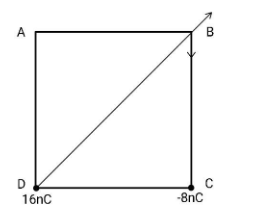
The direction of the electric field is shown in the figure. Let us find electric fields due to individual charge.
${E_{16nC}} = \dfrac{1}{{4\pi {\varepsilon _0}}}\dfrac{{{q_{16nC}}}}{{{{\left( {\sqrt 2 d} \right)}^2}}}\left( {\dfrac{{\widehat i + \widehat j}}{{\sqrt 2 }}} \right) \\
\Rightarrow{E_{16nC}} = \left( {9 \times {{10}^9}} \right)\dfrac{{\left( {16 \times {{10}^{ - 9}}} \right)}}{{{{\left( {\sqrt 2 \times 0.04} \right)}^2}}}\left( {\dfrac{{\widehat i + \widehat j}}{{\sqrt 2 }}} \right) \\
\Rightarrow{E_{16nC}} = 3.182 \times {10^4}\left( {\widehat i + \widehat j} \right) \\ $
\[\Rightarrow{E_{ - 8nC}} = \dfrac{1}{{4\pi {\varepsilon _0}}}\dfrac{{{q_{ - 8nC}}}}{{{d^2}}}\left( {\widehat j} \right) \\
\Rightarrow{E_{ - 8nC}} = \left( {9 \times {{10}^9}} \right)\dfrac{{\left( { - 8 \times {{10}^{ - 9}}} \right)}}{{{{\left( {0.04} \right)}^2}}}\left( {\widehat j} \right) \\
\Rightarrow{E_{ - 8nC}} = - 4.5 \times {10^4}\widehat j \\ \]
Now, according to the superposition theorem, the electric field at point B will be the vector sum of both the electric fields.
\[{E_B} = 3.182 \times {10^4}\widehat i + 3.182 \times {10^4}\widehat j + \left( { - 4.5 \times {{10}^4}} \right)\widehat j \\
\Rightarrow{E_B} = 3.182 \times {10^4}\widehat i - 1.318 \times {10^4}\widehat j \\
\therefore{E_B} = 3.44 \times {10^4}N{C^{ - 1}} \\ \]
Therefore, the electric field strength at point B is \[3.44 \times {10^4}N{C^{ - 1}}\].
Note:We have used Coulomb's law in order to find the electric field due to a point charge at the point of interest, so keep this in mind. Also, remember that the electric field due to positive charge is directed away from it and that due to negative charge is directed towards it, that is why the electric field arrow at point B due to negative charge is pointing in the downward direction.
Complete step by step answer:
Let us consider a single point charge having a charge equal to ${q_1}$ and this point charge is placed at the origin, for our ease, we have considered the charge to be positive. Now, take another point charge having charge equal to ${q_2}$, placed at some position vector $\overrightarrow r $. It is observed that the charge ${q_1}$ exerts a force on charge ${q_2}$.
This force is given by Coulomb’s law and is expressed as $\overrightarrow F = \dfrac{1}{{4\pi {\varepsilon _0}}}\dfrac{{{q_1}{q_2}}}{{{r^2}}}\widehat r$, where $\widehat r$ is the unit position vector. Now, electric field is defined as force per unit charge. Here, the ${q_2}$ is test charge, and therefore, electric field at the position vector $\overrightarrow r $ is given as $\overrightarrow E = \dfrac{{\overrightarrow F }}{{{q_2}}} = \dfrac{1}{{4\pi {\varepsilon _0}}}\dfrac{{{q_1}}}{{{r^2}}}\widehat r$. In terms of magnitude, electric field is $E = \dfrac{1}{{4\pi {\varepsilon _0}}}\dfrac{{{q_1}}}{{{r^2}}}$.
Let us come back to out question, the situation is as shown in the figure:
The direction of the electric field is shown in the figure. Let us find electric fields due to individual charge.
${E_{16nC}} = \dfrac{1}{{4\pi {\varepsilon _0}}}\dfrac{{{q_{16nC}}}}{{{{\left( {\sqrt 2 d} \right)}^2}}}\left( {\dfrac{{\widehat i + \widehat j}}{{\sqrt 2 }}} \right) \\
\Rightarrow{E_{16nC}} = \left( {9 \times {{10}^9}} \right)\dfrac{{\left( {16 \times {{10}^{ - 9}}} \right)}}{{{{\left( {\sqrt 2 \times 0.04} \right)}^2}}}\left( {\dfrac{{\widehat i + \widehat j}}{{\sqrt 2 }}} \right) \\
\Rightarrow{E_{16nC}} = 3.182 \times {10^4}\left( {\widehat i + \widehat j} \right) \\ $
\[\Rightarrow{E_{ - 8nC}} = \dfrac{1}{{4\pi {\varepsilon _0}}}\dfrac{{{q_{ - 8nC}}}}{{{d^2}}}\left( {\widehat j} \right) \\
\Rightarrow{E_{ - 8nC}} = \left( {9 \times {{10}^9}} \right)\dfrac{{\left( { - 8 \times {{10}^{ - 9}}} \right)}}{{{{\left( {0.04} \right)}^2}}}\left( {\widehat j} \right) \\
\Rightarrow{E_{ - 8nC}} = - 4.5 \times {10^4}\widehat j \\ \]
Now, according to the superposition theorem, the electric field at point B will be the vector sum of both the electric fields.
\[{E_B} = 3.182 \times {10^4}\widehat i + 3.182 \times {10^4}\widehat j + \left( { - 4.5 \times {{10}^4}} \right)\widehat j \\
\Rightarrow{E_B} = 3.182 \times {10^4}\widehat i - 1.318 \times {10^4}\widehat j \\
\therefore{E_B} = 3.44 \times {10^4}N{C^{ - 1}} \\ \]
Therefore, the electric field strength at point B is \[3.44 \times {10^4}N{C^{ - 1}}\].
Note:We have used Coulomb's law in order to find the electric field due to a point charge at the point of interest, so keep this in mind. Also, remember that the electric field due to positive charge is directed away from it and that due to negative charge is directed towards it, that is why the electric field arrow at point B due to negative charge is pointing in the downward direction.
Recently Updated Pages
Which of the following graphs shows the variation of class 12 physics CBSE

Draw a labelled diagram of the human male reproductive class 12 biology CBSE
Describe the experiment to compare the emf of two cells class 12 physics CBSE
What is standard hydrogen electrode
What is conventional current and electric current class 12 physics CBSE
2Bromopentane is treated with an alcoholic KOH solution class 12 chemistry CBSE
Trending doubts
Draw a labelled sketch of the human eye class 12 physics CBSE
Which are the Top 10 Largest Countries of the World?
Differentiate between homogeneous and heterogeneous class 12 chemistry CBSE
Draw ray diagrams each showing i myopic eye and ii class 12 physics CBSE
Which is the correct genotypic ratio of mendel dihybrid class 12 biology CBSE
What is the Full Form of PVC, PET, HDPE, LDPE, PP and PS ?