




Two point charges $1\times 10^{-3}C$ and $4\times 10^{-3}C$ are located $0.0\;6m$ apart in air. Find the location of the point between them where the resultant electric field is zero.
Answer
 Verified
645k+ views
Hint: Electric field is the electric force due to a unit positive charge which is at rest would exert on its surrounding. We can find the electric field due to the individual charges and then equate them to each other, to find the point where they are equal.
Formula used: $E=\dfrac{F}{q}$or$E=\dfrac{kq}{r^{2}}$
Complete step by step answer:
We know that the electric force due to a pair of charges is given by Coulomb's law. An electric field can be produced by a time-varying electric field or an electrical charge. These can be either attracting or repelling in nature.
An electric field E is defined as the electric force F per unit positive charge q , which is infinitesimally small and at rest, and is given as $E=\dfrac{F}{q}$. Then$E=\dfrac{kq}{r^{2}}$, where $k=\dfrac{1}{4\pi\epsilon_{0}}$ which is a constant and $r$ is the distance between the unit charges.
Given that the charges are $q_{1}=1\times 10^{-3}C$ and $q_{2}=4\times 10^{-3}C$, also given that they are at a distance $r=0.0\;6m$ from each other. For the electric fields to cancel each other, another point charge $q$ must be placed at a distance $x$ from $q_{1}$
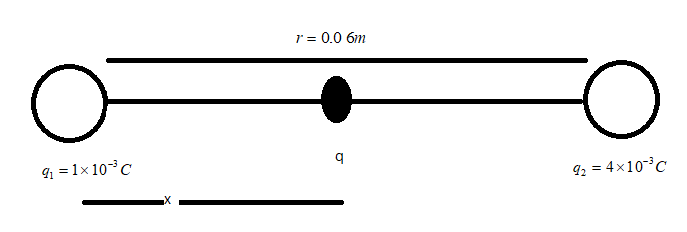
Then the electric field on $q$ is given as,
$\dfrac{kq_{1}}{x^{2}}=\dfrac{kq_{2}}{(r-x)^{2}}$
$\implies \dfrac{(r-x)^{2}}{x^{2}}=\dfrac{q_{2}}{q_{1}}$
$\implies \dfrac{r-x}{x}=\sqrt{\dfrac{q_{1}}{q_{2}}}$
Substituting the values we get,
$\implies\dfrac{0.06-x}{x}=\sqrt{\dfrac{1\times 10^{-3}}{4\times 10^{-3}}}$
$\implies\dfrac{0.06-x}{x}=\sqrt{\dfrac{1}{4}}$
$\implies\dfrac{0.06-x}{x}=\dfrac{1}{2}$
$\implies0.12-2x=x$
$\implies0.12=3x$
$\implies x=0.04m$
Hence the distance at a distance $0.04\;m$ from $q_{1}=10^{-3}C$ the electric field cancels each other.
Note: Electric field is in the direction of the force. Usually, the electric field of a point positive charge is radially outwards, whereas the electric field of a point negative charge is radially inwards to the charge. However, the electric field also depends on the symmetry of the charge carrying conductor.
Formula used: $E=\dfrac{F}{q}$or$E=\dfrac{kq}{r^{2}}$
Complete step by step answer:
We know that the electric force due to a pair of charges is given by Coulomb's law. An electric field can be produced by a time-varying electric field or an electrical charge. These can be either attracting or repelling in nature.
An electric field E is defined as the electric force F per unit positive charge q , which is infinitesimally small and at rest, and is given as $E=\dfrac{F}{q}$. Then$E=\dfrac{kq}{r^{2}}$, where $k=\dfrac{1}{4\pi\epsilon_{0}}$ which is a constant and $r$ is the distance between the unit charges.
Given that the charges are $q_{1}=1\times 10^{-3}C$ and $q_{2}=4\times 10^{-3}C$, also given that they are at a distance $r=0.0\;6m$ from each other. For the electric fields to cancel each other, another point charge $q$ must be placed at a distance $x$ from $q_{1}$
Then the electric field on $q$ is given as,
$\dfrac{kq_{1}}{x^{2}}=\dfrac{kq_{2}}{(r-x)^{2}}$
$\implies \dfrac{(r-x)^{2}}{x^{2}}=\dfrac{q_{2}}{q_{1}}$
$\implies \dfrac{r-x}{x}=\sqrt{\dfrac{q_{1}}{q_{2}}}$
Substituting the values we get,
$\implies\dfrac{0.06-x}{x}=\sqrt{\dfrac{1\times 10^{-3}}{4\times 10^{-3}}}$
$\implies\dfrac{0.06-x}{x}=\sqrt{\dfrac{1}{4}}$
$\implies\dfrac{0.06-x}{x}=\dfrac{1}{2}$
$\implies0.12-2x=x$
$\implies0.12=3x$
$\implies x=0.04m$
Hence the distance at a distance $0.04\;m$ from $q_{1}=10^{-3}C$ the electric field cancels each other.
Note: Electric field is in the direction of the force. Usually, the electric field of a point positive charge is radially outwards, whereas the electric field of a point negative charge is radially inwards to the charge. However, the electric field also depends on the symmetry of the charge carrying conductor.
Recently Updated Pages
Master Class 12 Economics: Engaging Questions & Answers for Success

Master Class 12 Social Science: Engaging Questions & Answers for Success
Master Class 12 English: Engaging Questions & Answers for Success
Master Class 12 Maths: Engaging Questions & Answers for Success
Master Class 12 Physics: Engaging Questions & Answers for Success
Master Class 12 Biology: Engaging Questions & Answers for Success
Trending doubts
Draw a labelled sketch of the human eye class 12 physics CBSE
Which are the Top 10 Largest Countries of the World?
Draw ray diagrams each showing i myopic eye and ii class 12 physics CBSE
Which is the correct genotypic ratio of mendel dihybrid class 12 biology CBSE
Differentiate between homogeneous and heterogeneous class 12 chemistry CBSE
Which animal never drinks water in its entire life class 12 biology CBSE