




Two plane mirrors are inclined to each other such that a ray of light incident on the first mirror $\left( {{M_1}} \right)$ and parallel to the second mirror $\left( {{M_2}} \right)$ is finally reflected from the second mirror $\left( {{M_2}} \right)$ parallel to the first mirror $\left( {{M_1}} \right)$. The angle between the two mirrors will be:
(A) $90^\circ $
(B) $45^\circ $
(C) $75^\circ $
(D) $60^\circ $
Answer
 Verified
558.7k+ views
Hint
We need to draw the diagram in which the incident ray falls on the second mirror parallel to the first mirror and the final reflected ray is parallel to the second mirror. So if we consider the angle between the mirrors as $\theta $ then from the geometry of the diagram, we can find the value of $\theta $.
Formula used: Sum of interior angles of a triangle $ = 180^\circ $
Complete step by step answer
In the question it is said that the incident ray falls on the first mirror $\left( {{M_1}} \right)$ parallel to the second mirror $\left( {{M_2}} \right)$. So if we take the angle of inclination between the two mirrors as $\theta $, then the angle which the incident ray makes with the mirror $\left( {{M_1}} \right)$ is $\theta $. Similarly we are given that the final reflected ray from the mirror $\left( {{M_2}} \right)$ is parallel to the mirror $\left( {{M_1}} \right)$. So we get the angle that the reflected ray makes with the mirror $\left( {{M_2}} \right)$is $\theta $.
So we can draw the raw diagram as,
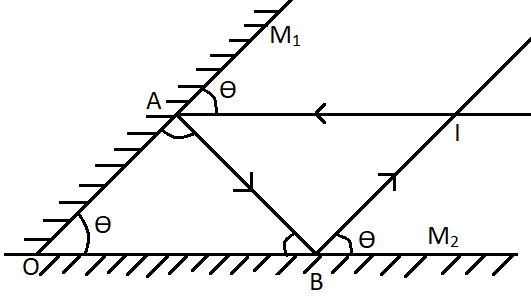
Here IA is the incident ray and BI is the reflected ray. The angle $\angle AOB$ is the angle between the mirrors equal to $\theta $. Now as the angle with which IA falls on $\left( {{M_1}} \right)$ is $\theta $. So from geometry, $\angle OAB$ is also equal to $\theta $. And similarly the angle which BI makes with $\left( {{M_2}} \right)$ is $\theta $. So again from geometry, $\angle OBA$ is also equal to $\theta $. So in the triangle $\Delta AOB$, the three angles are $\theta $ each.
Now the sum of all the angles in a triangle is $180^\circ $. So we can write,
$\theta + \theta + \theta = 180^\circ $
Adding the LHS we get
$3\theta = 180^\circ $
So on dividing both the sides with 3,
$\theta = \dfrac{{180^\circ }}{3} = 60^\circ $
Therefore the angle between the mirrors $\left( {{M_1}} \right)$ and $\left( {{M_2}} \right)$ is $60^\circ $.
So the correct answer is option (D).
Note
During the reflection of a ray of light in a mirror, according to the laws of reflection, the angle of incidence is equal to the angle of reflection. So this is why we have taken the angles $\angle OAB$ and $\angle OBA$ as $\theta $ from geometry.
We need to draw the diagram in which the incident ray falls on the second mirror parallel to the first mirror and the final reflected ray is parallel to the second mirror. So if we consider the angle between the mirrors as $\theta $ then from the geometry of the diagram, we can find the value of $\theta $.
Formula used: Sum of interior angles of a triangle $ = 180^\circ $
Complete step by step answer
In the question it is said that the incident ray falls on the first mirror $\left( {{M_1}} \right)$ parallel to the second mirror $\left( {{M_2}} \right)$. So if we take the angle of inclination between the two mirrors as $\theta $, then the angle which the incident ray makes with the mirror $\left( {{M_1}} \right)$ is $\theta $. Similarly we are given that the final reflected ray from the mirror $\left( {{M_2}} \right)$ is parallel to the mirror $\left( {{M_1}} \right)$. So we get the angle that the reflected ray makes with the mirror $\left( {{M_2}} \right)$is $\theta $.
So we can draw the raw diagram as,
Here IA is the incident ray and BI is the reflected ray. The angle $\angle AOB$ is the angle between the mirrors equal to $\theta $. Now as the angle with which IA falls on $\left( {{M_1}} \right)$ is $\theta $. So from geometry, $\angle OAB$ is also equal to $\theta $. And similarly the angle which BI makes with $\left( {{M_2}} \right)$ is $\theta $. So again from geometry, $\angle OBA$ is also equal to $\theta $. So in the triangle $\Delta AOB$, the three angles are $\theta $ each.
Now the sum of all the angles in a triangle is $180^\circ $. So we can write,
$\theta + \theta + \theta = 180^\circ $
Adding the LHS we get
$3\theta = 180^\circ $
So on dividing both the sides with 3,
$\theta = \dfrac{{180^\circ }}{3} = 60^\circ $
Therefore the angle between the mirrors $\left( {{M_1}} \right)$ and $\left( {{M_2}} \right)$ is $60^\circ $.
So the correct answer is option (D).
Note
During the reflection of a ray of light in a mirror, according to the laws of reflection, the angle of incidence is equal to the angle of reflection. So this is why we have taken the angles $\angle OAB$ and $\angle OBA$ as $\theta $ from geometry.
Recently Updated Pages
Master Class 12 Economics: Engaging Questions & Answers for Success

Master Class 12 English: Engaging Questions & Answers for Success
Master Class 12 Social Science: Engaging Questions & Answers for Success
Master Class 12 Maths: Engaging Questions & Answers for Success
Master Class 12 Physics: Engaging Questions & Answers for Success
Master Class 12 Business Studies: Engaging Questions & Answers for Success
Trending doubts
Which are the Top 10 Largest Countries of the World?
Draw a labelled sketch of the human eye class 12 physics CBSE
Differentiate between homogeneous and heterogeneous class 12 chemistry CBSE
Sulphuric acid is known as the king of acids State class 12 chemistry CBSE
Why is the cell called the structural and functional class 12 biology CBSE
Draw ray diagrams each showing i myopic eye and ii class 12 physics CBSE