




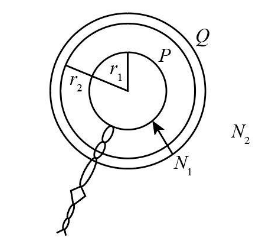
Two plane circular coils P and Q have radii ${r_1}$ and ${r_2}$respectively\[({r_1} << {r_2})\;\]and are coaxial as shown in fig. The number of turns in P and Q are respectively ${N_1}$and ${N_2}$. If the current in coil Q is varied steadily at a rate x ampere/sec, then the induced EMF in the coil P will be approximately?
(A) ${\mu _0}{N_1}{N_2}\pi r_1^2$
(B) ${\mu _0}{N_1}{N_2}\pi r_1^2$
(C) $\dfrac{{{\mu _0}{N_2}}}{{2{r_2}}} \times {N_1} \times \pi r_1^2 \times x$
(D) $0$
Answer
 Verified
574.2k+ views
Hint: Biot-Savart law provides the value of the magnetic field in a circular loop due to the current in the loop. The value of the magnetic field at the centre of a circular loop can be calculate by the formula $B = \dfrac{{{\mu _0}NI}}{{2r}}$ , here $I$ represents current in the loop, $r$ is the radius of the circular loop, $N$ is the number of turns and ${\mu _0}$ is the permeability of the vacuum. And The EMF induced can be calculated by Faraday's law.
Complete step by step answer:
Let the current ${I_2}$ is flowing in the coil Q
It is given that the current in coil Q is varied steadily at a rate x ampere/sec.
So
$\dfrac{{d{I_2}}}{{dt}} = x\;{{{\rm{ampere}}} {\left/
{\vphantom {{{\rm{ampere}}} {{\rm{sec}}}}} \right.
} {{\rm{sec}}}}...........{\rm{(1)}}$
It is given that \[({r_1} << {r_2})\;\] so the coil P will act as a centre for coil Q.
The magnetic field at coil Q is given as follows,
${B_Q} = \dfrac{{{\mu _0}{N_2}{I_2}}}{{2{r_2}}}$
This magnetic field will provide magnetic flux in the coil P.
So the magnetic flux in the coil P is
$\phi = {N_1}{B_Q}A$
Here, $A$ is the area of coil P and that is $A = \pi r_1^2$
The value of the EMF induced in coil P will be equal to the rate of change in the magnetic flux in the coil P.
So the EMF in the coil P by using of Faraday's law is,
$
\varepsilon = \dfrac{{d\phi }}{{dt}}\\
\Rightarrow\varepsilon = \dfrac{{d\left( {{N_1}{B_Q}A} \right)}}{{dt}}\\
\Rightarrow\varepsilon = {N_1}A\dfrac{{d\left( {{B_Q}} \right)}}{{dt}}
$
Substitute all the values in the above expression.
$
\varepsilon = {N_1}A\dfrac{{d\left( {\dfrac{{{\mu _0}{N_2}{I_2}}}{{2{r_2}}}} \right)}}{{dt}}\\
\Rightarrow\varepsilon = \dfrac{{{\mu _0}{N_2}}}{{2{r_2}}} \times {N_1}A \times \dfrac{{d{I_2}}}{{dt}}
$
Substitute the value of $A$ and the value of $\dfrac{{d{I_2}}}{{dt}}$ from equation (1).
$\therefore\varepsilon = \dfrac{{{\mu _0}{N_2}}}{{2{r_2}}} \times {N_1} \times \pi r_1^2 \times x$
Therefore, the induced EMF in the coil P is $\dfrac{{{\mu _0}{N_2}}}{{2{r_2}}} \times {N_1} \times \pi r_1^2 \times x$ and correct option is option (C).
Note:In such types of questions first find the magnetic field in the first coil then evaluate induced magnetic flux in the second coil and then you can calculate the change in magnetic flux or induced EMF in the second coil.
Complete step by step answer:
Let the current ${I_2}$ is flowing in the coil Q
It is given that the current in coil Q is varied steadily at a rate x ampere/sec.
So
$\dfrac{{d{I_2}}}{{dt}} = x\;{{{\rm{ampere}}} {\left/
{\vphantom {{{\rm{ampere}}} {{\rm{sec}}}}} \right.
} {{\rm{sec}}}}...........{\rm{(1)}}$
It is given that \[({r_1} << {r_2})\;\] so the coil P will act as a centre for coil Q.
The magnetic field at coil Q is given as follows,
${B_Q} = \dfrac{{{\mu _0}{N_2}{I_2}}}{{2{r_2}}}$
This magnetic field will provide magnetic flux in the coil P.
So the magnetic flux in the coil P is
$\phi = {N_1}{B_Q}A$
Here, $A$ is the area of coil P and that is $A = \pi r_1^2$
The value of the EMF induced in coil P will be equal to the rate of change in the magnetic flux in the coil P.
So the EMF in the coil P by using of Faraday's law is,
$
\varepsilon = \dfrac{{d\phi }}{{dt}}\\
\Rightarrow\varepsilon = \dfrac{{d\left( {{N_1}{B_Q}A} \right)}}{{dt}}\\
\Rightarrow\varepsilon = {N_1}A\dfrac{{d\left( {{B_Q}} \right)}}{{dt}}
$
Substitute all the values in the above expression.
$
\varepsilon = {N_1}A\dfrac{{d\left( {\dfrac{{{\mu _0}{N_2}{I_2}}}{{2{r_2}}}} \right)}}{{dt}}\\
\Rightarrow\varepsilon = \dfrac{{{\mu _0}{N_2}}}{{2{r_2}}} \times {N_1}A \times \dfrac{{d{I_2}}}{{dt}}
$
Substitute the value of $A$ and the value of $\dfrac{{d{I_2}}}{{dt}}$ from equation (1).
$\therefore\varepsilon = \dfrac{{{\mu _0}{N_2}}}{{2{r_2}}} \times {N_1} \times \pi r_1^2 \times x$
Therefore, the induced EMF in the coil P is $\dfrac{{{\mu _0}{N_2}}}{{2{r_2}}} \times {N_1} \times \pi r_1^2 \times x$ and correct option is option (C).
Note:In such types of questions first find the magnetic field in the first coil then evaluate induced magnetic flux in the second coil and then you can calculate the change in magnetic flux or induced EMF in the second coil.
Recently Updated Pages
Master Class 12 Economics: Engaging Questions & Answers for Success

Master Class 12 Physics: Engaging Questions & Answers for Success
Master Class 12 English: Engaging Questions & Answers for Success
Master Class 12 Social Science: Engaging Questions & Answers for Success
Master Class 12 Maths: Engaging Questions & Answers for Success
Master Class 12 Business Studies: Engaging Questions & Answers for Success
Trending doubts
Which are the Top 10 Largest Countries of the World?
What are the major means of transport Explain each class 12 social science CBSE
Draw a labelled sketch of the human eye class 12 physics CBSE
Why cannot DNA pass through cell membranes class 12 biology CBSE
Differentiate between insitu conservation and exsitu class 12 biology CBSE
Draw a neat and well labeled diagram of TS of ovary class 12 biology CBSE