




Two particles are oscillating along two close parallel straight lines side by side, with the same frequency and amplitudes. They pass each other, moving in opposite direction when their displacement is half of the amplitude. The mean positions of the two particles lie on a straight line perpendicular to the paths of the two particles. The phase difference is:
A. 0
B. $\dfrac{2\pi }{3}$
C. $\pi $
D. $\dfrac{\pi }{6}$
Answer
 Verified
547.2k+ views
Hint: As a first step, you could depict the given situation in a diagram. Then, you could write the equations for the displacement of the given two particles. Then find the angular displacement when the displacement is half the amplitude. Then you could take the difference of angular displacements of the two particles to get the required phase difference.
Complete Step by step solution:
In the question, we are given two particles that are oscillating side by side along two parallel straight lines with the same frequency and amplitudes. When their displacement is half their amplitudes, they are found to pass each other but moving in opposite directions to each other. We are also given that their mean positions lie on a straight line that is perpendicular to the paths of the two particles. We are supposed to find the phase difference between the two particles.
Let us first depict the given condition in a diagram.
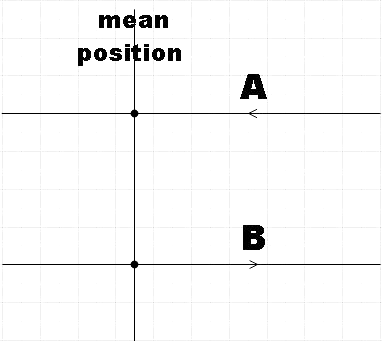
Let the displacement of the two particles 1 and 2 be given by,
${{y}_{1}}=A\sin \left( \omega t+{{\phi }_{1}} \right)$
${{y}_{2}}=A\sin \left( \omega t+{{\phi }_{2}} \right)$
We know that for a displacement of particle given by,$y=A\sin \left( \omega t+\phi \right)$, when the displacement is $\dfrac{A}{2}$,
$\dfrac{A}{2}=A\sin \left( \omega t+\phi \right)$
$\Rightarrow \sin \left( \omega t+\phi \right)=\dfrac{1}{2}$
$\Rightarrow \omega t+\phi ={{\sin }^{-1}}\left( \dfrac{1}{2} \right)$
$\therefore \left( \omega t+\phi \right)=\dfrac{\pi }{6},\dfrac{5\pi }{6}$
Therefore, we found the possible angular displacements of the particles to be $\dfrac{\pi }{6}$ and$\dfrac{5\pi }{6}$. From the figure, we see that angular displacement of the particle 1 is $\dfrac{5\pi }{6}$ and that of particle 2 would be$\dfrac{\pi }{6}$. That is,
$\left( \omega t+{{\phi }_{1}} \right)=\dfrac{5\pi }{6}$ ………………………………… (1)
$\left( \omega t+{{\phi }_{2}} \right)=\dfrac{\pi }{6}$………………………………… (2)
Subtracting equation (2) from equation (1), we get,
${{\phi }_{1}}-{{\phi }_{2}}=\dfrac{5\pi }{6}-\dfrac{\pi }{6}$
$\therefore {{\phi }_{1}}-{{\phi }_{2}}=\dfrac{4\pi }{6}=\dfrac{2\pi }{3}$
Therefore, we found the phase difference between the two given particles to be$\dfrac{2\pi }{3}$.
Hence, option B is found to be the correct answer.
Note:
We have written the above equations for the displacement of the given particles based on the given question that says that they both have the same frequency and amplitudes. The term $\phi $ in the equation of displacement is the respective phase angles of the particles. We could say that particle 1 moves to the extreme position before the other and passes each other on its way back.
Complete Step by step solution:
In the question, we are given two particles that are oscillating side by side along two parallel straight lines with the same frequency and amplitudes. When their displacement is half their amplitudes, they are found to pass each other but moving in opposite directions to each other. We are also given that their mean positions lie on a straight line that is perpendicular to the paths of the two particles. We are supposed to find the phase difference between the two particles.
Let us first depict the given condition in a diagram.
Let the displacement of the two particles 1 and 2 be given by,
${{y}_{1}}=A\sin \left( \omega t+{{\phi }_{1}} \right)$
${{y}_{2}}=A\sin \left( \omega t+{{\phi }_{2}} \right)$
We know that for a displacement of particle given by,$y=A\sin \left( \omega t+\phi \right)$, when the displacement is $\dfrac{A}{2}$,
$\dfrac{A}{2}=A\sin \left( \omega t+\phi \right)$
$\Rightarrow \sin \left( \omega t+\phi \right)=\dfrac{1}{2}$
$\Rightarrow \omega t+\phi ={{\sin }^{-1}}\left( \dfrac{1}{2} \right)$
$\therefore \left( \omega t+\phi \right)=\dfrac{\pi }{6},\dfrac{5\pi }{6}$
Therefore, we found the possible angular displacements of the particles to be $\dfrac{\pi }{6}$ and$\dfrac{5\pi }{6}$. From the figure, we see that angular displacement of the particle 1 is $\dfrac{5\pi }{6}$ and that of particle 2 would be$\dfrac{\pi }{6}$. That is,
$\left( \omega t+{{\phi }_{1}} \right)=\dfrac{5\pi }{6}$ ………………………………… (1)
$\left( \omega t+{{\phi }_{2}} \right)=\dfrac{\pi }{6}$………………………………… (2)
Subtracting equation (2) from equation (1), we get,
${{\phi }_{1}}-{{\phi }_{2}}=\dfrac{5\pi }{6}-\dfrac{\pi }{6}$
$\therefore {{\phi }_{1}}-{{\phi }_{2}}=\dfrac{4\pi }{6}=\dfrac{2\pi }{3}$
Therefore, we found the phase difference between the two given particles to be$\dfrac{2\pi }{3}$.
Hence, option B is found to be the correct answer.
Note:
We have written the above equations for the displacement of the given particles based on the given question that says that they both have the same frequency and amplitudes. The term $\phi $ in the equation of displacement is the respective phase angles of the particles. We could say that particle 1 moves to the extreme position before the other and passes each other on its way back.
Recently Updated Pages
Master Class 12 Business Studies: Engaging Questions & Answers for Success

Master Class 12 Biology: Engaging Questions & Answers for Success
Master Class 12 Chemistry: Engaging Questions & Answers for Success
Class 12 Question and Answer - Your Ultimate Solutions Guide
Master Class 11 Social Science: Engaging Questions & Answers for Success
Master Class 11 English: Engaging Questions & Answers for Success
Trending doubts
Which is more stable and why class 12 chemistry CBSE
Which are the Top 10 Largest Countries of the World?
Draw a labelled sketch of the human eye class 12 physics CBSE
Differentiate between homogeneous and heterogeneous class 12 chemistry CBSE
What are the major means of transport Explain each class 12 social science CBSE
Sulphuric acid is known as the king of acids State class 12 chemistry CBSE