




Two particles A and B having charges of \[4 \times {10^{ - 6}}C\] and \[ - 64 \times {10^{ -6}}C\] respectively are held at a separation of 90 cm. Locate the point(s) on the line AB or on its extension where the electric field is zero.
Answer
 Verified
591k+ views
Hint: We know the electric field between the two point is given by the formula \[F = k\dfrac{{Qq}}{{{r^2}}}\], where Q and q is the charge on the particles and r is the distance between them, in this question two points charges are given and we will assume a third charge on the line AB and then we will find the electric field on point charge C from the point A and the point B. And the we will find that point C.
Complete step by step answer:
Charge on particle A \[ = 4 \times {10^{ - 6}}C\]
Charge on particle B \[ = - 64 \times {10^{ - 6}}C\]
Separation between the two particles A and B \[d = 90cm = \dfrac{{90}}{{100}} = 0.9m\]
Now let us assume the charger on the particle C to be Q which lie to the right of point B on the line AB where the electric field will be equal to zero
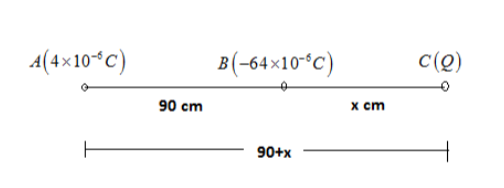
We know the amount of force between the two stationary and electric charged particles is defined by coulomb law which is given by the formula as
\[F = k\dfrac{{Qq}}{{{r^2}}}\]
So the electric field between the particle A and C which is at distance (90+x) cm will be equal to
\[{F_{AC}} = k\dfrac{{Q\left( {4 \times {{10}^{ - 6}}} \right)}}{{{{\left( {0.9 + x} \right)}^2}}} - - (i)\]
And the electric field between the particle B and C which is at distance x cm will be equal to
\[{F_{BC}} = k\dfrac{{Q\left( { - 64 \times {{10}^{ - 6}}} \right)}}{{{{\left( x \right)}^2}}} - - (ii)\]
Now equate equation (i) with equation (ii) to find the distance x where the electric field is zero
\[k\dfrac{{Q\left( {4 \times {{10}^{ - 6}}} \right)}}{{{{\left( {0.9 + x} \right)}^2}}} = k\dfrac{{Q\left( { - 64 \times {{10}^{ - 6}}} \right)}}{{{{\left( x \right)}^2}}}\]
By further solving we get
\[
\dfrac{{\left( {4 \times {{10}^{ - 6}}} \right)}}{{{{\left( {0.9 + x} \right)}^2}}} = \dfrac{{\left( { - 64 \times {{10}^{ - 6}}} \right)}}{{{{\left( x \right)}^2}}} \\
\Rightarrow {\left( x \right)^2}\left( {4 \times {{10}^{ - 6}}} \right) = {\left( {0.9 + x} \right)^2}\left( { - 64 \times {{10}^{ - 6}}} \right) \\
\Rightarrow {x^2} = \left( {{x^2} + 0.81 + 1.8x} \right)\left( { - 16} \right) \\
\Rightarrow {x^2} = - 16{x^2} - 28.8x - 12.96 \\
\Rightarrow 17{x^2} + 28.8x + 12.96 = 0 \\
\]
So we get the distance x in the quadratic form
\[17{x^2} + 28.8x + 12.96 = 0\]
So by solving the roots of the quadratic equation we get
$
x = \dfrac{{ - 28.8 \pm \sqrt {{{\left( {28.8} \right)}^2} - 4(17)(12.96)} }}{{2(17)}} \\
\Rightarrow x = \dfrac{{ - 28.8 \pm \sqrt {829.44 - 881.28} }}{{34}} \\
\Rightarrow x = \dfrac{{ - 28.8 \pm \sqrt { - 51.84} }}{{34}} \\
\Rightarrow x = \dfrac{{ - 28.8 \pm i7.2}}{{34}} \\
$
Hence, the point(s) on the line AB or on its extension where the electric field is zero are $\dfrac{{ - 28.8 + i7.2}}{{34}}$ and $\dfrac{{ - 28.8 - i7.2}}{{34}}$.
Note: Here, the points are lying on the coordinates axes where the terms associated with the imaginary terms indicates the distance of the point on the y-axis from the origin and the real terms indicates the distance of the point on the x-axis from the origin.
Complete step by step answer:
Charge on particle A \[ = 4 \times {10^{ - 6}}C\]
Charge on particle B \[ = - 64 \times {10^{ - 6}}C\]
Separation between the two particles A and B \[d = 90cm = \dfrac{{90}}{{100}} = 0.9m\]
Now let us assume the charger on the particle C to be Q which lie to the right of point B on the line AB where the electric field will be equal to zero
We know the amount of force between the two stationary and electric charged particles is defined by coulomb law which is given by the formula as
\[F = k\dfrac{{Qq}}{{{r^2}}}\]
So the electric field between the particle A and C which is at distance (90+x) cm will be equal to
\[{F_{AC}} = k\dfrac{{Q\left( {4 \times {{10}^{ - 6}}} \right)}}{{{{\left( {0.9 + x} \right)}^2}}} - - (i)\]
And the electric field between the particle B and C which is at distance x cm will be equal to
\[{F_{BC}} = k\dfrac{{Q\left( { - 64 \times {{10}^{ - 6}}} \right)}}{{{{\left( x \right)}^2}}} - - (ii)\]
Now equate equation (i) with equation (ii) to find the distance x where the electric field is zero
\[k\dfrac{{Q\left( {4 \times {{10}^{ - 6}}} \right)}}{{{{\left( {0.9 + x} \right)}^2}}} = k\dfrac{{Q\left( { - 64 \times {{10}^{ - 6}}} \right)}}{{{{\left( x \right)}^2}}}\]
By further solving we get
\[
\dfrac{{\left( {4 \times {{10}^{ - 6}}} \right)}}{{{{\left( {0.9 + x} \right)}^2}}} = \dfrac{{\left( { - 64 \times {{10}^{ - 6}}} \right)}}{{{{\left( x \right)}^2}}} \\
\Rightarrow {\left( x \right)^2}\left( {4 \times {{10}^{ - 6}}} \right) = {\left( {0.9 + x} \right)^2}\left( { - 64 \times {{10}^{ - 6}}} \right) \\
\Rightarrow {x^2} = \left( {{x^2} + 0.81 + 1.8x} \right)\left( { - 16} \right) \\
\Rightarrow {x^2} = - 16{x^2} - 28.8x - 12.96 \\
\Rightarrow 17{x^2} + 28.8x + 12.96 = 0 \\
\]
So we get the distance x in the quadratic form
\[17{x^2} + 28.8x + 12.96 = 0\]
So by solving the roots of the quadratic equation we get
$
x = \dfrac{{ - 28.8 \pm \sqrt {{{\left( {28.8} \right)}^2} - 4(17)(12.96)} }}{{2(17)}} \\
\Rightarrow x = \dfrac{{ - 28.8 \pm \sqrt {829.44 - 881.28} }}{{34}} \\
\Rightarrow x = \dfrac{{ - 28.8 \pm \sqrt { - 51.84} }}{{34}} \\
\Rightarrow x = \dfrac{{ - 28.8 \pm i7.2}}{{34}} \\
$
Hence, the point(s) on the line AB or on its extension where the electric field is zero are $\dfrac{{ - 28.8 + i7.2}}{{34}}$ and $\dfrac{{ - 28.8 - i7.2}}{{34}}$.
Note: Here, the points are lying on the coordinates axes where the terms associated with the imaginary terms indicates the distance of the point on the y-axis from the origin and the real terms indicates the distance of the point on the x-axis from the origin.
Recently Updated Pages
Basicity of sulphurous acid and sulphuric acid are

Master Class 12 English: Engaging Questions & Answers for Success
Master Class 12 Social Science: Engaging Questions & Answers for Success
Master Class 12 Maths: Engaging Questions & Answers for Success
Master Class 12 Economics: Engaging Questions & Answers for Success
Master Class 12 Physics: Engaging Questions & Answers for Success
Trending doubts
Which are the Top 10 Largest Countries of the World?
Draw a labelled sketch of the human eye class 12 physics CBSE
Which state in the country is at the forefront in controlling class 12 social science CBSE
Where is the largest hydroelectric power station located class 12 biology CBSE
Which country did Danny Casey play for class 12 english CBSE
Coming together federation is practiced in A India class 12 social science CBSE