




Two metal strips each of length l as shown are kept b apart and connected to a battery of emf Ԑ through a resistance R. A wire of mass m lies on it. Metal strips are smooth but the floor has coeff of friction µ. Find how far the wire will land after leaving the metal strips after the switch is made in figure.

Answer
 Verified
576.3k+ views
Hint: The magnitude of the force on the current carrying conductor is given by $F = IlB\sin \theta $, here is the angle between the direction of magnetic field and the direction of flow of current. Displacement of the metal wire is further calculated by using the third equation of motion.
Formula used:
Force on a current carrying conductor $F = IlB\sin \theta $
Current in loop $\eqalign{& I = \dfrac{\varepsilon }{R} \cr} $
Force on an object $\eqalign{& F = m \times a \cr} $
Third equation of motion $\eqalign{& {v^2} - {u^2} = 2as \cr} $
Complete step by step answer:
The magnitude of the force on the current carrying conductor is given by $F = IlB\sin \theta $, here is the angle between the direction of magnetic field and the direction of flow of current.
Let us consider two metal strips of length l and separated by b and connected to a battery of emf Ԑ through a resistance R.
Force on the wire $\eqalign{
& \vec F = IbB\overset{\lower0.5em\hbox{$\smash{\scriptscriptstyle\frown}$}}\to
{i} \cr}$
Current in the loop
$\eqalign{& I = \dfrac{\varepsilon }{R} \cr}$
$\eqalign{& \therefore \vec F = \dfrac{\varepsilon }{R} \times bB\overset{\lower0.5em\hbox{$\smash{\scriptscriptstyle\frown}$}}\to
{i} \cr}$
We know from second law of motion: $\eqalign{
& \vec F = ma \cr
& \Rightarrow a = \dfrac{{\vec F}}{m} = \dfrac{{\varepsilon bB}}{{mR}}\hat i \cr
& \cr} $
Velocity of wire after travelling a distance on the metal strips is given by :
$\eqalign{
& {v^2} - {u^2} = 2as \cr
& {v^2} - {u^2} = 2aL \cr
& {v^2} - 0 = 2\left[ {\dfrac{{\varepsilon bB}}{{mR}}} \right]L \cr} $
Or,
When the wire lands on the floor, frictional force will act on it and the wire will decelerate.
$a{}_1 = \mu {}_g$
So, deceleration due to friction is given by
Therefore, distance travelled before the wire comes to rest s is given by:
$\eqalign{ & s = \dfrac{{{v^2}}}{{2a{}_1}} \cr
& s = \dfrac{{2\dfrac{{\varepsilon bB}}{{mR}}L}}{{2{\mu _g}}} \cr
& \therefore s = \dfrac{{\varepsilon bBL}}{{mR{\mu _g}}} \cr} $
Therefore, when the switch is on the metal wire will land with the displacement s derived above.
Additional Information:
The magnitude of the force on the current carrying conductor is given by .
If $\theta = {0^\circ }$ or ${180^ \circ }$ then F=0. Thus a current carrying conductor placed parallel to the direction of the magnetic field does not experience any force.
If $\theta = {90^\circ }$ then ${F_{\max }} = Ilb$. Thus a current carrying conductor placed perpendicular to the direction of a magnetic field experiences a maximum force.
Note:
The direction of force on a current carrying conductor placed in a perpendicular magnetic field is given by Fleming’s left hand rule.
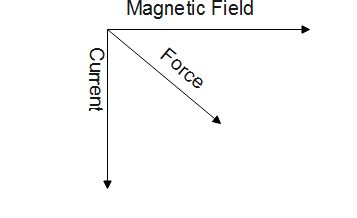
The forefinger points in the direction of the magnetic field, central finger in the direction of current, then the thumb gives the direction of force on the conductor.
Formula used:
Force on a current carrying conductor $F = IlB\sin \theta $
Current in loop $\eqalign{& I = \dfrac{\varepsilon }{R} \cr} $
Force on an object $\eqalign{& F = m \times a \cr} $
Third equation of motion $\eqalign{& {v^2} - {u^2} = 2as \cr} $
Complete step by step answer:
The magnitude of the force on the current carrying conductor is given by $F = IlB\sin \theta $, here is the angle between the direction of magnetic field and the direction of flow of current.
Let us consider two metal strips of length l and separated by b and connected to a battery of emf Ԑ through a resistance R.
Force on the wire $\eqalign{
& \vec F = IbB\overset{\lower0.5em\hbox{$\smash{\scriptscriptstyle\frown}$}}\to
{i} \cr}$
Current in the loop
$\eqalign{& I = \dfrac{\varepsilon }{R} \cr}$
$\eqalign{& \therefore \vec F = \dfrac{\varepsilon }{R} \times bB\overset{\lower0.5em\hbox{$\smash{\scriptscriptstyle\frown}$}}\to
{i} \cr}$
We know from second law of motion: $\eqalign{
& \vec F = ma \cr
& \Rightarrow a = \dfrac{{\vec F}}{m} = \dfrac{{\varepsilon bB}}{{mR}}\hat i \cr
& \cr} $
Velocity of wire after travelling a distance on the metal strips is given by :
$\eqalign{
& {v^2} - {u^2} = 2as \cr
& {v^2} - {u^2} = 2aL \cr
& {v^2} - 0 = 2\left[ {\dfrac{{\varepsilon bB}}{{mR}}} \right]L \cr} $
Or,
When the wire lands on the floor, frictional force will act on it and the wire will decelerate.
$a{}_1 = \mu {}_g$
So, deceleration due to friction is given by
Therefore, distance travelled before the wire comes to rest s is given by:
$\eqalign{ & s = \dfrac{{{v^2}}}{{2a{}_1}} \cr
& s = \dfrac{{2\dfrac{{\varepsilon bB}}{{mR}}L}}{{2{\mu _g}}} \cr
& \therefore s = \dfrac{{\varepsilon bBL}}{{mR{\mu _g}}} \cr} $
Therefore, when the switch is on the metal wire will land with the displacement s derived above.
Additional Information:
The magnitude of the force on the current carrying conductor is given by .
If $\theta = {0^\circ }$ or ${180^ \circ }$ then F=0. Thus a current carrying conductor placed parallel to the direction of the magnetic field does not experience any force.
If $\theta = {90^\circ }$ then ${F_{\max }} = Ilb$. Thus a current carrying conductor placed perpendicular to the direction of a magnetic field experiences a maximum force.
Note:
The direction of force on a current carrying conductor placed in a perpendicular magnetic field is given by Fleming’s left hand rule.
The forefinger points in the direction of the magnetic field, central finger in the direction of current, then the thumb gives the direction of force on the conductor.
Recently Updated Pages
Master Class 12 Economics: Engaging Questions & Answers for Success

Master Class 12 Physics: Engaging Questions & Answers for Success
Master Class 12 English: Engaging Questions & Answers for Success
Master Class 12 Social Science: Engaging Questions & Answers for Success
Master Class 12 Maths: Engaging Questions & Answers for Success
Master Class 12 Business Studies: Engaging Questions & Answers for Success
Trending doubts
Which are the Top 10 Largest Countries of the World?
What are the major means of transport Explain each class 12 social science CBSE
Draw a labelled sketch of the human eye class 12 physics CBSE
Why cannot DNA pass through cell membranes class 12 biology CBSE
Differentiate between insitu conservation and exsitu class 12 biology CBSE
Draw a neat and well labeled diagram of TS of ovary class 12 biology CBSE