




Two metal pieces having a potential difference of 800V are 0.02m apart horizontally. A particle of mass $1.96 \times {10^{ - 15}}kg$ is suspended in equilibrium between the plates. If e is the elementary charge, then charge on the particle is-
A.)8e
B.)6e
C.)e
D.)3e
Answer
 Verified
631.8k+ views
Hint: We will consider that as the elementary charge is given as e, it will mean that the total charge will be in the multiples e. we will also take the help of a figure. We will apply the formula for electric force.
Complete step by step answer:
Formula used: $E = \dfrac{V}{d}$, $F = Ee = mg$.
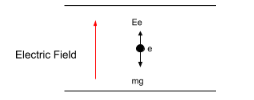
If the charge on the particle is given as e, then there must be an electric force working on the particle which will be Ee.
$ \Rightarrow F = Ee$
Since the particle is suspended in an equilibrium, then the electric force mentioned above must be balancing the force mg.
$ \Rightarrow F = Ee = mg$
Now, as we know that electric field is equal to $\dfrac{V}{d}$, this gives us-
$
\Rightarrow E = \dfrac{V}{d} \\
\\
\Rightarrow E = \dfrac{{800}}{{0.02}} \\
\\
\Rightarrow E = 40000 \\
\\
\Rightarrow E = 4 \times {10^4}V/m \\
$
Now, substituting this value in the equation $F = Ee = mg$, and the value of mass is already given to us by the question.
In the question, e is given as the elementary charge which means that the lowest unit will be in the multiples of e or that the total charge will be in the multiples of e. Thus, we will represent its charge with (ne). we will get-
$
\Rightarrow Ee = mg \\
\\
\Rightarrow 4 \times {10^4} \times ne = 1.96 \times {10^{ - 15}} \times 9.8 \\
\\
\Rightarrow ne = \dfrac{{1.96 \times {{10}^{ - 15}} \times 9.8}}{{4 \times {{10}^4}}} \\
$
Now, the value of n will be the number of electrons. And as we know, the value of e is $1.6 \times {10^{ - 19}}$. Thus, we get-
$
\Rightarrow ne = \dfrac{{1.96 \times {{10}^{ - 15}} \times 9.8}}{{4 \times {{10}^4}}} \\
\\
\Rightarrow n = \dfrac{{1.96 \times {{10}^{ - 15}} \times 9.8}}{{4 \times {{10}^4} \times 1.6 \times {{10}^{ - 19}}}} \\
\\
\Rightarrow n = \dfrac{{196 \times {{10}^{ - 15}} \times 98}}{{4 \times {{10}^4} \times 16 \times {{10}^{ - 17}}}} \\
\\
\Rightarrow n = \dfrac{{196 \times {{10}^{ - 15}} \times 98 \times {{10}^{17}} \times {{10}^{ - 4}}}}{{4 \times 16}} \\
\\
\Rightarrow n = \dfrac{{196 \times 98 \times {{10}^{ - 2}}}}{{4 \times 16}} \\
\\
\Rightarrow n = 300 \times {10^{ - 2}} \\
\\
\Rightarrow n = 3 \\
\\
$
Hence, our answer is 3e.
Thus, we can say that option D is the correct option.
Note: The difference in electrical potentials is the amount of work done to transport a unit charge in an electrical field from one point to another. The difference in the electrical potential of the two charged bodies is known as the potential difference.
Complete step by step answer:
Formula used: $E = \dfrac{V}{d}$, $F = Ee = mg$.
If the charge on the particle is given as e, then there must be an electric force working on the particle which will be Ee.
$ \Rightarrow F = Ee$
Since the particle is suspended in an equilibrium, then the electric force mentioned above must be balancing the force mg.
$ \Rightarrow F = Ee = mg$
Now, as we know that electric field is equal to $\dfrac{V}{d}$, this gives us-
$
\Rightarrow E = \dfrac{V}{d} \\
\\
\Rightarrow E = \dfrac{{800}}{{0.02}} \\
\\
\Rightarrow E = 40000 \\
\\
\Rightarrow E = 4 \times {10^4}V/m \\
$
Now, substituting this value in the equation $F = Ee = mg$, and the value of mass is already given to us by the question.
In the question, e is given as the elementary charge which means that the lowest unit will be in the multiples of e or that the total charge will be in the multiples of e. Thus, we will represent its charge with (ne). we will get-
$
\Rightarrow Ee = mg \\
\\
\Rightarrow 4 \times {10^4} \times ne = 1.96 \times {10^{ - 15}} \times 9.8 \\
\\
\Rightarrow ne = \dfrac{{1.96 \times {{10}^{ - 15}} \times 9.8}}{{4 \times {{10}^4}}} \\
$
Now, the value of n will be the number of electrons. And as we know, the value of e is $1.6 \times {10^{ - 19}}$. Thus, we get-
$
\Rightarrow ne = \dfrac{{1.96 \times {{10}^{ - 15}} \times 9.8}}{{4 \times {{10}^4}}} \\
\\
\Rightarrow n = \dfrac{{1.96 \times {{10}^{ - 15}} \times 9.8}}{{4 \times {{10}^4} \times 1.6 \times {{10}^{ - 19}}}} \\
\\
\Rightarrow n = \dfrac{{196 \times {{10}^{ - 15}} \times 98}}{{4 \times {{10}^4} \times 16 \times {{10}^{ - 17}}}} \\
\\
\Rightarrow n = \dfrac{{196 \times {{10}^{ - 15}} \times 98 \times {{10}^{17}} \times {{10}^{ - 4}}}}{{4 \times 16}} \\
\\
\Rightarrow n = \dfrac{{196 \times 98 \times {{10}^{ - 2}}}}{{4 \times 16}} \\
\\
\Rightarrow n = 300 \times {10^{ - 2}} \\
\\
\Rightarrow n = 3 \\
\\
$
Hence, our answer is 3e.
Thus, we can say that option D is the correct option.
Note: The difference in electrical potentials is the amount of work done to transport a unit charge in an electrical field from one point to another. The difference in the electrical potential of the two charged bodies is known as the potential difference.
Recently Updated Pages
Master Class 12 Economics: Engaging Questions & Answers for Success

Master Class 12 English: Engaging Questions & Answers for Success
Master Class 12 Social Science: Engaging Questions & Answers for Success
Master Class 12 Maths: Engaging Questions & Answers for Success
Master Class 12 Physics: Engaging Questions & Answers for Success
Master Class 9 General Knowledge: Engaging Questions & Answers for Success
Trending doubts
Which are the Top 10 Largest Countries of the World?
Draw a labelled sketch of the human eye class 12 physics CBSE
Differentiate between homogeneous and heterogeneous class 12 chemistry CBSE
Sulphuric acid is known as the king of acids State class 12 chemistry CBSE
Why is the cell called the structural and functional class 12 biology CBSE
Draw ray diagrams each showing i myopic eye and ii class 12 physics CBSE