




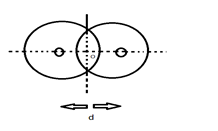
Two long cylinders are arranged as shown to form overlapping cylinders, each of radius r, whose centres are separated by a distance d. Current of density J flows into a plane of page along the right shaded part of page along the left shaded part of the other. The magnitude and direction of magnetic field at point O (O is the origin of x and y plane) are
$\left( 1 \right)\dfrac{{{\mu _0}\pi Jd}}{{2\pi }}$, in the +y direction.
$\left( 2 \right)\dfrac{{{\mu _0}{d^2}J}}{{2\pi r}}$, in the +y direction
$\left( 3 \right)zero$
$\left( 4 \right)$None of these
Answer
 Verified
576k+ views
Hint:In the above question they are two cylinders, in which the current enters through one cylinder and leaves through the other cylinder. Apply Ampere circuital law on both cylinders separately. Ampere circuital law states the relationship between the magnetic and the electric field. Then by using the ampere’s circuital law we can determine the net magnetic field.
Formula used:
$\int {Bdl = {\mu _0}i} $
Here${\mu _0}$ is the permeability of the medium, $i$ is the current enclosed by the closed path and $B$ is the magnetic field.
Complete step by step answer:
Ampere’s circuital law states the relationship between the magnetic and the electric field.
According to the law, states that the product of current enclosed by the closed path and permeability of the medium is equal to the integral of (B) in an imaginary closed path.
Here the current enters through the right-side long cylinder and current leaves through the left side long cylinder. Then let us apply the Ampere’s circuital law on each cylinder.
It is given that Radius of the cylinders =$r$, Distance between their centres =$d$
Let us apply Ampere’s circuital law on the right-side cylinder
$\int {Bdl = {\mu _0}i} $
\[\int {Bdl = \int {Bdl\cos 0} } \]
($\theta $ is 0 because $B$ and $dl$ are in same direction)
Also $B$ is constant so we write \[B\int {dl} \] , where $dl$ is equal to $\dfrac{{2\pi d}}{2}$ (Since $r = \dfrac{d}{2}$ ).
Hence, $B\dfrac{{2\pi d}}{2} = {\mu _0}i$
Also, $i = {\dfrac{{j\pi \left( d \right)}}{{{{\left( 2 \right)}^2}}}^2}$here \[j\]is the current density.
Now,$B\dfrac{{2\pi d}}{2} = \dfrac{{{\mu _0}j\pi {d^2}}}{4}$
On cancelling the term and we get,
$B = \dfrac{{{\mu _0}dj}}{4}$
Applying the Ampere’s circuital law on the left cylinder we also get $B = \dfrac{{{\mu _0}dj}}{4}$
Now the net magnetic field
${B_{net}} = 2B = \dfrac{{{\mu _0}dj}}{2}$
We can also write as
${B_{net}} = \dfrac{{{\mu _0}}}{{2\pi }}\pi dj$, the magnitude of magnetic field and direction is along the + y direction.
Hence option $\left( 1 \right)$ is the correct option.
Note: A magnetic field is generated, whenever a current travels through a conductor. The force will be zero, when the conductor is parallel to the magnetic field.
The force will be maximum, when it is perpendicular to the magnetic field.
The Magnetic field lines around a conductor carrying current are concentric circles whose centres lie on the wire. The Right-Hand Thumb Rule determines the direction of magnetic field lines.
Formula used:
$\int {Bdl = {\mu _0}i} $
Here${\mu _0}$ is the permeability of the medium, $i$ is the current enclosed by the closed path and $B$ is the magnetic field.
Complete step by step answer:
Ampere’s circuital law states the relationship between the magnetic and the electric field.
According to the law, states that the product of current enclosed by the closed path and permeability of the medium is equal to the integral of (B) in an imaginary closed path.
Here the current enters through the right-side long cylinder and current leaves through the left side long cylinder. Then let us apply the Ampere’s circuital law on each cylinder.
It is given that Radius of the cylinders =$r$, Distance between their centres =$d$
Let us apply Ampere’s circuital law on the right-side cylinder
$\int {Bdl = {\mu _0}i} $
\[\int {Bdl = \int {Bdl\cos 0} } \]
($\theta $ is 0 because $B$ and $dl$ are in same direction)
Also $B$ is constant so we write \[B\int {dl} \] , where $dl$ is equal to $\dfrac{{2\pi d}}{2}$ (Since $r = \dfrac{d}{2}$ ).
Hence, $B\dfrac{{2\pi d}}{2} = {\mu _0}i$
Also, $i = {\dfrac{{j\pi \left( d \right)}}{{{{\left( 2 \right)}^2}}}^2}$here \[j\]is the current density.
Now,$B\dfrac{{2\pi d}}{2} = \dfrac{{{\mu _0}j\pi {d^2}}}{4}$
On cancelling the term and we get,
$B = \dfrac{{{\mu _0}dj}}{4}$
Applying the Ampere’s circuital law on the left cylinder we also get $B = \dfrac{{{\mu _0}dj}}{4}$
Now the net magnetic field
${B_{net}} = 2B = \dfrac{{{\mu _0}dj}}{2}$
We can also write as
${B_{net}} = \dfrac{{{\mu _0}}}{{2\pi }}\pi dj$, the magnitude of magnetic field and direction is along the + y direction.
Hence option $\left( 1 \right)$ is the correct option.
Note: A magnetic field is generated, whenever a current travels through a conductor. The force will be zero, when the conductor is parallel to the magnetic field.
The force will be maximum, when it is perpendicular to the magnetic field.
The Magnetic field lines around a conductor carrying current are concentric circles whose centres lie on the wire. The Right-Hand Thumb Rule determines the direction of magnetic field lines.
Recently Updated Pages
Master Class 12 Economics: Engaging Questions & Answers for Success

Master Class 12 Physics: Engaging Questions & Answers for Success
Master Class 12 English: Engaging Questions & Answers for Success
Master Class 12 Social Science: Engaging Questions & Answers for Success
Master Class 12 Maths: Engaging Questions & Answers for Success
Master Class 12 Business Studies: Engaging Questions & Answers for Success
Trending doubts
Which are the Top 10 Largest Countries of the World?
What are the major means of transport Explain each class 12 social science CBSE
Draw a labelled sketch of the human eye class 12 physics CBSE
Why cannot DNA pass through cell membranes class 12 biology CBSE
Differentiate between insitu conservation and exsitu class 12 biology CBSE
Draw a neat and well labeled diagram of TS of ovary class 12 biology CBSE