




Two lenses of power -15D and +5D are in contact with each other. The focal length combination is:
A. -20 cm
B. -10 cm
C. +20 cm
D. +10 cm
Answer
 Verified
527.8k+ views
Hint: We have well defined sign conventions for the focal lengths of different lenses. We usually take the focal length of a concave lens as negative and for a convex lens as positive. The power of a lens is the ability or measure of how much an optical instrument can converge or diverge light rays.
Formula used:
$P = \dfrac 1f,\ P_{net} = P_1+P_2$
Complete answer:
Since power of lens is the reciprocal of focal length, hence the sign of power is the same as that of focal length. We are given two lenses- one having power -15D and other +5D.
A concave lens has negative power, thus -15D is the power of a concave lens. A convex lens has positive power, thus +5D is the power of a convex lens.
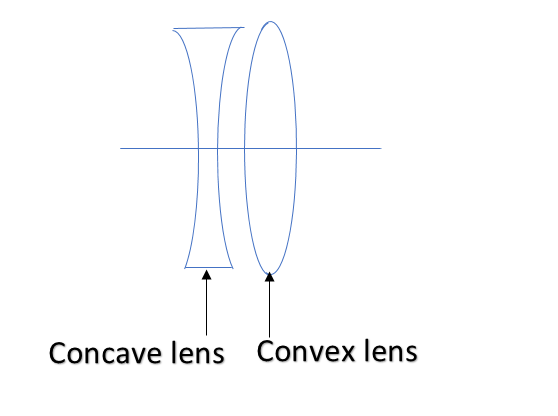
Also, when two lenses are connected with each other, their power gets added up.
Thus, $P_{net} = P_1+P_2$
$\implies P_{net} = -15 + 5 = -10D$
Now, as $P = \dfrac 1f$, so $f = \dfrac 1P$
$\implies f = \dfrac{1}{-10} =-0.1m = -10cm$
So, the correct answer is “Option B”.
Additional Information:
The power of combination of two or more lenses could be obtained by adding time algebraically. This suggests that power is a scalar quantity.
Note:
In optics lens and mirror problems, the first and foremost thing is to understand the sign conventions properly and then proceed, otherwise the topic will seem very difficult. Students are also advised to understand the diagrams of image formation in various cases of lens and mirror. Also power is the measure of how much a lens can diverge or converge light rays. The power of a concave lens is negative means it usually diverges light rays whereas for convex lenses it is positive which suggests that it converges light rays.
Formula used:
$P = \dfrac 1f,\ P_{net} = P_1+P_2$
Complete answer:
Since power of lens is the reciprocal of focal length, hence the sign of power is the same as that of focal length. We are given two lenses- one having power -15D and other +5D.
A concave lens has negative power, thus -15D is the power of a concave lens. A convex lens has positive power, thus +5D is the power of a convex lens.
Also, when two lenses are connected with each other, their power gets added up.
Thus, $P_{net} = P_1+P_2$
$\implies P_{net} = -15 + 5 = -10D$
Now, as $P = \dfrac 1f$, so $f = \dfrac 1P$
$\implies f = \dfrac{1}{-10} =-0.1m = -10cm$
So, the correct answer is “Option B”.
Additional Information:
The power of combination of two or more lenses could be obtained by adding time algebraically. This suggests that power is a scalar quantity.
Note:
In optics lens and mirror problems, the first and foremost thing is to understand the sign conventions properly and then proceed, otherwise the topic will seem very difficult. Students are also advised to understand the diagrams of image formation in various cases of lens and mirror. Also power is the measure of how much a lens can diverge or converge light rays. The power of a concave lens is negative means it usually diverges light rays whereas for convex lenses it is positive which suggests that it converges light rays.
Recently Updated Pages
Master Class 12 Economics: Engaging Questions & Answers for Success

Master Class 12 Physics: Engaging Questions & Answers for Success
Master Class 12 English: Engaging Questions & Answers for Success
Master Class 12 Social Science: Engaging Questions & Answers for Success
Master Class 12 Maths: Engaging Questions & Answers for Success
Master Class 12 Business Studies: Engaging Questions & Answers for Success
Trending doubts
Which are the Top 10 Largest Countries of the World?
What are the major means of transport Explain each class 12 social science CBSE
Draw a labelled sketch of the human eye class 12 physics CBSE
Why cannot DNA pass through cell membranes class 12 biology CBSE
Differentiate between insitu conservation and exsitu class 12 biology CBSE
Draw a neat and well labeled diagram of TS of ovary class 12 biology CBSE