




Two large vertical and parallel metal plates having a separation of 1cm are connected to a DC voltage source of potential difference X. A proton is released at rest midway between the two plates. It remains at rest in the air then X is:
\[\begin{align}
& A)\text{ 1}\times \text{1}{{\text{0}}^{-5}}V \\
& B)\text{ 1}\times \text{1}{{\text{0}}^{-7}}V \\
& C)\text{ 1}\times \text{1}{{\text{0}}^{-9}}V \\
& D)\text{ 1}\times \text{1}{{\text{0}}^{-10}}V \\
\end{align}\]
Answer
 Verified
634.8k+ views
Hint: Two large vertical parallel metal plates separated by a distance is the elaborated definition for a capacitor. So, we have to use the capacitance formulae and concepts to solve the Voltage between the plates. The release of a proton indicates that the air between the gap has ionized.
Complete answer:
Let us consider a capacitor with separation of 1cm and dielectric medium as air.
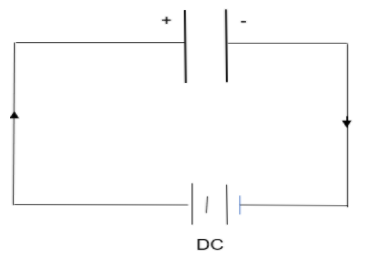
We know that the release of proton was a result of the energy produced by the DC source which created an electric field enough for the proton to be ionised.
We can calculate the equivalent force required to ionise a proton of mass ‘m’. We know that the force developed by an electric field if
\[F=qE\]
The force required to ionise a particle of mass ‘m’ is equivalent to its force due to mass, i.e.,
\[{{F}^{'}}=mg\]
Now, at the time of ionisation, these two forces must be equal, which will give the Electric field strength required for ionisation. i.e.,
\[qE=mg\]
Now we know that the potential difference X is related to the electric field as:
\[\begin{align}
& \Rightarrow E=\dfrac{V}{d} \\
& \Rightarrow V=Ed \\
\end{align}\]
Given that,
\[\begin{align}
& d=1cm={{10}^{-2}}m \\
& m={{m}_{p}}=1.6\times {{10}^{-27}}kg \\
& q=1.6\times {{10}^{-19}}C \\
& g=10m{{s}^{-2}} \\
\end{align}\]
Now equating the forces,
\[\begin{align}
& \Rightarrow F={{F}^{'}} \\
& \Rightarrow qE=mg \\
& \Rightarrow q\dfrac{V}{d}=mg \\
& \Rightarrow V=\dfrac{mgd}{q} \\
& \Rightarrow V=\dfrac{1.6\times {{10}^{-27}}\times 10\times {{10}^{-2}}}{1.6\times {{10}^{-19}}} \\
& \Rightarrow V=1\times {{10}^{-9}}V \\
\end{align}\]
i.e., the required voltage X is \[1\times {{10}^{-9}}V\].
The correct answer is option C.
Note:
The mass of the proton is approximated to two digits for the ease of solving. The need to consider the situation as a capacitor is based on the reader’s way of understanding. It can be considered a direct problem as we have done above or can be more related to a capacitor.
Complete answer:
Let us consider a capacitor with separation of 1cm and dielectric medium as air.
We know that the release of proton was a result of the energy produced by the DC source which created an electric field enough for the proton to be ionised.
We can calculate the equivalent force required to ionise a proton of mass ‘m’. We know that the force developed by an electric field if
\[F=qE\]
The force required to ionise a particle of mass ‘m’ is equivalent to its force due to mass, i.e.,
\[{{F}^{'}}=mg\]
Now, at the time of ionisation, these two forces must be equal, which will give the Electric field strength required for ionisation. i.e.,
\[qE=mg\]
Now we know that the potential difference X is related to the electric field as:
\[\begin{align}
& \Rightarrow E=\dfrac{V}{d} \\
& \Rightarrow V=Ed \\
\end{align}\]
Given that,
\[\begin{align}
& d=1cm={{10}^{-2}}m \\
& m={{m}_{p}}=1.6\times {{10}^{-27}}kg \\
& q=1.6\times {{10}^{-19}}C \\
& g=10m{{s}^{-2}} \\
\end{align}\]
Now equating the forces,
\[\begin{align}
& \Rightarrow F={{F}^{'}} \\
& \Rightarrow qE=mg \\
& \Rightarrow q\dfrac{V}{d}=mg \\
& \Rightarrow V=\dfrac{mgd}{q} \\
& \Rightarrow V=\dfrac{1.6\times {{10}^{-27}}\times 10\times {{10}^{-2}}}{1.6\times {{10}^{-19}}} \\
& \Rightarrow V=1\times {{10}^{-9}}V \\
\end{align}\]
i.e., the required voltage X is \[1\times {{10}^{-9}}V\].
The correct answer is option C.
Note:
The mass of the proton is approximated to two digits for the ease of solving. The need to consider the situation as a capacitor is based on the reader’s way of understanding. It can be considered a direct problem as we have done above or can be more related to a capacitor.
Recently Updated Pages
Basicity of sulphurous acid and sulphuric acid are

Master Class 12 Economics: Engaging Questions & Answers for Success
Master Class 12 Biology: Engaging Questions & Answers for Success
Master Class 11 English: Engaging Questions & Answers for Success
Master Class 11 Physics: Engaging Questions & Answers for Success
Master Class 11 Computer Science: Engaging Questions & Answers for Success
Trending doubts
Draw a labelled sketch of the human eye class 12 physics CBSE
The chemical formula of tear gas is A CO Cl 2 B C 10 class 12 chemistry CBSE
Draw ray diagrams each showing i myopic eye and ii class 12 physics CBSE
Which are the Top 10 Largest Countries of the World?
Differentiate between homogeneous and heterogeneous class 12 chemistry CBSE
Which is the correct genotypic ratio of mendel dihybrid class 12 biology CBSE