




Two lamps, one rated 100W at 220V, and the other 60W at 220V, are connected in parallel to electric mains supply. What current is drawn from the line if the supply voltage is 220V?
Answer
 Verified
631.2k+ views
Hint: The two lamps have been connected in parallel and their power ratings and voltages have been given. We can first calculate the current in each of the lamps by using the power formula. Then, the required result will be the sum of the two currents in each lamp.
Complete step by step solution:
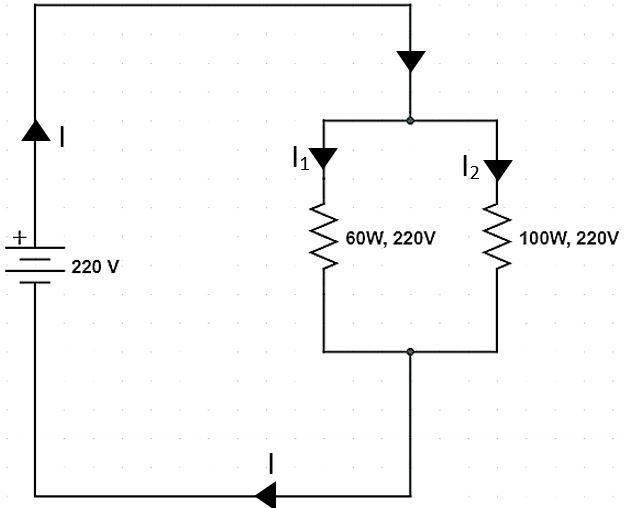
Let us assume the power of one lamp be $P_1$ and that of the second one be $P_2$.
It has been given that the voltage at the supply and in both the lamps is, say V=220V.
Therefore, using the formula of power, $P=VI$, where V is the voltage supplied and I is the current.
Therefore, current passing through the first lamp, $I_1 = \dfrac{P_1}{V}=\dfrac{100}{220}=\dfrac{5}{11}A$
Similarly, current passing through the second lamp, $I_2 =\dfrac{P_2}{V}=\dfrac{60}{220}=\dfrac{3}{11}A$
According to the questions, the lamps are connected in parallel, that means the current drawn through the supply will get divided in the two lamps.
So, net current, $I={I_1}+{I_2}=\dfrac{5}{11}+\dfrac{3}{11}=\dfrac{8}{11}=0.73A$
Hence, the net current drawn through the supply is 0.73 A.
Additional information:
In a circuit, when two distinct resistances are connected in series, the current remains the same while the voltage varies. But, when the same resistors are connected in parallel, the voltage remains the same, while the current gets distributed.
When two resistors are connected in parallel, the overall resistance of the circuit decreases. And that is why, in our homes, the electrical appliances are usually connected in parallel with the main supply to reduce the overall resistance and thus reduce the power loss.
Note: As the lamps were connected in parallel and are of different ratings, the current will be distributed unequally and the potential difference or voltage will remain same in each of the lamps while the currents would have been same, if they were connected in series.
Complete step by step solution:
Let us assume the power of one lamp be $P_1$ and that of the second one be $P_2$.
It has been given that the voltage at the supply and in both the lamps is, say V=220V.
Therefore, using the formula of power, $P=VI$, where V is the voltage supplied and I is the current.
Therefore, current passing through the first lamp, $I_1 = \dfrac{P_1}{V}=\dfrac{100}{220}=\dfrac{5}{11}A$
Similarly, current passing through the second lamp, $I_2 =\dfrac{P_2}{V}=\dfrac{60}{220}=\dfrac{3}{11}A$
According to the questions, the lamps are connected in parallel, that means the current drawn through the supply will get divided in the two lamps.
So, net current, $I={I_1}+{I_2}=\dfrac{5}{11}+\dfrac{3}{11}=\dfrac{8}{11}=0.73A$
Hence, the net current drawn through the supply is 0.73 A.
Additional information:
In a circuit, when two distinct resistances are connected in series, the current remains the same while the voltage varies. But, when the same resistors are connected in parallel, the voltage remains the same, while the current gets distributed.
When two resistors are connected in parallel, the overall resistance of the circuit decreases. And that is why, in our homes, the electrical appliances are usually connected in parallel with the main supply to reduce the overall resistance and thus reduce the power loss.
Note: As the lamps were connected in parallel and are of different ratings, the current will be distributed unequally and the potential difference or voltage will remain same in each of the lamps while the currents would have been same, if they were connected in series.
Recently Updated Pages
Master Class 12 Economics: Engaging Questions & Answers for Success

Master Class 12 English: Engaging Questions & Answers for Success
Master Class 12 Social Science: Engaging Questions & Answers for Success
Master Class 12 Maths: Engaging Questions & Answers for Success
Master Class 12 Physics: Engaging Questions & Answers for Success
Master Class 12 Business Studies: Engaging Questions & Answers for Success
Trending doubts
Which are the Top 10 Largest Countries of the World?
Draw a labelled sketch of the human eye class 12 physics CBSE
Differentiate between homogeneous and heterogeneous class 12 chemistry CBSE
Why is the cell called the structural and functional class 12 biology CBSE
Draw ray diagrams each showing i myopic eye and ii class 12 physics CBSE
Which is the correct genotypic ratio of mendel dihybrid class 12 biology CBSE