




Two infinite sheets carry equal and opposite uniform charge of densities $\pm \sigma$. The electric field in the free space between the two sheets will be:
a). $\dfrac{\sigma}{{\epsilon}_{0}}$
b). $\dfrac{\sigma}{2{\epsilon}_{0}}$
c). $\dfrac{2\sigma}{{\epsilon}_{0}}$
d). Zero
Answer
 Verified
633.6k+ views
Hint: Since the two electric plates are oppositely charged and are infinite, we can neglect the fringing effect here and by using the Gauss law, we can calculate the electric field in the free space between the two sheets.
Complete step by step solution:
It has been given that two infinite sheets carry opposite uniform charges of densities $+\sigma$ and $-\sigma$ respectively, which we can represent as below
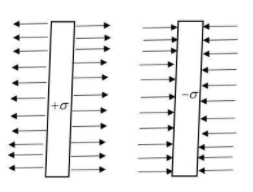
Taking the direction towards right as positive, and by using Gauss law the electric field by a infinitely long charged sheet can be given by $E=\dfrac{\sigma}{2{\epsilon}_{0}}$, where $\sigma$ is the charge density and ${\epsilon}_{0}$ is the permittivity.
So, the electric field from the sheet with the positive charge density, $E’=\dfrac{\sigma}{2{\epsilon}_{0}}$ ………. (i)
And electric field due to the sheet with negative charge density,
$E’’=-\dfrac{\sigma}{2{\epsilon}_{0}}$ ………. (ii)
Now, we need to find the electric field in the space between the two charged sheets,
Therefore, $E=E’-E’’=(\dfrac{\sigma}{2{\epsilon}_{0}})-(-\dfrac{\sigma}{2{\epsilon}_{0}})=\dfrac{\sigma}{{\epsilon}_{0}}$
Hence, option a is the correct answer.
Additional information:
Gauss law states that electric flux through any hypothetical closed surface is always equal to the $\dfrac{1}{{\epsilon}_{0}}$ times of the net electric charge within that closed surface. It is given by the relation
${\Phi}_{E}=\dfrac{Q}{{\epsilon}_{0}}$, where Q is the charge in the closed surface and ${\epsilon}_{0}$ is the permittivity of the medium in which the closed surface is present.
Note: It should be noted that for a positively charged sheet the electric field lines will be in a direction away from the sheet while that of for a negatively charged sheet, its direction will be towards the sheet itself. So, direction should be considered carefully or else we can get ambiguous answers.
Complete step by step solution:
It has been given that two infinite sheets carry opposite uniform charges of densities $+\sigma$ and $-\sigma$ respectively, which we can represent as below
Taking the direction towards right as positive, and by using Gauss law the electric field by a infinitely long charged sheet can be given by $E=\dfrac{\sigma}{2{\epsilon}_{0}}$, where $\sigma$ is the charge density and ${\epsilon}_{0}$ is the permittivity.
So, the electric field from the sheet with the positive charge density, $E’=\dfrac{\sigma}{2{\epsilon}_{0}}$ ………. (i)
And electric field due to the sheet with negative charge density,
$E’’=-\dfrac{\sigma}{2{\epsilon}_{0}}$ ………. (ii)
Now, we need to find the electric field in the space between the two charged sheets,
Therefore, $E=E’-E’’=(\dfrac{\sigma}{2{\epsilon}_{0}})-(-\dfrac{\sigma}{2{\epsilon}_{0}})=\dfrac{\sigma}{{\epsilon}_{0}}$
Hence, option a is the correct answer.
Additional information:
Gauss law states that electric flux through any hypothetical closed surface is always equal to the $\dfrac{1}{{\epsilon}_{0}}$ times of the net electric charge within that closed surface. It is given by the relation
${\Phi}_{E}=\dfrac{Q}{{\epsilon}_{0}}$, where Q is the charge in the closed surface and ${\epsilon}_{0}$ is the permittivity of the medium in which the closed surface is present.
Note: It should be noted that for a positively charged sheet the electric field lines will be in a direction away from the sheet while that of for a negatively charged sheet, its direction will be towards the sheet itself. So, direction should be considered carefully or else we can get ambiguous answers.
Recently Updated Pages
Master Class 12 Economics: Engaging Questions & Answers for Success

Master Class 12 English: Engaging Questions & Answers for Success
Master Class 12 Social Science: Engaging Questions & Answers for Success
Master Class 12 Maths: Engaging Questions & Answers for Success
Master Class 12 Physics: Engaging Questions & Answers for Success
Master Class 9 General Knowledge: Engaging Questions & Answers for Success
Trending doubts
Which are the Top 10 Largest Countries of the World?
Draw a labelled sketch of the human eye class 12 physics CBSE
Differentiate between homogeneous and heterogeneous class 12 chemistry CBSE
Why is the cell called the structural and functional class 12 biology CBSE
Draw ray diagrams each showing i myopic eye and ii class 12 physics CBSE
Which is the correct genotypic ratio of mendel dihybrid class 12 biology CBSE