




Two identical plano convex lenses are placed as shown below. If ${f_a},{f_b},{f_c}$ and ${f_d}$ re
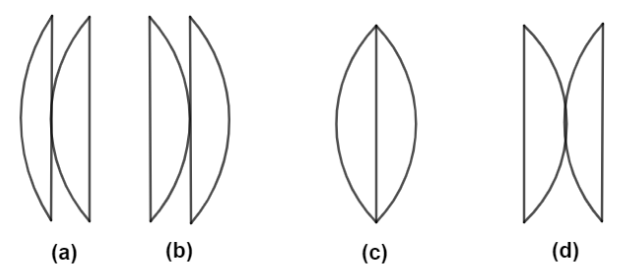 presents effective focal length of the combinations then,
A. ${f_a} > {f_b} > {f_c} > {f_d}$
B. ${f_a} = {f_b} > {f_c} > {f_d}$
C. ${f_a} < {f_b} < {f_c} < {f_d}$
D. ${f_a} = {f_b} = {f_c} = {f_d}$
Answer
 Verified
540.9k+ views
Hint: In the above diagram there are plano convex lenses which are identical . By using those lenses we have to prove the identical convex lens from pictures a, b, c, d which are identical. For this we are assuming the convex lenses are all equal. Let's discuss it step by step.
Complete step by step answer:
Above figure represents the focal lengths of the plano convex lens. From this diagram we are going to discuss whether the focal lengths are equal or unequal or greater to each other or less than to each other or few are greater and few are equal. Let's discuss deeply,
Case (i) $\dfrac{1}{{{f_a}}} = \dfrac{1}{{{f_1}}} + \dfrac{1}{{{f_2}}}$
Where as all the focal lengths are equal that means, $f = {f_1} = {f_2} = {f_3} = {f_4}$
So the diagram (a) is,
$\dfrac{1}{{{f_a}}} = \dfrac{1}{f} + \dfrac{1}{f} \\
\Rightarrow \dfrac{1}{{{f_a}}} = \dfrac{2}{f} \\ $
Similarly we are going to find for the remaining three focal lengths,
$\dfrac{1}{{{f_b}}} = \dfrac{1}{f} + \dfrac{1}{f} \\
\Rightarrow \dfrac{1}{{{f_b}}} = \dfrac{2}{f} \\ $
Whereas,
$\dfrac{1}{{{f_c}}} = \dfrac{2}{f} \\
\therefore \dfrac{1}{{{f_d}}} = \dfrac{2}{f} $
From the above calculations we have proved that all the focal lengths are equal ${f_a} = {f_b} = {f_c} = {f_d}$.
Hence the correct option is D.
Note: It should be remembered that, a plano convex lens has a flat surface on one side and at other converging portion of biconvex lens and it behave as a converging lens when light passes through it and if net focal length of any combination of lenses is negative it will behave as a concave lens otherwise if its positive it will behave as a convex lens.
Complete step by step answer:
Above figure represents the focal lengths of the plano convex lens. From this diagram we are going to discuss whether the focal lengths are equal or unequal or greater to each other or less than to each other or few are greater and few are equal. Let's discuss deeply,
Case (i) $\dfrac{1}{{{f_a}}} = \dfrac{1}{{{f_1}}} + \dfrac{1}{{{f_2}}}$
Where as all the focal lengths are equal that means, $f = {f_1} = {f_2} = {f_3} = {f_4}$
So the diagram (a) is,
$\dfrac{1}{{{f_a}}} = \dfrac{1}{f} + \dfrac{1}{f} \\
\Rightarrow \dfrac{1}{{{f_a}}} = \dfrac{2}{f} \\ $
Similarly we are going to find for the remaining three focal lengths,
$\dfrac{1}{{{f_b}}} = \dfrac{1}{f} + \dfrac{1}{f} \\
\Rightarrow \dfrac{1}{{{f_b}}} = \dfrac{2}{f} \\ $
Whereas,
$\dfrac{1}{{{f_c}}} = \dfrac{2}{f} \\
\therefore \dfrac{1}{{{f_d}}} = \dfrac{2}{f} $
From the above calculations we have proved that all the focal lengths are equal ${f_a} = {f_b} = {f_c} = {f_d}$.
Hence the correct option is D.
Note: It should be remembered that, a plano convex lens has a flat surface on one side and at other converging portion of biconvex lens and it behave as a converging lens when light passes through it and if net focal length of any combination of lenses is negative it will behave as a concave lens otherwise if its positive it will behave as a convex lens.
Recently Updated Pages
Master Class 12 Business Studies: Engaging Questions & Answers for Success

Master Class 12 Chemistry: Engaging Questions & Answers for Success
Master Class 12 Biology: Engaging Questions & Answers for Success
Class 12 Question and Answer - Your Ultimate Solutions Guide
Master Class 11 English: Engaging Questions & Answers for Success
Master Class 11 Social Science: Engaging Questions & Answers for Success
Trending doubts
Which are the Top 10 Largest Countries of the World?
Draw a labelled sketch of the human eye class 12 physics CBSE
Differentiate between homogeneous and heterogeneous class 12 chemistry CBSE
In order to find out the different types of gametes class 12 biology NEET_UG
Why is the cell called the structural and functional class 12 biology CBSE
Draw ray diagrams each showing i myopic eye and ii class 12 physics CBSE