




Two identical particles each of mass M and charge Q are placed a certain distance part. If they are in equilibrium under mutual gravitational and electric force then calculate the order of $\dfrac{Q}{M}$ in SI units.
Answer
 Verified
603.3k+ views
Hint: Concept of mutual gravitational force and electric force. As here the electric force and gravitational forces are in equilibrium which means both forces are equal. Gravitation or just gravity is the force of attraction between any two bodies. All the objects in the universe attract each other with a certain amount of force, but in most of the cases, the force is too weak to be observed due to the very large distance of separation. Besides, gravity’s range is infinite but the effect becomes weaker as objects move away.
Formula used:
1. Gravitational force
${F_g} = \,\;G\,\;\dfrac{{\,{m_1}{m_2}}}{{{r^2}}}$
2. Electrostatic force
${F_e} = \;\;K\;\;\dfrac{{{q_1}{q_2}}}{{{r^2}}}$
Complete step by step solution:
Gravitational Force – According to universal law of gravitation each and every object in this universe attracts another object with a force given by
${F_g} = G\;\dfrac{{{m_1}{m_2}}}{{{r^2}}}$
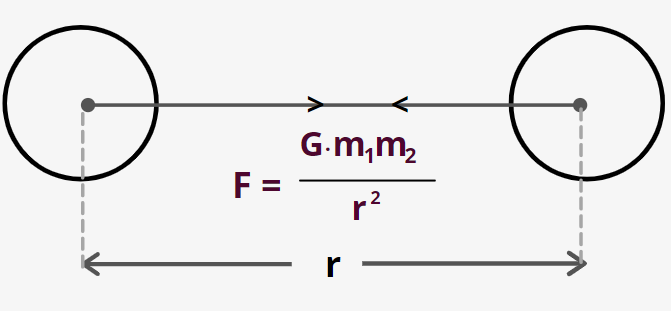
Where ${m_1}\;and\,\;{m_2}$ are two particles separated by a distance of r.
- It follows inverse square law
- Gravitational force is always attractive in nature
- G is the universal gravitational constant and $G = 6.67 \times {10^{ - 11}}\;N{m^2}/K{g^2}$
- Coulomb’s law: According to Coulomb’s s law, two charge particles of charges ${q_1}\;and\;{q_2}$ and separated by a distance r exerts an electrostatic force on each other given by
${F_e}\; = \;K\;\dfrac{{{q_1}\,{q_2}}}{{{r^2}}}$
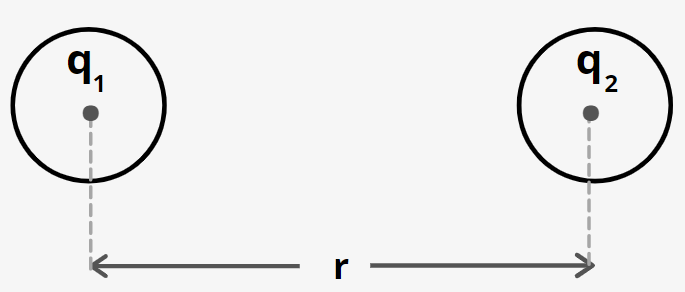
where k is a constant.
- The value of k is
$K = \dfrac{1}{{4\pi {\varepsilon _0}}} = 9 \times {10^9}\;N{m^2}/{C^2}$
- It can be attractive or repulsive
- For similar charges, it is repulsive
- For opposite charges, it is attractive in nature.
Now, as in question the given system of charges are in equilibrium.
Hence, ${F_e} = {F_g}$ …(1)
Now, \[{F_e} = K\dfrac{{{q_1}\,{q_2}}}{{{r^2}}}\]
and \[{F_g} = G\dfrac{{{m_1}\,{m_2}}}{{{r^2}}}\]
Here ${q_1} = {q_2} = Q\;,\;\,\;{m_1} = {m_2} = M$
So, From (1)
${F_e} = {F_g}$
\[K\dfrac{{(Q)\,(Q)}}{{{r^2}}} = G\dfrac{{(M)\,(M)}}{{{r^2}}}\]
\[
\Rightarrow \;\;K\,{Q^2}\, = \;\;G{M^2} \\
\Rightarrow \;\;\dfrac{{{Q^2}}}{{{M^2}}}\; = \;\dfrac{G}{K} \\
\Rightarrow \;\;\dfrac{Q}{M}\; = \;\sqrt {\dfrac{G}{K}} \\
\]
$
G\; = \;6.67 \times {10^{ - 11}}\;N{m^2}/K{g^2} \\
K\; = \;9 \times {10^9}\;N{m^2}/{C^2} \\ $
So,
\[\dfrac{Q}{M} = {\left( {\dfrac{{6.67 \times {{10}^{ - 11}}\;\;N{m^2}/K{g^2}}}{{9 \times {{10}^9}\;\;\;N{m^2}/K{g^2}}}} \right)^{1/2}}\]
$\implies \dfrac{Q}{M} = {[0.7411\; \times \;{10^{ - 20}}\;\;{C^2}/K{g^2}]^{1/2}}$
$\therefore \dfrac{Q}{M} = 0.86\; \times \;{10^{ - 10}}\;\;C/Kg $
So, the correct answer is “Option A”.
Note:
As they have asked the answer to be in SI units, so the values of K and G to be used should also be in SI. Only then the correct answer can be obtained. If values of K and G are used in some other units then the answer will be incorrect.Each body in this universe attracts other bodies towards itself with a force known as Gravitational Force, thus gravitation is a study of the interaction between two masses. Out of the two masses, the heavier one is called source mass and the lighter one is called test mass.
Formula used:
1. Gravitational force
${F_g} = \,\;G\,\;\dfrac{{\,{m_1}{m_2}}}{{{r^2}}}$
2. Electrostatic force
${F_e} = \;\;K\;\;\dfrac{{{q_1}{q_2}}}{{{r^2}}}$
Complete step by step solution:
Gravitational Force – According to universal law of gravitation each and every object in this universe attracts another object with a force given by
${F_g} = G\;\dfrac{{{m_1}{m_2}}}{{{r^2}}}$
Where ${m_1}\;and\,\;{m_2}$ are two particles separated by a distance of r.
- It follows inverse square law
- Gravitational force is always attractive in nature
- G is the universal gravitational constant and $G = 6.67 \times {10^{ - 11}}\;N{m^2}/K{g^2}$
- Coulomb’s law: According to Coulomb’s s law, two charge particles of charges ${q_1}\;and\;{q_2}$ and separated by a distance r exerts an electrostatic force on each other given by
${F_e}\; = \;K\;\dfrac{{{q_1}\,{q_2}}}{{{r^2}}}$
where k is a constant.
- The value of k is
$K = \dfrac{1}{{4\pi {\varepsilon _0}}} = 9 \times {10^9}\;N{m^2}/{C^2}$
- It can be attractive or repulsive
- For similar charges, it is repulsive
- For opposite charges, it is attractive in nature.
Now, as in question the given system of charges are in equilibrium.
Hence, ${F_e} = {F_g}$ …(1)
Now, \[{F_e} = K\dfrac{{{q_1}\,{q_2}}}{{{r^2}}}\]
and \[{F_g} = G\dfrac{{{m_1}\,{m_2}}}{{{r^2}}}\]
Here ${q_1} = {q_2} = Q\;,\;\,\;{m_1} = {m_2} = M$
So, From (1)
${F_e} = {F_g}$
\[K\dfrac{{(Q)\,(Q)}}{{{r^2}}} = G\dfrac{{(M)\,(M)}}{{{r^2}}}\]
\[
\Rightarrow \;\;K\,{Q^2}\, = \;\;G{M^2} \\
\Rightarrow \;\;\dfrac{{{Q^2}}}{{{M^2}}}\; = \;\dfrac{G}{K} \\
\Rightarrow \;\;\dfrac{Q}{M}\; = \;\sqrt {\dfrac{G}{K}} \\
\]
$
G\; = \;6.67 \times {10^{ - 11}}\;N{m^2}/K{g^2} \\
K\; = \;9 \times {10^9}\;N{m^2}/{C^2} \\ $
So,
\[\dfrac{Q}{M} = {\left( {\dfrac{{6.67 \times {{10}^{ - 11}}\;\;N{m^2}/K{g^2}}}{{9 \times {{10}^9}\;\;\;N{m^2}/K{g^2}}}} \right)^{1/2}}\]
$\implies \dfrac{Q}{M} = {[0.7411\; \times \;{10^{ - 20}}\;\;{C^2}/K{g^2}]^{1/2}}$
$\therefore \dfrac{Q}{M} = 0.86\; \times \;{10^{ - 10}}\;\;C/Kg $
So, the correct answer is “Option A”.
Note:
As they have asked the answer to be in SI units, so the values of K and G to be used should also be in SI. Only then the correct answer can be obtained. If values of K and G are used in some other units then the answer will be incorrect.Each body in this universe attracts other bodies towards itself with a force known as Gravitational Force, thus gravitation is a study of the interaction between two masses. Out of the two masses, the heavier one is called source mass and the lighter one is called test mass.
Recently Updated Pages
Which of the following graphs shows the variation of class 12 physics CBSE

Draw a labelled diagram of the human male reproductive class 12 biology CBSE
Describe the experiment to compare the emf of two cells class 12 physics CBSE
What is standard hydrogen electrode
What is conventional current and electric current class 12 physics CBSE
2Bromopentane is treated with an alcoholic KOH solution class 12 chemistry CBSE
Trending doubts
Draw a labelled sketch of the human eye class 12 physics CBSE
Which are the Top 10 Largest Countries of the World?
Differentiate between homogeneous and heterogeneous class 12 chemistry CBSE
Draw ray diagrams each showing i myopic eye and ii class 12 physics CBSE
Which is the correct genotypic ratio of mendel dihybrid class 12 biology CBSE
What is the Full Form of PVC, PET, HDPE, LDPE, PP and PS ?