




Two identical non-relativistic particles $A$ and $B$ move at right angles to each other, processing de Broglie wavelengths ${\lambda _1}$ and ${\lambda _2}$ respectively. The de Broglie wavelength of each particle in their centre of mass frame of reference is
A) ${\lambda _1} + {\lambda _2}$
B) $\dfrac{{2{\lambda _1}{\lambda _2}}}{{\left( {\sqrt {{\lambda _1}^2 + {\lambda _2}^2} } \right)}}$
C) $\dfrac{{{\lambda _1}{\lambda _2}}}{{\left( {\sqrt {\left| {{\lambda _1}^2 + {\lambda _2}^2} \right|} } \right)}}$
D) $\dfrac{{\left( {{\lambda _1} + {\lambda _2}} \right)}}{2}$
Answer
 Verified
615.6k+ views
Hint:The two particles are moving at right angle to each other, processing de Broglie wavelength. The velocity of the centre of mass can be derived using the vector form of two velocities and the velocity of the two particles with respect to the centre of mass velocity is derived. And by applying the de Broglie wavelength formula, to find the de Broglie wavelength of each particle in the centre of mass is derived.
Useful formula:
The velocity of centre of mass with respect to the two velocities,
${\vec v_c} = \dfrac{{{v_1}}}{2}\vec i + \dfrac{{{v_2}}}{2}\vec j$
Where, ${v_c}$ is the velocity of centre of mass, ${v_1}$ is the velocity of first particle, ${v_2}$ is the velocity of second particle, $\vec i$ and $\vec j$ are the direction vectors.
De Broglie wavelength, $\lambda = \dfrac{h}{{mv}}$
Where, $h$ is the Planck’s constant, $m$ is the mass of the particle and $v$ is the velocity of the particle.
Complete step by step answer:
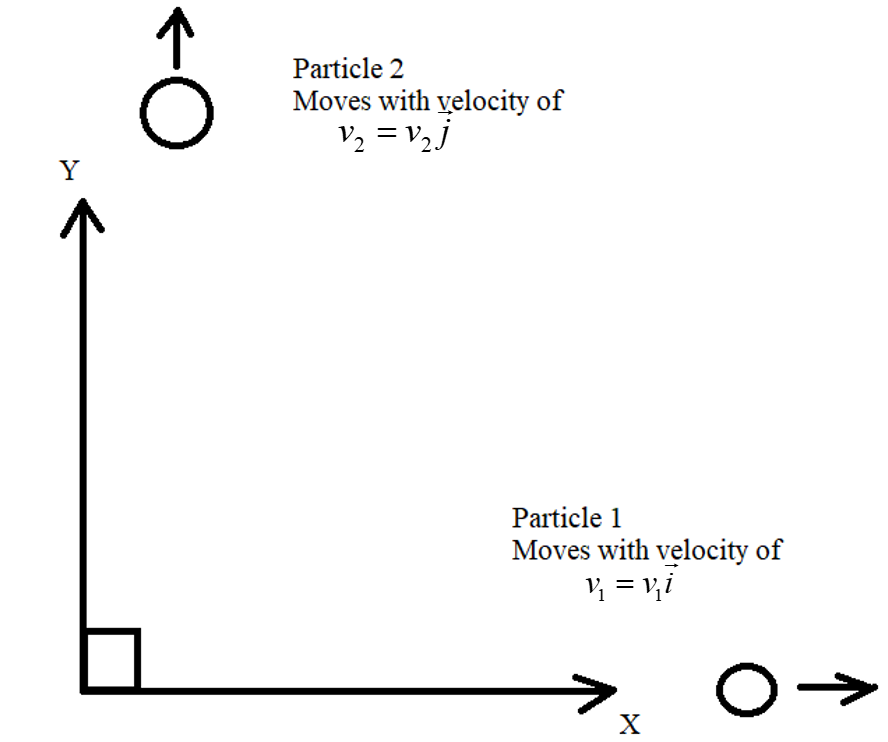
Assume that,
The velocity of the first particle is ${v_1} = {v_1}\vec i$
The velocity of the second particle is ${v_2} = {v_2}\vec j$
The wavelength of the first particle is ${\lambda _1}$
The wavelength of the second particle is ${\lambda _2}$
Thus, the velocity of the first particle with respect to centre of mass,
${v_{1c}} = {v_1} - {v_c}$
Substituting the value of ${v_1}$ and ${v_c}$ in above relation,
${v_{1c}} = {v_1}\vec i - \dfrac{{{v_1}}}{2}\vec i - \dfrac{{{v_2}}}{2}\vec j$
Performing the arithmetic operation on RHS of the equation, we get
$
{v_{1c}} = \dfrac{{{v_1}}}{2}\vec i - \dfrac{{{v_2}}}{2}\vec j \\
{v_{1c}} = \dfrac{{{v_1}\vec i - {v_2}\vec j}}{2} \\
$
De Broglie wavelength of first particle with respect to centre of mass,
${\lambda _{1c}} = \dfrac{h}{{m{v_{1c}}}}$
Substituting the value of ${v_{1c}}$ in above relation,
$
{\lambda _{1c}} = \dfrac{h}{{m\left( {\dfrac{{{v_1}\vec i - {v_2}\vec j}}{2}} \right)}} \\
{\lambda _{1c}} = \dfrac{{2h}}{{m\left( {{v_1}\vec i - {v_2}\vec j} \right)}} \\
$
Converting vector form into normal form, we get
$
{\lambda _{1c}} = \dfrac{{2h}}{{m\sqrt {\left( {{v_1}^2 + {v_2}^2} \right)} }}\;..................................\left( 1 \right) \\
\\
$
By de Broglie wavelength,
${\lambda _1} = \dfrac{h}{{m{v_1}}}$
By rearranging the terms, we get
${v_1} = \dfrac{h}{{m{\lambda _1}}}$
And
${\lambda _2} = \dfrac{h}{{m{v_2}}}$
By rearranging the terms, we get
${v_2} = \dfrac{h}{{m{\lambda _2}}}$
By substituting the values of ${v_1}$ and ${v_2}$ in equation (1), we get
${\lambda _{1c}} = \dfrac{{2h}}{{m\sqrt {\left( {{{\left( {\dfrac{h}{{m{\lambda _1}}}} \right)}^2} + {{\left( {\dfrac{h}{{m{\lambda _2}}}} \right)}^2}} \right)} }}\;$
By taking out the terms $h$ and $m$, by cancelling the square with square root, we get
${\lambda _{1c}} = \dfrac{{2h}}{{\dfrac{{mh}}{m}\sqrt {\left( {\dfrac{1}{{{\lambda _1}^2}} + \dfrac{1}{{{\lambda _2}^2}}} \right)} }}$
By cancelling the common terms in fraction in denominator of RHS,
${\lambda _{1c}} = \dfrac{2}{{\sqrt {\left( {\dfrac{{{\lambda _1}^2 + {\lambda _2}^2}}{{{\lambda _1}{\lambda _2}}}} \right)} }}$
\[{\lambda _{1c}} = \dfrac{{2{\lambda _1}{\lambda _2}}}{{\sqrt {{\lambda _1}^2 + {\lambda _2}^2} }}\]
Similarly, for the de Broglie wavelength of the second particle with respect to the centre of the mass is given by,
\[{\lambda _{2c}} = \dfrac{{2{\lambda _1}{\lambda _2}}}{{\sqrt {{\lambda _1}^2 + {\lambda _2}^2} }}\]
Hence, the option (B) is correct.
Note:
The same steps are followed to find out the de Broglie wavelength of the second particle with respect to the centre of mass which is resulted in the same value which is equal to that of the first particle. Hence, the two particles exhibit the same be Broglie wavelength with respect to the centre of the mass even if they are moving at a right angle to each other.
Useful formula:
The velocity of centre of mass with respect to the two velocities,
${\vec v_c} = \dfrac{{{v_1}}}{2}\vec i + \dfrac{{{v_2}}}{2}\vec j$
Where, ${v_c}$ is the velocity of centre of mass, ${v_1}$ is the velocity of first particle, ${v_2}$ is the velocity of second particle, $\vec i$ and $\vec j$ are the direction vectors.
De Broglie wavelength, $\lambda = \dfrac{h}{{mv}}$
Where, $h$ is the Planck’s constant, $m$ is the mass of the particle and $v$ is the velocity of the particle.
Complete step by step answer:
Assume that,
The velocity of the first particle is ${v_1} = {v_1}\vec i$
The velocity of the second particle is ${v_2} = {v_2}\vec j$
The wavelength of the first particle is ${\lambda _1}$
The wavelength of the second particle is ${\lambda _2}$
Thus, the velocity of the first particle with respect to centre of mass,
${v_{1c}} = {v_1} - {v_c}$
Substituting the value of ${v_1}$ and ${v_c}$ in above relation,
${v_{1c}} = {v_1}\vec i - \dfrac{{{v_1}}}{2}\vec i - \dfrac{{{v_2}}}{2}\vec j$
Performing the arithmetic operation on RHS of the equation, we get
$
{v_{1c}} = \dfrac{{{v_1}}}{2}\vec i - \dfrac{{{v_2}}}{2}\vec j \\
{v_{1c}} = \dfrac{{{v_1}\vec i - {v_2}\vec j}}{2} \\
$
De Broglie wavelength of first particle with respect to centre of mass,
${\lambda _{1c}} = \dfrac{h}{{m{v_{1c}}}}$
Substituting the value of ${v_{1c}}$ in above relation,
$
{\lambda _{1c}} = \dfrac{h}{{m\left( {\dfrac{{{v_1}\vec i - {v_2}\vec j}}{2}} \right)}} \\
{\lambda _{1c}} = \dfrac{{2h}}{{m\left( {{v_1}\vec i - {v_2}\vec j} \right)}} \\
$
Converting vector form into normal form, we get
$
{\lambda _{1c}} = \dfrac{{2h}}{{m\sqrt {\left( {{v_1}^2 + {v_2}^2} \right)} }}\;..................................\left( 1 \right) \\
\\
$
By de Broglie wavelength,
${\lambda _1} = \dfrac{h}{{m{v_1}}}$
By rearranging the terms, we get
${v_1} = \dfrac{h}{{m{\lambda _1}}}$
And
${\lambda _2} = \dfrac{h}{{m{v_2}}}$
By rearranging the terms, we get
${v_2} = \dfrac{h}{{m{\lambda _2}}}$
By substituting the values of ${v_1}$ and ${v_2}$ in equation (1), we get
${\lambda _{1c}} = \dfrac{{2h}}{{m\sqrt {\left( {{{\left( {\dfrac{h}{{m{\lambda _1}}}} \right)}^2} + {{\left( {\dfrac{h}{{m{\lambda _2}}}} \right)}^2}} \right)} }}\;$
By taking out the terms $h$ and $m$, by cancelling the square with square root, we get
${\lambda _{1c}} = \dfrac{{2h}}{{\dfrac{{mh}}{m}\sqrt {\left( {\dfrac{1}{{{\lambda _1}^2}} + \dfrac{1}{{{\lambda _2}^2}}} \right)} }}$
By cancelling the common terms in fraction in denominator of RHS,
${\lambda _{1c}} = \dfrac{2}{{\sqrt {\left( {\dfrac{{{\lambda _1}^2 + {\lambda _2}^2}}{{{\lambda _1}{\lambda _2}}}} \right)} }}$
\[{\lambda _{1c}} = \dfrac{{2{\lambda _1}{\lambda _2}}}{{\sqrt {{\lambda _1}^2 + {\lambda _2}^2} }}\]
Similarly, for the de Broglie wavelength of the second particle with respect to the centre of the mass is given by,
\[{\lambda _{2c}} = \dfrac{{2{\lambda _1}{\lambda _2}}}{{\sqrt {{\lambda _1}^2 + {\lambda _2}^2} }}\]
Hence, the option (B) is correct.
Note:
The same steps are followed to find out the de Broglie wavelength of the second particle with respect to the centre of mass which is resulted in the same value which is equal to that of the first particle. Hence, the two particles exhibit the same be Broglie wavelength with respect to the centre of the mass even if they are moving at a right angle to each other.
Recently Updated Pages
Three beakers labelled as A B and C each containing 25 mL of water were taken A small amount of NaOH anhydrous CuSO4 and NaCl were added to the beakers A B and C respectively It was observed that there was an increase in the temperature of the solutions contained in beakers A and B whereas in case of beaker C the temperature of the solution falls Which one of the following statements isarecorrect i In beakers A and B exothermic process has occurred ii In beakers A and B endothermic process has occurred iii In beaker C exothermic process has occurred iv In beaker C endothermic process has occurred

Master Class 12 Social Science: Engaging Questions & Answers for Success
Master Class 12 Physics: Engaging Questions & Answers for Success
Master Class 12 Maths: Engaging Questions & Answers for Success
Master Class 12 Economics: Engaging Questions & Answers for Success
Master Class 12 Chemistry: Engaging Questions & Answers for Success
Three beakers labelled as A B and C each containing 25 mL of water were taken A small amount of NaOH anhydrous CuSO4 and NaCl were added to the beakers A B and C respectively It was observed that there was an increase in the temperature of the solutions contained in beakers A and B whereas in case of beaker C the temperature of the solution falls Which one of the following statements isarecorrect i In beakers A and B exothermic process has occurred ii In beakers A and B endothermic process has occurred iii In beaker C exothermic process has occurred iv In beaker C endothermic process has occurred
Master Class 12 Social Science: Engaging Questions & Answers for Success
Master Class 12 Physics: Engaging Questions & Answers for Success
Trending doubts
Which are the Top 10 Largest Countries of the World?
Draw a labelled sketch of the human eye class 12 physics CBSE
What are the major means of transport Explain each class 12 social science CBSE
Differentiate between homogeneous and heterogeneous class 12 chemistry CBSE
Sulphuric acid is known as the king of acids State class 12 chemistry CBSE
Why should a magnesium ribbon be cleaned before burning class 12 chemistry CBSE