




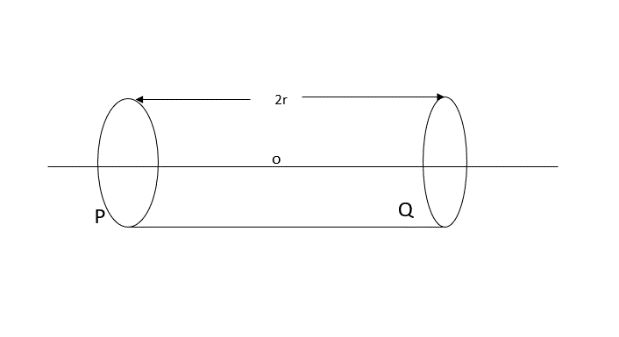
Two identical circular loops \[P\] and $Q$, each of radius \[r\] and carrying equal currents are kept in the parallel planes having a common axis passing through\[O\] . The direction of current in \[P\] is clockwise and in $Q$ is anti-clockwise as seen from \[O\], which is equidistant from the loops P and $Q$. Find the magnitude of the net magnetic field at \[O\].
Answer
 Verified
588.3k+ views
Hint: All magnetic fields are due to currents and due to intrinsic magnetic moments of particles. The relation between current and magnetic field produced by the current is given by the Biot Savart law. Know the relationship between the magnetic field, current, and radius by using Biot Savart law. Apply the logic magnetic field at \[P\] and $Q$. then add the two magnetic fields to obtain the net magnetic field.
Formula used:
$B = \dfrac{{{\mu _0}i{a^2}}}{{2{{\left( {{a^2} + {d^2}} \right)}^{\dfrac{3}{2}}}}}$
\[B\] is the magnetic field, $i$ is current, $a$ is the distance from the center of the loop.
Complete step to step solution:
The magnetic field produced due to a current-carrying segment is given by Biot Savart law. It is a vector quantity. In order to know the magnetic field produced at a point due to this small element, one can use Biot-Savart’s Law. According to Biot Savart law, the magnetic field depends is directly proportional to the current, is directly proportional to the length, and is inversely proportional to the square of the distance of the point from the element.
The formula to find the magnetic field at an axial point:
$B = \dfrac{{{\mu _0}i{a^2}}}{{2{{\left( {{a^2} + {d^2}} \right)}^{\dfrac{3}{2}}}}}$
Now let us consider current is flowing in \[P\] a loop. By using the right-hand thumb rule the direction of the magnetic field is towards left and the current in \[Q\] the loop, then the direction of the magnetic field is towards left. So, the net magnetic field at \[O\] is the sum of the magnetic field due to \[Q\] and \[P\] loops
$B = \dfrac{{{\mu _0}I{r^2}}}{{2{{\left( {{r^2} + {{\left( {\dfrac{{2r}}{2}} \right)}^2}} \right)}^{\dfrac{3}{2}}}}}$
Since the field produced is at the same distance as\[O\] ,${B_P} = {B_Q}$
Then the net magnetic field at \[O\]:
$B = {B_p} + {B_Q} = 2\dfrac{{{\mu _0}I}}{{{{\left( 2 \right)}^{\dfrac{5}{3}}}r}} = \dfrac{{{\mu _0}I}}{{{{\left( 2 \right)}^{\dfrac{3}{2}}}r}}$.
Note: Biot-Savart’s Law for the magnetic field has certain similarities as well as the difference with the coulomb's law. In Biot-Savart’s Law, the magnetic field is directly proportional to the sine of the angle. The magnetic field produced due to a current-carrying segment is given by Biot Savart law. Biot-Savart’s Law is a vector quantity.
Formula used:
$B = \dfrac{{{\mu _0}i{a^2}}}{{2{{\left( {{a^2} + {d^2}} \right)}^{\dfrac{3}{2}}}}}$
\[B\] is the magnetic field, $i$ is current, $a$ is the distance from the center of the loop.
Complete step to step solution:
The magnetic field produced due to a current-carrying segment is given by Biot Savart law. It is a vector quantity. In order to know the magnetic field produced at a point due to this small element, one can use Biot-Savart’s Law. According to Biot Savart law, the magnetic field depends is directly proportional to the current, is directly proportional to the length, and is inversely proportional to the square of the distance of the point from the element.
The formula to find the magnetic field at an axial point:
$B = \dfrac{{{\mu _0}i{a^2}}}{{2{{\left( {{a^2} + {d^2}} \right)}^{\dfrac{3}{2}}}}}$
Now let us consider current is flowing in \[P\] a loop. By using the right-hand thumb rule the direction of the magnetic field is towards left and the current in \[Q\] the loop, then the direction of the magnetic field is towards left. So, the net magnetic field at \[O\] is the sum of the magnetic field due to \[Q\] and \[P\] loops
$B = \dfrac{{{\mu _0}I{r^2}}}{{2{{\left( {{r^2} + {{\left( {\dfrac{{2r}}{2}} \right)}^2}} \right)}^{\dfrac{3}{2}}}}}$
Since the field produced is at the same distance as\[O\] ,${B_P} = {B_Q}$
Then the net magnetic field at \[O\]:
$B = {B_p} + {B_Q} = 2\dfrac{{{\mu _0}I}}{{{{\left( 2 \right)}^{\dfrac{5}{3}}}r}} = \dfrac{{{\mu _0}I}}{{{{\left( 2 \right)}^{\dfrac{3}{2}}}r}}$.
Note: Biot-Savart’s Law for the magnetic field has certain similarities as well as the difference with the coulomb's law. In Biot-Savart’s Law, the magnetic field is directly proportional to the sine of the angle. The magnetic field produced due to a current-carrying segment is given by Biot Savart law. Biot-Savart’s Law is a vector quantity.
Recently Updated Pages
Master Class 12 Social Science: Engaging Questions & Answers for Success

Master Class 12 Physics: Engaging Questions & Answers for Success
Master Class 12 Maths: Engaging Questions & Answers for Success
Master Class 12 Economics: Engaging Questions & Answers for Success
Master Class 12 Chemistry: Engaging Questions & Answers for Success
Master Class 12 Business Studies: Engaging Questions & Answers for Success
Trending doubts
Which are the Top 10 Largest Countries of the World?
Draw a labelled sketch of the human eye class 12 physics CBSE
Explain the structure of megasporangium class 12 biology CBSE
What are the major means of transport Explain each class 12 social science CBSE
How many chromosomes are found in human ovum a 46 b class 12 biology CBSE
The diagram of the section of a maize grain is given class 12 biology CBSE