




Two identical bar magnets, each having magnetic moment\[M\], are kept at a distance of $2d$ with their axes perpendicular to each other in a horizontal plane. Find the magnetic induction midway between them.
A. $(\sqrt 2 )$$\dfrac{{{\mu _0}}}{{4\pi }}\dfrac{M}{{{d^3}}}$
B. $(\sqrt 3 )$$\dfrac{{{\mu _0}}}{{4\pi }}\dfrac{M}{{{d^3}}}$
C. $\dfrac{{{\mu _0}}}{{4\pi }}\dfrac{M}{{{d^3}}}$
D. $(\sqrt 5 )$$\dfrac{{{\mu _0}}}{{4\pi }}\dfrac{M}{{{d^3}}}$
Answer
 Verified
563.7k+ views
Hint: As, Bar magnets consist of North pole(N) and South pole(S) and the direction of magnetic induction is always from N to S. We will find magnetic induction due to both bar magnets at mid-point of their axes and will add them using vector algebra.
Formula used:
Since, $B_1$ due to first bar magnet produce magnetic induction in its axial line hence,
$B_1 = \dfrac{{{\mu _0}}}{{4\pi }} \times \dfrac{{2M}}{{{d^3}}}$
Where, $M$ is the magnetic moment of each given bar magnet and ${\mu _0}$ is the vacuum permeability.
Complete step by step answer:
Let us first draw the diagram, consider two bar magnets having both magnetic moments $M$ lying perpendicular to each other at a distance of $2d$ . We will measure this distance from mid-point of the axial bar magnet to the equatorial bar magnet.
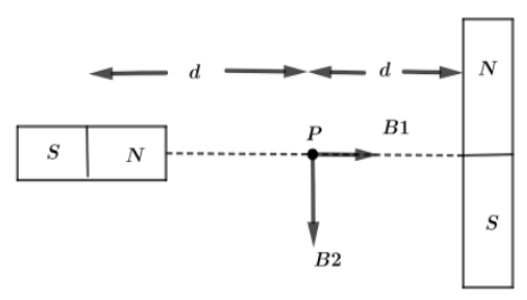
Here, $P$ is the midpoint of two bars lying perpendicular to each other and At this point, $B_1$ is the magnetic induction due to the first bar magnet in the given direction and $B_2$ is the magnetic induction due to the second bar magnet. Since $B_1$ and $B_2$ are perpendicular to each other so net magnetic induction at point $P$ can be calculated as
\[{B_p} = \sqrt {{{(B1)}^2} + {{(B2)}^2}} \].........{Vector addition formula for two perpendicular vectors}
Since, $B1$ due to first bar magnet produce magnetic induction in its axial line hence,
$B_1 = \dfrac{{{\mu _0}}}{{4\pi }} \times \dfrac{{2M}}{{{d^3}}}$
$B_2$ Is the magnetic induction due to the second bar on its equatorial line which is given by?
$B_1 = \dfrac{{{\mu _0}}}{{4\pi }} \times \dfrac{M}{{{d^3}}}$.
Now, net magnetic induction ${B_p}$ is given by
${B_p} = \dfrac{{{\mu _0}}}{{4\pi }} \times \dfrac{M}{{{d^3}}}\sqrt {{2^2} + {1^2}} $
$\therefore {B_p} = \sqrt 5 $$\dfrac{{{\mu _0}}}{{4\pi }} \times \dfrac{M}{{{d^3}}}$.
Hence, correct option is D.
Note:Remember, Magnetic field lines always originate from North Pole (N) and enters to South Pole (S) which shows the direction of magnetic field from N to S but it’s important to note that inside the bar magnet the direction of magnetic induction is always from South Pole (S) to North Pole (N).
Formula used:
Since, $B_1$ due to first bar magnet produce magnetic induction in its axial line hence,
$B_1 = \dfrac{{{\mu _0}}}{{4\pi }} \times \dfrac{{2M}}{{{d^3}}}$
Where, $M$ is the magnetic moment of each given bar magnet and ${\mu _0}$ is the vacuum permeability.
Complete step by step answer:
Let us first draw the diagram, consider two bar magnets having both magnetic moments $M$ lying perpendicular to each other at a distance of $2d$ . We will measure this distance from mid-point of the axial bar magnet to the equatorial bar magnet.
Here, $P$ is the midpoint of two bars lying perpendicular to each other and At this point, $B_1$ is the magnetic induction due to the first bar magnet in the given direction and $B_2$ is the magnetic induction due to the second bar magnet. Since $B_1$ and $B_2$ are perpendicular to each other so net magnetic induction at point $P$ can be calculated as
\[{B_p} = \sqrt {{{(B1)}^2} + {{(B2)}^2}} \].........{Vector addition formula for two perpendicular vectors}
Since, $B1$ due to first bar magnet produce magnetic induction in its axial line hence,
$B_1 = \dfrac{{{\mu _0}}}{{4\pi }} \times \dfrac{{2M}}{{{d^3}}}$
$B_2$ Is the magnetic induction due to the second bar on its equatorial line which is given by?
$B_1 = \dfrac{{{\mu _0}}}{{4\pi }} \times \dfrac{M}{{{d^3}}}$.
Now, net magnetic induction ${B_p}$ is given by
${B_p} = \dfrac{{{\mu _0}}}{{4\pi }} \times \dfrac{M}{{{d^3}}}\sqrt {{2^2} + {1^2}} $
$\therefore {B_p} = \sqrt 5 $$\dfrac{{{\mu _0}}}{{4\pi }} \times \dfrac{M}{{{d^3}}}$.
Hence, correct option is D.
Note:Remember, Magnetic field lines always originate from North Pole (N) and enters to South Pole (S) which shows the direction of magnetic field from N to S but it’s important to note that inside the bar magnet the direction of magnetic induction is always from South Pole (S) to North Pole (N).
Recently Updated Pages
Master Class 12 Business Studies: Engaging Questions & Answers for Success

Master Class 12 Chemistry: Engaging Questions & Answers for Success
Master Class 12 Biology: Engaging Questions & Answers for Success
Class 12 Question and Answer - Your Ultimate Solutions Guide
Master Class 11 English: Engaging Questions & Answers for Success
Master Class 11 Social Science: Engaging Questions & Answers for Success
Trending doubts
Which are the Top 10 Largest Countries of the World?
Draw a labelled sketch of the human eye class 12 physics CBSE
Differentiate between homogeneous and heterogeneous class 12 chemistry CBSE
Differentiate between Pyramid of energy and pyramid class 12 biology CBSE
Why is the cell called the structural and functional class 12 biology CBSE
Draw the diagram of the pyramid of energy Explain In class 12 biology CBSE