




Two fixed charges A and B of $ 5\mu C $ each are separated by a distance of 6 m. C is the mid point of the line joining A and B. A charge 'Q' of $ -5\mu C $ is shot perpendicular to the line joining A and B through C with a kinetic energy of 0.06 J. The charge 'Q' comes to rest at a point D. The distance CD is :
$ \begin{align}
& \text{A}\text{. 3m} \\
& \text{B}\text{. }\sqrt{3}\text{m} \\
& \text{C}\text{. 3}\sqrt{3}\text{m} \\
& \text{D}\text{. 4m} \\
\end{align} $
Answer
 Verified
609.3k+ views
Hint: First try to draw the diagram as given in the question, Now try to find the initial potential energy in the system. After we get the initial potential energy, we have to find the total initial energy of the system. Now, apply the law of conservation of energy and find the magnitude of one side of the triangle formed. From that side apply the Pythagoras theorem to get the required value.
Formula used:
$ U=K\left( \dfrac{{{Q}_{1}}{{Q}_{2}}}{{{r}_{12}}}+\dfrac{{{Q}_{2}}{{Q}_{3}}}{{{r}_{23}}}+\dfrac{{{Q}_{3}}{{Q}_{1}}}{{{r}_{13}}} \right) $
E = U + K . E
\[\text{hypotenus}{{\text{e}}^{2}}=\text{ perpendicula}{{\text{r}}^{2}}\text{ + bas}{{\text{e}}^{2}}\]
Complete step-by-step answer:
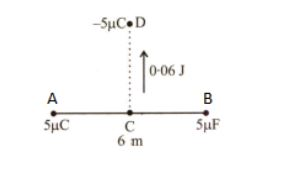
Here in the above diagram we see that, at two points A and B we see a charge of $ 5\mu C $ , and the distance between the two charges are 6 m, now at point D a charge of $ -5\mu C $ , is shot just perpendicular to the midpoint of charge AB with a kinetic energy of 0.06 J.
Now according to the problem,
Initial potential energy of the system must be,
$ U=K\left( \dfrac{{{Q}_{1}}{{Q}_{2}}}{{{r}_{12}}}+\dfrac{{{Q}_{2}}{{Q}_{3}}}{{{r}_{23}}}+\dfrac{{{Q}_{3}}{{Q}_{1}}}{{{r}_{13}}} \right) $ , K=constant. $ U=9\times {{10}^{9}}\left( \dfrac{5\times {{10}^{-6}}\times 5\times {{10}^{-6}}}{6}+\dfrac{5\times {{10}^{-6}}\times -5\times {{10}^{-6}}}{3}+\dfrac{5\times {{10}^{-6}}\times -5\times {{10}^{-6}}}{3} \right) $ , now substituting the values with,
(K= $ 9\times {{10}^{9}} $ , $ {{Q}_{1}}=5\times {{10}^{-6}} $ , $ {{Q}_{2}}=5\times {{10}^{-6}} $ , $ {{Q}_{3}}=-5\times {{10}^{-6}} $ ),
On solving this we get the initial potential energy as, U= -0.1125 J
Therefore we know that the system already has a kinetic energy of 0.06J, so the total initial energy of the system is,
E = U + K . E,
E = -0.1125 + 0.06 = -0.0525 J.
Now, at D, the charge $ -5\mu C $ comes to rest, so we can say that the total energy is equal to the potential energy at that point.
Now if we extend two lines from ‘A’ and ‘B’ to point D.
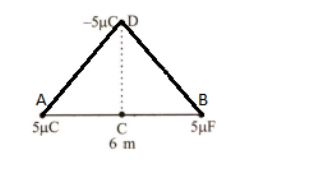
Now by using symmetry, we can say that AD=BD.
On, applying law of conservation of energy,
$ -0.0525=9\times {{10}^{9}}\left( \dfrac{5\times {{10}^{-6}}\times 5\times {{10}^{-6}}}{6}+\dfrac{5\times {{10}^{-6}}\times -5\times {{10}^{-6}}}{AD}+\dfrac{5\times {{10}^{-6}}\times -5\times {{10}^{-6}}}{BD} \right) $ ,
Therefore on solving the above equation, we get AD=5m
If we apply Pythagoras theorem, we get
$ \text{A}{{\text{D}}^{2}}\text{=A}{{\text{C}}^{2}}\text{+C}{{\text{D}}^{2}} $
$ {{\text{5}}^{2}}\text{=}{{\text{3}}^{2}}\text{+C}{{\text{D}}^{2}} $
CD= 4 m
So, the correct answer is “Option D”.
Note: In the formula for initial potential energy, k is the proportionality constant known as coulomb’s law constant, this value totally depends on the medium in which the charged objects are placed. Pythagoras theorem states that,
\[\text{hypotenus}{{\text{e}}^{2}}=\text{ perpendicula}{{\text{r}}^{2}}\text{ + bas}{{\text{e}}^{2}}\] .
Formula used:
$ U=K\left( \dfrac{{{Q}_{1}}{{Q}_{2}}}{{{r}_{12}}}+\dfrac{{{Q}_{2}}{{Q}_{3}}}{{{r}_{23}}}+\dfrac{{{Q}_{3}}{{Q}_{1}}}{{{r}_{13}}} \right) $
E = U + K . E
\[\text{hypotenus}{{\text{e}}^{2}}=\text{ perpendicula}{{\text{r}}^{2}}\text{ + bas}{{\text{e}}^{2}}\]
Complete step-by-step answer:
Here in the above diagram we see that, at two points A and B we see a charge of $ 5\mu C $ , and the distance between the two charges are 6 m, now at point D a charge of $ -5\mu C $ , is shot just perpendicular to the midpoint of charge AB with a kinetic energy of 0.06 J.
Now according to the problem,
Initial potential energy of the system must be,
$ U=K\left( \dfrac{{{Q}_{1}}{{Q}_{2}}}{{{r}_{12}}}+\dfrac{{{Q}_{2}}{{Q}_{3}}}{{{r}_{23}}}+\dfrac{{{Q}_{3}}{{Q}_{1}}}{{{r}_{13}}} \right) $ , K=constant. $ U=9\times {{10}^{9}}\left( \dfrac{5\times {{10}^{-6}}\times 5\times {{10}^{-6}}}{6}+\dfrac{5\times {{10}^{-6}}\times -5\times {{10}^{-6}}}{3}+\dfrac{5\times {{10}^{-6}}\times -5\times {{10}^{-6}}}{3} \right) $ , now substituting the values with,
(K= $ 9\times {{10}^{9}} $ , $ {{Q}_{1}}=5\times {{10}^{-6}} $ , $ {{Q}_{2}}=5\times {{10}^{-6}} $ , $ {{Q}_{3}}=-5\times {{10}^{-6}} $ ),
On solving this we get the initial potential energy as, U= -0.1125 J
Therefore we know that the system already has a kinetic energy of 0.06J, so the total initial energy of the system is,
E = U + K . E,
E = -0.1125 + 0.06 = -0.0525 J.
Now, at D, the charge $ -5\mu C $ comes to rest, so we can say that the total energy is equal to the potential energy at that point.
Now if we extend two lines from ‘A’ and ‘B’ to point D.
Now by using symmetry, we can say that AD=BD.
On, applying law of conservation of energy,
$ -0.0525=9\times {{10}^{9}}\left( \dfrac{5\times {{10}^{-6}}\times 5\times {{10}^{-6}}}{6}+\dfrac{5\times {{10}^{-6}}\times -5\times {{10}^{-6}}}{AD}+\dfrac{5\times {{10}^{-6}}\times -5\times {{10}^{-6}}}{BD} \right) $ ,
Therefore on solving the above equation, we get AD=5m
If we apply Pythagoras theorem, we get
$ \text{A}{{\text{D}}^{2}}\text{=A}{{\text{C}}^{2}}\text{+C}{{\text{D}}^{2}} $
$ {{\text{5}}^{2}}\text{=}{{\text{3}}^{2}}\text{+C}{{\text{D}}^{2}} $
CD= 4 m
So, the correct answer is “Option D”.
Note: In the formula for initial potential energy, k is the proportionality constant known as coulomb’s law constant, this value totally depends on the medium in which the charged objects are placed. Pythagoras theorem states that,
\[\text{hypotenus}{{\text{e}}^{2}}=\text{ perpendicula}{{\text{r}}^{2}}\text{ + bas}{{\text{e}}^{2}}\] .
Recently Updated Pages
Master Class 12 Social Science: Engaging Questions & Answers for Success

Master Class 12 Physics: Engaging Questions & Answers for Success
Master Class 12 Maths: Engaging Questions & Answers for Success
Master Class 12 Economics: Engaging Questions & Answers for Success
Master Class 12 Chemistry: Engaging Questions & Answers for Success
Master Class 12 Business Studies: Engaging Questions & Answers for Success
Trending doubts
Which are the Top 10 Largest Countries of the World?
Draw a labelled sketch of the human eye class 12 physics CBSE
Explain the structure of megasporangium class 12 biology CBSE
What are the major means of transport Explain each class 12 social science CBSE
How many chromosomes are found in human ovum a 46 b class 12 biology CBSE
The diagram of the section of a maize grain is given class 12 biology CBSE