




Two equal forces \[\overrightarrow{F}\] each act at a right angles to each other. The third force which can neutralize their effect is:
\[\begin{align}
& \text{A) }\sqrt{2}F\text{,in the same plane of two forces}\text{.} \\
& \text{B) }\sqrt{2}F\text{,in the different plane of the two forces}\text{.} \\
& \text{C) 2}F\text{,in the same plane of two forces}\text{.} \\
& \text{D) 2}F\text{,in the different plane of two forces}\text{.} \\
\end{align}\]
Answer
 Verified
611.4k+ views
Hint: We have been given that two equal forces act at the right angle to each other and we have to find the third force which can neutralize their effect on each other. First, we will draw a simple diagram and then discuss the given situation and find the answer to it. From the option, we can say that we have to find answers in terms of F.
Complete step-by-step solution
Let us draw a simple diagram for the given question.
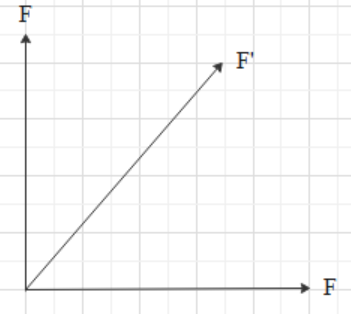
Here we can see there are two forces of magnitude F which are acted at right angles to each other. The force F’ is the resultant force, and this resultant force will neutralize the effect of both forces having magnitude F.
Now the resultant force F’ can be given by addition of vectors, hence we can write
\[\begin{align}
& F'=\sqrt{{{\left( F \right)}^{2}}+{{\left( F \right)}^{2}}} \\
& \Rightarrow F'=\sqrt{2{{F}^{2}}} \\
& \Rightarrow F'=\sqrt{2}F \\
\end{align}\]
Now as the force are acted at right angles therefore the resultant force will be acting in the same plane as the plane of two forces.
Hence the magnitude of the force, which can neutralize the effect of F is \[\sqrt{2}F\], in the same plane of the two forces.
Hence option A is the correct answer.
Note: The force is a vector quantity, which has both directions as well as magnitude. Therefore, here we have used the addition of vectors to find the resultant force. As mentioned above \[\sqrt{2}F\]is the magnitude and it does not give the direction in which the force is acted. Note that these forces are not acting on each other it is acted on somebody.
Complete step-by-step solution
Let us draw a simple diagram for the given question.
Here we can see there are two forces of magnitude F which are acted at right angles to each other. The force F’ is the resultant force, and this resultant force will neutralize the effect of both forces having magnitude F.
Now the resultant force F’ can be given by addition of vectors, hence we can write
\[\begin{align}
& F'=\sqrt{{{\left( F \right)}^{2}}+{{\left( F \right)}^{2}}} \\
& \Rightarrow F'=\sqrt{2{{F}^{2}}} \\
& \Rightarrow F'=\sqrt{2}F \\
\end{align}\]
Now as the force are acted at right angles therefore the resultant force will be acting in the same plane as the plane of two forces.
Hence the magnitude of the force, which can neutralize the effect of F is \[\sqrt{2}F\], in the same plane of the two forces.
Hence option A is the correct answer.
Note: The force is a vector quantity, which has both directions as well as magnitude. Therefore, here we have used the addition of vectors to find the resultant force. As mentioned above \[\sqrt{2}F\]is the magnitude and it does not give the direction in which the force is acted. Note that these forces are not acting on each other it is acted on somebody.
Recently Updated Pages
Master Class 11 Social Science: Engaging Questions & Answers for Success

Master Class 11 Chemistry: Engaging Questions & Answers for Success
Master Class 12 Business Studies: Engaging Questions & Answers for Success
Master Class 12 Chemistry: Engaging Questions & Answers for Success
Master Class 12 Biology: Engaging Questions & Answers for Success
Class 12 Question and Answer - Your Ultimate Solutions Guide
Trending doubts
How many of the following diseases can be studied with class 11 biology CBSE
Which of the following enzymes is used for carboxylation class 11 biology CBSE
Explain zero factorial class 11 maths CBSE
Draw a diagram of a plant cell and label at least eight class 11 biology CBSE
Receptor sites for neurotransmitters are present on class 11 biology CBSE
JGA JuxtaGlomerular Apparatus a sensitive region which class 11 biology CBSE