




Two equal and opposite charges are placed at a certain distance. The force between them is F. If 25% of one charge is transferred to other, then the force between them is:
\[\begin{align}
& \text{A}\text{. F} \\
& \text{B}\text{. }\dfrac{9F}{16} \\
& \text{C}\text{. }\dfrac{15F}{16} \\
& \text{D}\text{. }\dfrac{4F}{15} \\
\end{align}\]
Answer
 Verified
601.5k+ views
Hint: It is given that two equal and opposite charges are placed at a certain distance therefore they will have Coulomb’s force of attraction. Hence by using Coulomb's law we can solve the given question. Here will get two equations one when the charges are equal and second when 25% of one charge is transferred to another charge.
Formula used:
\[F=\dfrac{1}{4\pi {{\varepsilon }_{0}}}\dfrac{{{q}_{1}}{{q}_{2}}}{{{r}^{2}}}\]
Complete step by step answer:
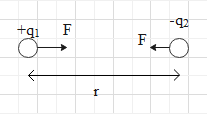
If two charges \[{{q}_{1}}\text{ and }{{q}_{2}}\] are separated by a distance r then according to Coulomb’s law the force between them is given by
\[F=\dfrac{1}{4\pi {{\varepsilon }_{0}}}\dfrac{{{q}_{1}}{{q}_{2}}}{{{r}^{2}}}\]
Here \[{{\varepsilon }_{0}}\]is permittivity in free space.
Now according to question the charges are equal therefore we can write
\[{{q}_{1}}={{q}_{2}}=q\]
Hence force between them is given as
\[\begin{align}
& F=\dfrac{1}{4\pi {{\varepsilon }_{0}}}\dfrac{qq}{{{r}^{2}}} \\
& \Rightarrow F=\dfrac{1}{4\pi {{\varepsilon }_{0}}}\dfrac{{{q}^{2}}}{{{r}^{2}}}\text{ }................\text{(i)} \\
\end{align}\]
Now if \[{{q}_{1}}\] transfers its 25% of charge to \[{{q}_{2}}\]i.e.
\[25\%\text{ of }q\text{ is }\dfrac{25q}{100}=\dfrac{q}{4}\]
Then the charges on \[{{q}_{1}}\text{ and }{{q}_{2}}\]can be given as
\[\begin{align}
& {{q}_{1}}=q-\dfrac{q}{4}\text{ and }{{q}_{2}}=q+\dfrac{q}{4} \\
& \Rightarrow {{q}_{1}}=\dfrac{3q}{4}\text{ and }{{q}_{2}}=\dfrac{5q}{4} \\
\end{align}\]
Now the force is given as
\[\begin{align}
& F'=\dfrac{1}{4\pi {{\varepsilon }_{0}}}\dfrac{\left( \dfrac{3q}{4} \right)\left( \dfrac{5q}{4} \right)}{{{r}^{2}}} \\
& \Rightarrow F'=\dfrac{1}{4\pi {{\varepsilon }_{0}}}\dfrac{15{{q}^{2}}}{16{{r}^{2}}} \\
\end{align}\]
Comparing the above equation with equation (i), we can write
\[\begin{align}
& \Rightarrow F'=\dfrac{15}{16}\left( \dfrac{1}{4\pi {{\varepsilon }_{0}}}\dfrac{{{q}^{2}}}{{{r}^{2}}} \right) \\
& \Rightarrow F'=\dfrac{15}{16}F \\
\end{align}\]
So, the correct answer is “Option C”.
Note:
The diagram used here is for the opposite charges in case of like charges the direction of the force will be in the opposite direction. Also, here it is a force of attraction as the charges are opposite, in case of like charges the force will be a repulsive force. We have ignored the charges i.e. negative or positive charge here, taking that in account there will be negative signs for attractive force and positive for repulsive force.
Formula used:
\[F=\dfrac{1}{4\pi {{\varepsilon }_{0}}}\dfrac{{{q}_{1}}{{q}_{2}}}{{{r}^{2}}}\]
Complete step by step answer:
If two charges \[{{q}_{1}}\text{ and }{{q}_{2}}\] are separated by a distance r then according to Coulomb’s law the force between them is given by
\[F=\dfrac{1}{4\pi {{\varepsilon }_{0}}}\dfrac{{{q}_{1}}{{q}_{2}}}{{{r}^{2}}}\]
Here \[{{\varepsilon }_{0}}\]is permittivity in free space.
Now according to question the charges are equal therefore we can write
\[{{q}_{1}}={{q}_{2}}=q\]
Hence force between them is given as
\[\begin{align}
& F=\dfrac{1}{4\pi {{\varepsilon }_{0}}}\dfrac{qq}{{{r}^{2}}} \\
& \Rightarrow F=\dfrac{1}{4\pi {{\varepsilon }_{0}}}\dfrac{{{q}^{2}}}{{{r}^{2}}}\text{ }................\text{(i)} \\
\end{align}\]
Now if \[{{q}_{1}}\] transfers its 25% of charge to \[{{q}_{2}}\]i.e.
\[25\%\text{ of }q\text{ is }\dfrac{25q}{100}=\dfrac{q}{4}\]
Then the charges on \[{{q}_{1}}\text{ and }{{q}_{2}}\]can be given as
\[\begin{align}
& {{q}_{1}}=q-\dfrac{q}{4}\text{ and }{{q}_{2}}=q+\dfrac{q}{4} \\
& \Rightarrow {{q}_{1}}=\dfrac{3q}{4}\text{ and }{{q}_{2}}=\dfrac{5q}{4} \\
\end{align}\]
Now the force is given as
\[\begin{align}
& F'=\dfrac{1}{4\pi {{\varepsilon }_{0}}}\dfrac{\left( \dfrac{3q}{4} \right)\left( \dfrac{5q}{4} \right)}{{{r}^{2}}} \\
& \Rightarrow F'=\dfrac{1}{4\pi {{\varepsilon }_{0}}}\dfrac{15{{q}^{2}}}{16{{r}^{2}}} \\
\end{align}\]
Comparing the above equation with equation (i), we can write
\[\begin{align}
& \Rightarrow F'=\dfrac{15}{16}\left( \dfrac{1}{4\pi {{\varepsilon }_{0}}}\dfrac{{{q}^{2}}}{{{r}^{2}}} \right) \\
& \Rightarrow F'=\dfrac{15}{16}F \\
\end{align}\]
So, the correct answer is “Option C”.
Note:
The diagram used here is for the opposite charges in case of like charges the direction of the force will be in the opposite direction. Also, here it is a force of attraction as the charges are opposite, in case of like charges the force will be a repulsive force. We have ignored the charges i.e. negative or positive charge here, taking that in account there will be negative signs for attractive force and positive for repulsive force.
Recently Updated Pages
Master Class 12 Social Science: Engaging Questions & Answers for Success

Master Class 12 Physics: Engaging Questions & Answers for Success
Master Class 12 Maths: Engaging Questions & Answers for Success
Master Class 12 Economics: Engaging Questions & Answers for Success
Master Class 12 Chemistry: Engaging Questions & Answers for Success
Master Class 12 Business Studies: Engaging Questions & Answers for Success
Trending doubts
Which are the Top 10 Largest Countries of the World?
Draw a labelled sketch of the human eye class 12 physics CBSE
Explain the structure of megasporangium class 12 biology CBSE
What are the major means of transport Explain each class 12 social science CBSE
How many chromosomes are found in human ovum a 46 b class 12 biology CBSE
The diagram of the section of a maize grain is given class 12 biology CBSE