




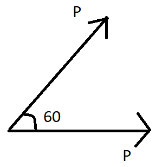
Two electric dipoles each of dipole moment $P$ are placed as shown in the figure.The net dipole moment of system of dipole is
A. $P$
B. $2P$
C. $\dfrac{P}{{\sqrt 3 }}$
D. $\sqrt 3 P$
Answer
 Verified
541.5k+ views
Hint: Electric dipole is defined as the two equal and opposite charges separated by a small distance whereas electric dipole moment is defined as the product of the magnitude of either charge and the dipole length. Electric dipole is a scalar quantity whereas electric dipole moment is a vector quantity the direction of electric dipole moment is from negative charge to positive charge and it is given by the symbol $P$ . In this problem we need to find the net dipole moment in which the two dipole moments are at an angle ${60^ \circ }$ .
Formula used:
The net dipole moment is given by,
\[{P_{net}} = \sqrt {P_1^2 + P_2^2 + 2 \times {P_1} \times {P_2} \times \cos \theta } \]
Where, ${P_1}$ and ${P_2}$ are the electric dipole moment.
$\theta = $ Angle between two electric dipole moments.
Complete step by step answer:
The net dipole moment is given as
\[{P_{net}} = \sqrt {P_1^2 + P_2^2 + 2 \times {P_1} \times {P_2} \times \cos \theta } \] ……….. $\left( 1 \right)$
Given:- ${P_1} = {P_2} = P$
$\theta = {60^ \circ }$
Substituting the given data in equation $\left( 1 \right)$ we get
\[{P_{net}} = \sqrt {{P^2} + {P^2} + 2 \times P \times P \times \cos \theta } \]
\[\Rightarrow {P_{net}} = \sqrt {{P^2} + {P^2} + 2 \times P \times P \times \cos 60} \]
On simplifying the above equation we get
\[{P_{net}} = \sqrt {2{P^2} + 2 \times {P^2} \times \dfrac{1}{2}} \]
\[\Rightarrow {P_{net}} = \sqrt {2{P^2} + {P^2}} \]
\[\therefore {P_{net}} = \sqrt {3{P^2}} \]
Therefore, \[{P_{net}} = \sqrt 3 P\]
Hence, option D is correct.
Note: Total charge of the electric dipole is zero because the electric dipole consists of two equal and opposite charges. But the electric field of the dipole is not equal to zero because charges $q$ and $ - q$ are separated by a small distance and when the electric field due to charge is added is not zero. Electric dipole moment gives the electric polarity of the system of charges and the conventional direction of the electric dipole moment is from a negative charge to the positive. The $S.I$ unit for electric dipole moment is coulomb metre $\left( {Cm} \right)$.
Formula used:
The net dipole moment is given by,
\[{P_{net}} = \sqrt {P_1^2 + P_2^2 + 2 \times {P_1} \times {P_2} \times \cos \theta } \]
Where, ${P_1}$ and ${P_2}$ are the electric dipole moment.
$\theta = $ Angle between two electric dipole moments.
Complete step by step answer:
The net dipole moment is given as
\[{P_{net}} = \sqrt {P_1^2 + P_2^2 + 2 \times {P_1} \times {P_2} \times \cos \theta } \] ……….. $\left( 1 \right)$
Given:- ${P_1} = {P_2} = P$
$\theta = {60^ \circ }$
Substituting the given data in equation $\left( 1 \right)$ we get
\[{P_{net}} = \sqrt {{P^2} + {P^2} + 2 \times P \times P \times \cos \theta } \]
\[\Rightarrow {P_{net}} = \sqrt {{P^2} + {P^2} + 2 \times P \times P \times \cos 60} \]
On simplifying the above equation we get
\[{P_{net}} = \sqrt {2{P^2} + 2 \times {P^2} \times \dfrac{1}{2}} \]
\[\Rightarrow {P_{net}} = \sqrt {2{P^2} + {P^2}} \]
\[\therefore {P_{net}} = \sqrt {3{P^2}} \]
Therefore, \[{P_{net}} = \sqrt 3 P\]
Hence, option D is correct.
Note: Total charge of the electric dipole is zero because the electric dipole consists of two equal and opposite charges. But the electric field of the dipole is not equal to zero because charges $q$ and $ - q$ are separated by a small distance and when the electric field due to charge is added is not zero. Electric dipole moment gives the electric polarity of the system of charges and the conventional direction of the electric dipole moment is from a negative charge to the positive. The $S.I$ unit for electric dipole moment is coulomb metre $\left( {Cm} \right)$.
Recently Updated Pages
Master Class 12 Business Studies: Engaging Questions & Answers for Success

Master Class 12 Biology: Engaging Questions & Answers for Success
Master Class 12 Chemistry: Engaging Questions & Answers for Success
Class 12 Question and Answer - Your Ultimate Solutions Guide
Master Class 11 Social Science: Engaging Questions & Answers for Success
Master Class 11 English: Engaging Questions & Answers for Success
Trending doubts
Which are the Top 10 Largest Countries of the World?
Draw a labelled sketch of the human eye class 12 physics CBSE
Name the crygenes that control cotton bollworm and class 12 biology CBSE
Differentiate between homogeneous and heterogeneous class 12 chemistry CBSE
Ribosomal RNA is actively synthesised in A Nucleoplasm class 12 biology CBSE
How many molecules of ATP and NADPH are required information class 12 biology CBSE