




Two dipoles each of moment $5 \times {10^{ - 12}}Cm$ form a cross with their axis (- to +) along the coordinate axes. The potential at a point $20cm$ away in a direction making an angle of ${30^ \circ }$ with axis is
A. 1.12 V
B. 2.12 V
C. 2.4 V
D. 1.536 V
Answer
 Verified
623.4k+ views
Hint: Electric dipole is defined as the separation of positive and negative charges. Electric potential energy is defined as the amount of work needed to move a unit positive charge from a point to a specific point in an electric field. We will find the electric potential due to both of the dipoles then find the required solution which is the potential at a point $20cm$ away in a direction making an angle of ${30^ \circ }$ with the axis.
Formula Used:
$V = \dfrac{1}{{4\pi {\varepsilon _ \circ }}}\dfrac{{p\cos \theta }}{{{r^2}}}$
Complete answer:
We will create a rough diagram of the two dipoles which are crossing each other for a better understanding of the given question.
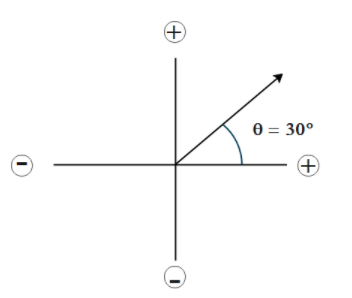
An electric potential due to dipole at a point which is far away from the dipole is given as,
$V = \dfrac{1}{{4\pi {\varepsilon _ \circ }}}\dfrac{{p\cos \theta }}{{{r^2}}}$
where V represents the electric potential,
and p represents the dipole moment.
Now, electric potential due to first dipole is given by,
${V_1} = \dfrac{1}{{4\pi {\varepsilon _ \circ }}}\dfrac{{p\cos \theta }}{{{r^2}}}$ ; where it is given that $\theta = {30^ \circ }$
$ \Rightarrow {V_1} = \dfrac{1}{{4\pi {\varepsilon _ \circ }}}\dfrac{{p\cos \left( {{{30}^ \circ }} \right)}}{{{r^2}}}$
$ \Rightarrow {V_1} = \dfrac{{9 \times {{10}^9} \times 5 \times {{10}^{ - 12}} \times \cos {{30}^ \circ }}}{{{{\left( {0.2} \right)}^2}}}$
${V_1} = 0.97425V$
Similarly, electric potential due to second dipole is given by,
${V_2} = \dfrac{1}{{4\pi {\varepsilon _ \circ }}}\dfrac{{p\cos \theta }}{{{r^2}}}$; where value of ‘$\theta $’ will be $\theta = 270 + {30^ \circ }$
$ \Rightarrow {V_2} = \dfrac{1}{{4\pi {\varepsilon _ \circ }}}\dfrac{{p\cos \left( {{{270}^ \circ } + {{30}^ \circ }} \right)}}{{{r^2}}}$
Now, we know that $\cos \left( {{{270}^ \circ } + \theta } \right) = \sin \theta $
So,
$ \Rightarrow {V_2} = \dfrac{{9 \times {{10}^9} \times 5 \times {{10}^{ - 12}} \times \sin {{30}^ \circ }}}{{{{\left( {0.2} \right)}^2}}}$
${V_2} = 0.5625V$
Thus, total potential of the two dipoles is given by,
$ \Rightarrow V = {V_1} + {V_2}$
$ = \left( {0.97425 + 0.5625} \right)V = 1.536V$
Therefore, the potential at a point $20cm$ away in a direction making an angle of ${30^ \circ }$ with axis is 1.536V.
Hence, option (D) is the correct answer.
Note:
Electric dipole is known as the couple of opposite charges q and -q which is separated by distance ‘r’. An electric dipole moment is defined as the product of the magnitude of the charge and the distance between the centres of the positive and negative charges.
Mathematically it is given as, $\mu = Q \times r$
Where ‘Q’ is expressed as the charge and ‘r’ is the distance.
Formula Used:
$V = \dfrac{1}{{4\pi {\varepsilon _ \circ }}}\dfrac{{p\cos \theta }}{{{r^2}}}$
Complete answer:
We will create a rough diagram of the two dipoles which are crossing each other for a better understanding of the given question.
An electric potential due to dipole at a point which is far away from the dipole is given as,
$V = \dfrac{1}{{4\pi {\varepsilon _ \circ }}}\dfrac{{p\cos \theta }}{{{r^2}}}$
where V represents the electric potential,
and p represents the dipole moment.
Now, electric potential due to first dipole is given by,
${V_1} = \dfrac{1}{{4\pi {\varepsilon _ \circ }}}\dfrac{{p\cos \theta }}{{{r^2}}}$ ; where it is given that $\theta = {30^ \circ }$
$ \Rightarrow {V_1} = \dfrac{1}{{4\pi {\varepsilon _ \circ }}}\dfrac{{p\cos \left( {{{30}^ \circ }} \right)}}{{{r^2}}}$
$ \Rightarrow {V_1} = \dfrac{{9 \times {{10}^9} \times 5 \times {{10}^{ - 12}} \times \cos {{30}^ \circ }}}{{{{\left( {0.2} \right)}^2}}}$
${V_1} = 0.97425V$
Similarly, electric potential due to second dipole is given by,
${V_2} = \dfrac{1}{{4\pi {\varepsilon _ \circ }}}\dfrac{{p\cos \theta }}{{{r^2}}}$; where value of ‘$\theta $’ will be $\theta = 270 + {30^ \circ }$
$ \Rightarrow {V_2} = \dfrac{1}{{4\pi {\varepsilon _ \circ }}}\dfrac{{p\cos \left( {{{270}^ \circ } + {{30}^ \circ }} \right)}}{{{r^2}}}$
Now, we know that $\cos \left( {{{270}^ \circ } + \theta } \right) = \sin \theta $
So,
$ \Rightarrow {V_2} = \dfrac{{9 \times {{10}^9} \times 5 \times {{10}^{ - 12}} \times \sin {{30}^ \circ }}}{{{{\left( {0.2} \right)}^2}}}$
${V_2} = 0.5625V$
Thus, total potential of the two dipoles is given by,
$ \Rightarrow V = {V_1} + {V_2}$
$ = \left( {0.97425 + 0.5625} \right)V = 1.536V$
Therefore, the potential at a point $20cm$ away in a direction making an angle of ${30^ \circ }$ with axis is 1.536V.
Hence, option (D) is the correct answer.
Note:
Electric dipole is known as the couple of opposite charges q and -q which is separated by distance ‘r’. An electric dipole moment is defined as the product of the magnitude of the charge and the distance between the centres of the positive and negative charges.
Mathematically it is given as, $\mu = Q \times r$
Where ‘Q’ is expressed as the charge and ‘r’ is the distance.
Recently Updated Pages
Master Class 12 Business Studies: Engaging Questions & Answers for Success

Master Class 12 Chemistry: Engaging Questions & Answers for Success
Master Class 12 Biology: Engaging Questions & Answers for Success
Class 12 Question and Answer - Your Ultimate Solutions Guide
Master Class 11 English: Engaging Questions & Answers for Success
Master Class 11 Social Science: Engaging Questions & Answers for Success
Trending doubts
Which are the Top 10 Largest Countries of the World?
Draw a labelled sketch of the human eye class 12 physics CBSE
Differentiate between homogeneous and heterogeneous class 12 chemistry CBSE
Differentiate between Pyramid of energy and pyramid class 12 biology CBSE
Why is the cell called the structural and functional class 12 biology CBSE
Draw the diagram of the pyramid of energy Explain In class 12 biology CBSE