




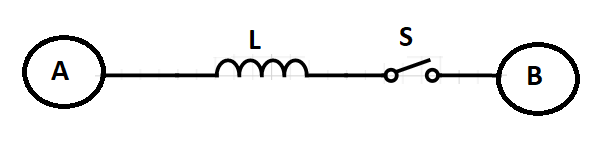
Two conducting spheres of radius $R$ are placed at a large distance from each other. They are connected by a coil of inductance $L$, as shown in the figure. Sphere A is given a charge of $Q$ and the switch ‘S’ is closed at time $t = 0$. Find charge on sphere B as a function of time. At what time charge on B is $\dfrac{Q}{2}$?
Answer
 Verified
502.5k+ views
Hint: The spherical capacitor of any conducting solid sphere of radius $R$ is $C = 4\pi {\varepsilon _0}R$. Where ${\varepsilon _0}$ is the permittivity of free space.
The potential on the surface of a conducting sphere is $V = \dfrac{Q}{{4\pi {\varepsilon _0}R}}$. Where $Q$ is the total charge on the surface of the sphere.
Find the potential difference across the inductor. Then you will get a familiar differential equation like $\dfrac{{{d^2}x}}{{d{t^2}}} + ax = 0$. The general solution of this equation is $x = A\cos at + B\sin at$. Now find the values of $A$ and $B$ by the application of the initial condition.
Complete step by step answer:
It is given that the radius of the two conducting spheres A and B is $R$.
The charge on sphere A is $Q$.
The sphere A and B are connected through an inductor of inductance $L$.
Switch S is closed at time $t = 0$
Consider the charge on the sphere B is $Q'$ at a time $t = t$
The charge on the sphere A at the same time $t = t$ is $Q - Q'$
The current through the inductor is $i = \dfrac{{dQ'}}{{dt}}$
The potential on the surface of the sphere A, ${V_A} = \dfrac{{Q - Q'}}{{4\pi {\varepsilon _0}R}}$
The potential on the surface of the sphere B, ${V_B} = \dfrac{{Q'}}{{4\pi {\varepsilon _0}R}}$
Both the spheres have equal spherical capacitance, ${C_A} = {C_B} = 4\pi {\varepsilon _0}R$
Sphere A and B are connected in series, The effective capacitance is $C = \dfrac{{{C_A}}}{2} = 2\pi {\varepsilon _0}R$
Now the e.m.f. induced across the inductor is given by
$E = - L\dfrac{{di}}{{dt}}$
Or ${V_A} - {V_B} = - L\dfrac{{di}}{{dt}}$
Substitute all the required values
$ \Rightarrow \dfrac{{Q - Q'}}{{4\pi {\varepsilon _0}R}} - \dfrac{{Q'}}{{4\pi {\varepsilon _0}R}} = - L\dfrac{{{d^2}Q'}}{{d{t^2}}}$
$ \Rightarrow \dfrac{{Q - 2Q'}}{{4\pi {\varepsilon _0}R}} = - L\dfrac{{{d^2}Q'}}{{d{t^2}}}$
Further simplify to get a differential equation.
$ \Rightarrow \dfrac{{{d^2}Q'}}{{d{t^2}}} + \dfrac{1}{{2\pi {\varepsilon _0}RL}}\left( {\dfrac{Q}{2} - Q'} \right) = 0$
We know that the angular frequency $\omega = \sqrt {\dfrac{1}{{LC}}} $
Or $\omega = \sqrt {\dfrac{1}{{2\pi {\varepsilon _0}RL}}} $
$ \Rightarrow \dfrac{{{d^2}Q'}}{{d{t^2}}} + \omega \left( {\dfrac{Q}{2} - Q'} \right) = 0$
Let $q = \dfrac{Q}{2} - Q'$, Then $\dfrac{{{d^2}q}}{{d{t^2}}} = - \dfrac{{{d^2}Q'}}{{d{t^2}}}$
The above equation becomes
$ \Rightarrow \dfrac{{{d^2}q}}{{d{t^2}}} - \omega q = 0$ …… (1)
The general Solution of the above differential equation is given by
$q = A\cos \omega t - B\sin \omega t$ …… (2)
Now we have to find the values of $A$ and $B$.
At time $t = 0$, $Q' = 0$, So $q = Q$
$Q = A\cos 0 - B\sin 0$
$ \Rightarrow A = Q$
Now $i = \dfrac{{dQ'}}{{dt}} = - \dfrac{{dq}}{{dt}}$
Or $i = - \left( { - A\sin \omega t - B\cos \omega t} \right)$
Or $i = A\sin \omega t + B\cos \omega t$
At time $t = 0$, $i = 0$, We got
$0 = A\sin 0 + B\cos 0$
$ \Rightarrow B = 0$
The equation (2) becomes
$q = Q\cos \omega t$
$ \Rightarrow \dfrac{Q}{2} - Q' = Q\cos \omega t$
$ \Rightarrow Q' = \dfrac{Q}{2}\left( {1 - \cos \omega t} \right)$ …… (3)
Hence, the charge on the surface of the sphere B at a time $t = t$ is $\dfrac{Q}{2}\left( {1 - \cos \omega t} \right)$.
Now we have to find the time when the charge on sphere B is $\dfrac{Q}{2}$.
i.e., From equation (3), $1 - \cos \omega t = 1$
$ \Rightarrow \cos \omega t = 0$
$ \Rightarrow \cos \omega t = \cos \dfrac{\pi }{2}$
Or $\omega t = \dfrac{\pi }{2}$
Now substitute the value $\omega = \sqrt {\dfrac{1}{{2\pi {\varepsilon _0}RL}}} $, We got
$ \Rightarrow t = \dfrac{\pi }{2}\sqrt {2\pi {\varepsilon _0}RL} $
Hence, at the time $t = \dfrac{\pi }{2}\sqrt {2\pi {\varepsilon _0}RL} $, the charge on the surface of the sphere B will be $\dfrac{Q}{2}$.
Note:
The given circuit diagram is a LC oscillations circuit. Where the two conducting spheres act as spherical capacitors. When a charged capacitor is allowed to discharge through an inductor, electrical oscillations are produced. These oscillations are called LC oscillations.
The frequency of oscillating charge is given by $f = \dfrac{1}{{2\pi \sqrt {LC} }}$.
The potential on the surface of a conducting sphere is $V = \dfrac{Q}{{4\pi {\varepsilon _0}R}}$. Where $Q$ is the total charge on the surface of the sphere.
Find the potential difference across the inductor. Then you will get a familiar differential equation like $\dfrac{{{d^2}x}}{{d{t^2}}} + ax = 0$. The general solution of this equation is $x = A\cos at + B\sin at$. Now find the values of $A$ and $B$ by the application of the initial condition.
Complete step by step answer:
It is given that the radius of the two conducting spheres A and B is $R$.
The charge on sphere A is $Q$.
The sphere A and B are connected through an inductor of inductance $L$.
Switch S is closed at time $t = 0$
Consider the charge on the sphere B is $Q'$ at a time $t = t$
The charge on the sphere A at the same time $t = t$ is $Q - Q'$
The current through the inductor is $i = \dfrac{{dQ'}}{{dt}}$
The potential on the surface of the sphere A, ${V_A} = \dfrac{{Q - Q'}}{{4\pi {\varepsilon _0}R}}$
The potential on the surface of the sphere B, ${V_B} = \dfrac{{Q'}}{{4\pi {\varepsilon _0}R}}$
Both the spheres have equal spherical capacitance, ${C_A} = {C_B} = 4\pi {\varepsilon _0}R$
Sphere A and B are connected in series, The effective capacitance is $C = \dfrac{{{C_A}}}{2} = 2\pi {\varepsilon _0}R$
Now the e.m.f. induced across the inductor is given by
$E = - L\dfrac{{di}}{{dt}}$
Or ${V_A} - {V_B} = - L\dfrac{{di}}{{dt}}$
Substitute all the required values
$ \Rightarrow \dfrac{{Q - Q'}}{{4\pi {\varepsilon _0}R}} - \dfrac{{Q'}}{{4\pi {\varepsilon _0}R}} = - L\dfrac{{{d^2}Q'}}{{d{t^2}}}$
$ \Rightarrow \dfrac{{Q - 2Q'}}{{4\pi {\varepsilon _0}R}} = - L\dfrac{{{d^2}Q'}}{{d{t^2}}}$
Further simplify to get a differential equation.
$ \Rightarrow \dfrac{{{d^2}Q'}}{{d{t^2}}} + \dfrac{1}{{2\pi {\varepsilon _0}RL}}\left( {\dfrac{Q}{2} - Q'} \right) = 0$
We know that the angular frequency $\omega = \sqrt {\dfrac{1}{{LC}}} $
Or $\omega = \sqrt {\dfrac{1}{{2\pi {\varepsilon _0}RL}}} $
$ \Rightarrow \dfrac{{{d^2}Q'}}{{d{t^2}}} + \omega \left( {\dfrac{Q}{2} - Q'} \right) = 0$
Let $q = \dfrac{Q}{2} - Q'$, Then $\dfrac{{{d^2}q}}{{d{t^2}}} = - \dfrac{{{d^2}Q'}}{{d{t^2}}}$
The above equation becomes
$ \Rightarrow \dfrac{{{d^2}q}}{{d{t^2}}} - \omega q = 0$ …… (1)
The general Solution of the above differential equation is given by
$q = A\cos \omega t - B\sin \omega t$ …… (2)
Now we have to find the values of $A$ and $B$.
At time $t = 0$, $Q' = 0$, So $q = Q$
$Q = A\cos 0 - B\sin 0$
$ \Rightarrow A = Q$
Now $i = \dfrac{{dQ'}}{{dt}} = - \dfrac{{dq}}{{dt}}$
Or $i = - \left( { - A\sin \omega t - B\cos \omega t} \right)$
Or $i = A\sin \omega t + B\cos \omega t$
At time $t = 0$, $i = 0$, We got
$0 = A\sin 0 + B\cos 0$
$ \Rightarrow B = 0$
The equation (2) becomes
$q = Q\cos \omega t$
$ \Rightarrow \dfrac{Q}{2} - Q' = Q\cos \omega t$
$ \Rightarrow Q' = \dfrac{Q}{2}\left( {1 - \cos \omega t} \right)$ …… (3)
Hence, the charge on the surface of the sphere B at a time $t = t$ is $\dfrac{Q}{2}\left( {1 - \cos \omega t} \right)$.
Now we have to find the time when the charge on sphere B is $\dfrac{Q}{2}$.
i.e., From equation (3), $1 - \cos \omega t = 1$
$ \Rightarrow \cos \omega t = 0$
$ \Rightarrow \cos \omega t = \cos \dfrac{\pi }{2}$
Or $\omega t = \dfrac{\pi }{2}$
Now substitute the value $\omega = \sqrt {\dfrac{1}{{2\pi {\varepsilon _0}RL}}} $, We got
$ \Rightarrow t = \dfrac{\pi }{2}\sqrt {2\pi {\varepsilon _0}RL} $
Hence, at the time $t = \dfrac{\pi }{2}\sqrt {2\pi {\varepsilon _0}RL} $, the charge on the surface of the sphere B will be $\dfrac{Q}{2}$.
Note:
The given circuit diagram is a LC oscillations circuit. Where the two conducting spheres act as spherical capacitors. When a charged capacitor is allowed to discharge through an inductor, electrical oscillations are produced. These oscillations are called LC oscillations.
The frequency of oscillating charge is given by $f = \dfrac{1}{{2\pi \sqrt {LC} }}$.
Recently Updated Pages
Master Class 12 Business Studies: Engaging Questions & Answers for Success

Master Class 12 Chemistry: Engaging Questions & Answers for Success
Master Class 12 Biology: Engaging Questions & Answers for Success
Class 12 Question and Answer - Your Ultimate Solutions Guide
Master Class 11 English: Engaging Questions & Answers for Success
Master Class 11 Maths: Engaging Questions & Answers for Success
Trending doubts
Which is more stable and why class 12 chemistry CBSE
Which are the Top 10 Largest Countries of the World?
Draw a labelled sketch of the human eye class 12 physics CBSE
Differentiate between homogeneous and heterogeneous class 12 chemistry CBSE
What are the major means of transport Explain each class 12 social science CBSE
Sulphuric acid is known as the king of acids State class 12 chemistry CBSE