




Two concentric thin metallic spheres of radii $ {R_1} $ and $ {R_2} $ $ \left( {{R_1} > {R_2}} \right) $ bear charges $ {Q_1} $ and $ {Q_2} $ respectively. Then the potential at a radius $ r $ between $ {R_1} $ and $ {R_2} $ will be $ 1/4(\pi {\varepsilon _0}) $ times:
(A) $ \dfrac{{{Q_1} + {Q_2}}}{4} $
(B) $ \dfrac{{{Q_1}}}{{{R_1}}} + \dfrac{{{Q_2}}}{r} $
(C) $ \dfrac{{{Q_1}}}{{{R_1}}} + \dfrac{{{Q_2}}}{{{R_2}}} $
(D) $ \dfrac{{{Q_1}}}{{{R_2}}} + \dfrac{{{Q_2}}}{{{R_1}}} $
Answer
 Verified
641.7k+ views
Hint: We consider two concentric thin metallic spheres of radii $ {R_1} $ containing a charge $ {Q_1} $ and $ {R_2} $ containing a charge $ {Q_2} $ . We are considering a particular radius $ r $ that is located between the radii of the two spheres. We have to find the potential at this particular radius.
Complete Step by step solution:
There will be potential due to the two charged spheres.
The radius $ r $ will be inside the sphere of radius $ {R_1} $ and outside the sphere of radius $ {R_2} $ as shown in the figure.
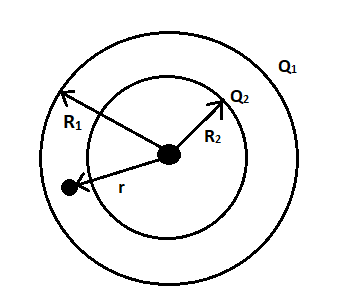
Let the potential due to the sphere of radius $ {R_2} $ be $ {V_2} = k\dfrac{{{Q_2}}}{r} $ since $ r $ is outside the sphere
Let the potential due to the sphere of radius $ {R_1} $ be $ {V_1} = k\dfrac{{{Q_1}}}{{{R_1}}} $ as the radius $ r $ is inside the sphere the potential will be constant.
The total potential at the radius $ r $ can be written as,
$ {V_r} = {V_1} + {V_2} $
Substituting the values of $ {V_1} $ and $ {V_2} $ within the above equation, we get
$ {V_r} = k\dfrac{{{Q_2}}}{r} + k\dfrac{{{Q_1}}}{{{R_1}}} $
Taking the common term $ k $ outside, we get
$ {V_r} = k\left( {\dfrac{{{Q_1}}}{{{R_1}}} + \dfrac{{{Q_2}}}{r}} \right) $
It is given that $ k = 1/4(\pi {\varepsilon _0}) $
The answer is: Option (B): $ \dfrac{{{Q_1}}}{{{R_1}}} + \dfrac{{{Q_2}}}{r} $ .
Additional Information
Surfaces having the same potential at every point is called equipotential surfaces. The electric field is usually normal to the equipotential surface. For moving a charge on the equipotential surface no work is required.
Note:
There is a potential associated with every field. The potential associated with an electric field is called electric potential. It is a scalar quantity. The electric field to some extent is the negative gradient of the electrical potential at that point. It is the work done in bringing a positive charge $ q\; $ from infinity to that point. The potential decreases within the direction of the electrical field.
Complete Step by step solution:
There will be potential due to the two charged spheres.
The radius $ r $ will be inside the sphere of radius $ {R_1} $ and outside the sphere of radius $ {R_2} $ as shown in the figure.
Let the potential due to the sphere of radius $ {R_2} $ be $ {V_2} = k\dfrac{{{Q_2}}}{r} $ since $ r $ is outside the sphere
Let the potential due to the sphere of radius $ {R_1} $ be $ {V_1} = k\dfrac{{{Q_1}}}{{{R_1}}} $ as the radius $ r $ is inside the sphere the potential will be constant.
The total potential at the radius $ r $ can be written as,
$ {V_r} = {V_1} + {V_2} $
Substituting the values of $ {V_1} $ and $ {V_2} $ within the above equation, we get
$ {V_r} = k\dfrac{{{Q_2}}}{r} + k\dfrac{{{Q_1}}}{{{R_1}}} $
Taking the common term $ k $ outside, we get
$ {V_r} = k\left( {\dfrac{{{Q_1}}}{{{R_1}}} + \dfrac{{{Q_2}}}{r}} \right) $
It is given that $ k = 1/4(\pi {\varepsilon _0}) $
The answer is: Option (B): $ \dfrac{{{Q_1}}}{{{R_1}}} + \dfrac{{{Q_2}}}{r} $ .
Additional Information
Surfaces having the same potential at every point is called equipotential surfaces. The electric field is usually normal to the equipotential surface. For moving a charge on the equipotential surface no work is required.
Note:
There is a potential associated with every field. The potential associated with an electric field is called electric potential. It is a scalar quantity. The electric field to some extent is the negative gradient of the electrical potential at that point. It is the work done in bringing a positive charge $ q\; $ from infinity to that point. The potential decreases within the direction of the electrical field.
Recently Updated Pages
Explain the structure of megasporangium class 12 biology CBSE

Why is chloroform kept in dark coloured bottles class 12 chemistry CBSE
Derive the balancing condition of a Wheatstone bri class 12 physics CBSE
Draw VI characteristics of a pn junction diode Explain class 12 physics CBSE
Is it possible to carry pride in ones language too class 12 english CBSE
In a population at Hardy Weinberg equilibrium the allele class 12 biology CBSE
Trending doubts
Draw a labelled sketch of the human eye class 12 physics CBSE
Which are the Top 10 Largest Countries of the World?
Draw ray diagrams each showing i myopic eye and ii class 12 physics CBSE
One megawatt is equal to how many units of electri class 12 physics CBSE
Which is the correct genotypic ratio of mendel dihybrid class 12 biology CBSE
Give 10 examples of unisexual and bisexual flowers