




Two concentric spheres kept in air have radii ‘R’ and ‘r’. They have similar charges and equal surface charge density ‘\[\sigma \]’. The electric potential at their common centre is _________. (\[{\varepsilon _o} = \]permittivity of free space)
A. \[\dfrac{{\sigma (R + r)}}{{{\varepsilon _o}}}\]
B. \[\dfrac{{\sigma (R - r)}}{{{\varepsilon _o}}}\]
C. \[\dfrac{{\sigma (R + r)}}{{2{\varepsilon _o}}}\]
D. \[\dfrac{{\sigma (R + r)}}{{4{\varepsilon _o}}}\]
Answer
 Verified
569.7k+ views
Hint: Use the formula for electric potential at the centre of a sphere. The electric potential follows the principle of superposition. Using these two conditions the solution for the given problem can be found out.
Complete step by step answer:
Given, radius of smaller sphere \[ = r\]
Radius of larger sphere \[ = R\]
Charge density of each sphere \[ = \sigma \]
Let O be the centre of both spheres and \[q\] and \[Q\]be the charge on smaller and larger spheres respectively.
As \[n\] is the charge density on each sphere, so charge on the smaller sphere with radius \[r\]is
\[q = \sigma \times 4\pi {r^2}\]
And charge on the larger sphere with radius \[R\]is,
\[Q = \sigma \times 4\pi {R^2}\]
Let us draw a diagram for the problem,
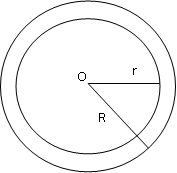
For the electric potential at the centre due to a charged sphere we have the formula, \[{V_{centre}} = \dfrac{{kQ}}{R}\], where \[k\]is proportionality constant, \[Q\] is the charge on the sphere and \[R\] is the radius of the sphere.
Here, the electric potential at the centre due to the smaller sphere with radius \[r\] and charge \[q\] is,
\[{V_1} = \dfrac{{kq}}{r}\]
And electric potential at the centre due to the larger sphere with radius \[R\] and charge \[Q\] is,
\[{V_2} = \dfrac{{kQ}}{R}\]
Electric potential follows superposition principle, therefore potential at the centre is the sum of the potentials due to the smaller and larger sphere, so potential at the centre can be written as,
\[{V_{centre}} = {V_1} + {V_2}\]
\[ \Rightarrow {V_{centre}} = \dfrac{{kq}}{r} + \dfrac{{kQ}}{R}\]
Proportionality of constant is written as \[k = 4\pi {\varepsilon _o}\]
where \[{\varepsilon _o}\]is the permittivity of free space.
Putting the values of \[k\]\[q\]and \[Q\] from equations (6), (1) and (2) in equation (5), we have
\[{V_{centre}} = \dfrac{1}{{4\pi {\varepsilon _o}}}\dfrac{{\sigma 4\pi {r^2}}}{r} + \dfrac{1}{{4\pi {\varepsilon _o}}}\dfrac{{\sigma 4\pi {R^2}}}{R} \\
\Rightarrow {V_{centre}} = \dfrac{{\sigma r}}{{{\varepsilon _o}}} + \dfrac{{\sigma R}}{{{\varepsilon _o}}} \\
\Rightarrow {V_{centre}} = \dfrac{\sigma }{{{\varepsilon _o}}}\left( {r + R} \right) \\\]
Hence, electric potential at the centre of both the sphere is \[\dfrac{\sigma }{{{\varepsilon _o}}}\left( {r + R} \right)\]
\[\dfrac{\sigma }{{{\varepsilon _o}}}\left( {r + R} \right)\]
So, the correct answer is “Option A”.
Note:
In this question two concentric spheres were given and their centre were the same, so we could use the formula for electric potential at the centre and get the solution. But if the spheres are not concentric and we would need to find the electric potential at a given point, then the formula for potential will not be the same and we have to use the formula for potential accordingly.
Complete step by step answer:
Given, radius of smaller sphere \[ = r\]
Radius of larger sphere \[ = R\]
Charge density of each sphere \[ = \sigma \]
Let O be the centre of both spheres and \[q\] and \[Q\]be the charge on smaller and larger spheres respectively.
As \[n\] is the charge density on each sphere, so charge on the smaller sphere with radius \[r\]is
\[q = \sigma \times 4\pi {r^2}\]
And charge on the larger sphere with radius \[R\]is,
\[Q = \sigma \times 4\pi {R^2}\]
Let us draw a diagram for the problem,
For the electric potential at the centre due to a charged sphere we have the formula, \[{V_{centre}} = \dfrac{{kQ}}{R}\], where \[k\]is proportionality constant, \[Q\] is the charge on the sphere and \[R\] is the radius of the sphere.
Here, the electric potential at the centre due to the smaller sphere with radius \[r\] and charge \[q\] is,
\[{V_1} = \dfrac{{kq}}{r}\]
And electric potential at the centre due to the larger sphere with radius \[R\] and charge \[Q\] is,
\[{V_2} = \dfrac{{kQ}}{R}\]
Electric potential follows superposition principle, therefore potential at the centre is the sum of the potentials due to the smaller and larger sphere, so potential at the centre can be written as,
\[{V_{centre}} = {V_1} + {V_2}\]
\[ \Rightarrow {V_{centre}} = \dfrac{{kq}}{r} + \dfrac{{kQ}}{R}\]
Proportionality of constant is written as \[k = 4\pi {\varepsilon _o}\]
where \[{\varepsilon _o}\]is the permittivity of free space.
Putting the values of \[k\]\[q\]and \[Q\] from equations (6), (1) and (2) in equation (5), we have
\[{V_{centre}} = \dfrac{1}{{4\pi {\varepsilon _o}}}\dfrac{{\sigma 4\pi {r^2}}}{r} + \dfrac{1}{{4\pi {\varepsilon _o}}}\dfrac{{\sigma 4\pi {R^2}}}{R} \\
\Rightarrow {V_{centre}} = \dfrac{{\sigma r}}{{{\varepsilon _o}}} + \dfrac{{\sigma R}}{{{\varepsilon _o}}} \\
\Rightarrow {V_{centre}} = \dfrac{\sigma }{{{\varepsilon _o}}}\left( {r + R} \right) \\\]
Hence, electric potential at the centre of both the sphere is \[\dfrac{\sigma }{{{\varepsilon _o}}}\left( {r + R} \right)\]
\[\dfrac{\sigma }{{{\varepsilon _o}}}\left( {r + R} \right)\]
So, the correct answer is “Option A”.
Note:
In this question two concentric spheres were given and their centre were the same, so we could use the formula for electric potential at the centre and get the solution. But if the spheres are not concentric and we would need to find the electric potential at a given point, then the formula for potential will not be the same and we have to use the formula for potential accordingly.
Recently Updated Pages
Master Class 12 Economics: Engaging Questions & Answers for Success

Master Class 12 Physics: Engaging Questions & Answers for Success
Master Class 12 English: Engaging Questions & Answers for Success
Master Class 12 Social Science: Engaging Questions & Answers for Success
Master Class 12 Maths: Engaging Questions & Answers for Success
Master Class 12 Business Studies: Engaging Questions & Answers for Success
Trending doubts
Which are the Top 10 Largest Countries of the World?
What are the major means of transport Explain each class 12 social science CBSE
Draw a labelled sketch of the human eye class 12 physics CBSE
Why cannot DNA pass through cell membranes class 12 biology CBSE
Differentiate between insitu conservation and exsitu class 12 biology CBSE
Draw a neat and well labeled diagram of TS of ovary class 12 biology CBSE