




Two coherent sources of light can be obtained by
(A) Two different lamps
(B) Two different lamps of same power and same colour
(C) Two different lamps of same power
(D) None of these
Answer
 Verified
559.5k+ views
Hint: Use the definition of coherent waves, which state that two wave sources are said perfectly coherent if their frequency and waveform are identical and their phase difference is constant.
Complete answer:
We know that two coherent wave sources are perfectly coherent if their frequency and waveform are identical and their phase difference is constant. From this, we can define two coherent sources of light, which states that two sources are said to be coherent if their frequency and phase difference between them is constant or zero.
If we have two waves, say, $ {y_1} = a\sin \omega t $ and $ {y_2} = a\sin (\omega t + \theta ) $ where $ \theta $ is the phase difference between them , $ \omega $ is the frequency of the wave and $ a $ is the amplitude of the wave, then these two waves can produce a coherent source of light or wave.
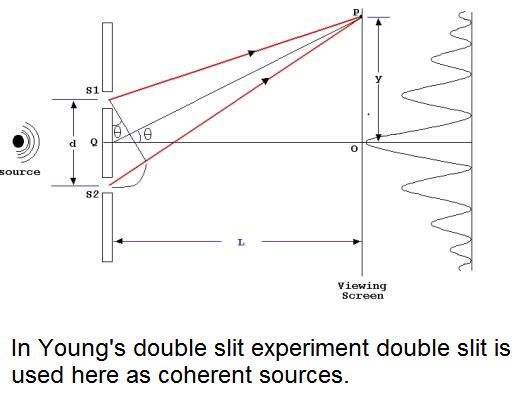
Here, we have asked how we can obtain two coherent sources of light. So, we can say that two same lamps of the same colour can only produce coherent sources. Since, lamps of the same colour will contain the same frequency of light. Since we know wavelength (on which colour of the light depends) is inversely proportional to the frequency of the light.
Hence, to get coherent sources lamps need to have the same colour of light.
So, no options match this condition.
Hence, option ( D) is correct.
Note:
$ \bullet $ Coherent sources of light can also be produced using a single source as Huygen’s principle states that all points of a wave front of light in a vacuum or transparent medium may be regarded as new sources of wavelets that expand in every direction at a rate depending on their velocities .
$ \bullet $ This problem is a definition based problem. So, students are advised to learn the concept of coherence well to draw a conclusion.
$ \bullet $ Interference of light can be observed using only coherent sources of light.
Complete answer:
We know that two coherent wave sources are perfectly coherent if their frequency and waveform are identical and their phase difference is constant. From this, we can define two coherent sources of light, which states that two sources are said to be coherent if their frequency and phase difference between them is constant or zero.
If we have two waves, say, $ {y_1} = a\sin \omega t $ and $ {y_2} = a\sin (\omega t + \theta ) $ where $ \theta $ is the phase difference between them , $ \omega $ is the frequency of the wave and $ a $ is the amplitude of the wave, then these two waves can produce a coherent source of light or wave.
Here, we have asked how we can obtain two coherent sources of light. So, we can say that two same lamps of the same colour can only produce coherent sources. Since, lamps of the same colour will contain the same frequency of light. Since we know wavelength (on which colour of the light depends) is inversely proportional to the frequency of the light.
Hence, to get coherent sources lamps need to have the same colour of light.
So, no options match this condition.
Hence, option ( D) is correct.
Note:
$ \bullet $ Coherent sources of light can also be produced using a single source as Huygen’s principle states that all points of a wave front of light in a vacuum or transparent medium may be regarded as new sources of wavelets that expand in every direction at a rate depending on their velocities .
$ \bullet $ This problem is a definition based problem. So, students are advised to learn the concept of coherence well to draw a conclusion.
$ \bullet $ Interference of light can be observed using only coherent sources of light.
Recently Updated Pages
Master Class 12 Business Studies: Engaging Questions & Answers for Success

Master Class 12 Biology: Engaging Questions & Answers for Success
Master Class 12 Chemistry: Engaging Questions & Answers for Success
Class 12 Question and Answer - Your Ultimate Solutions Guide
Master Class 11 Social Science: Engaging Questions & Answers for Success
Master Class 11 English: Engaging Questions & Answers for Success
Trending doubts
Which is more stable and why class 12 chemistry CBSE
Which are the Top 10 Largest Countries of the World?
Draw a labelled sketch of the human eye class 12 physics CBSE
Differentiate between homogeneous and heterogeneous class 12 chemistry CBSE
What are the major means of transport Explain each class 12 social science CBSE
Sulphuric acid is known as the king of acids State class 12 chemistry CBSE