




Two coherent monochromatic point sources ${{S}_{1}}$ and ${{S}_{2}}$ of wavelength $\lambda =600\,\,nm$ are placed symmetrically on either side of the center of the circle as shown. The sources are separated by a distance $d=1.8\,\,mm$. This arrangement produces interference fringes visible as alternate bright and dark spots on the circumference of the circle. The angular separation between two consecutive bright spots is $\Delta \theta $. Which of the following options are correct?
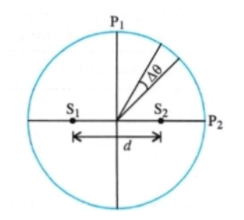
(A) The total number of fringes produced between ${{P}_{1}}$ and ${{P}_{2}}$ in the first quadrant is close to $3000$
(B) A dark spot will be formed at the point ${{P}_{2}}$
(C) At ${{P}_{2}}$ the order of fringe will be maximum
(D) The angular separation between two consecutive bright spots decreases as we move from ${{P}_{1}}$ to ${{P}_{2}}$ along the first quadrant
Answer
 Verified
603.3k+ views
Hint: The interference taking place at points of maximum intensity is called constructive interference. For constructive interference phase difference should be zero or even multiple of $\pi $.
i.e. $\phi =2n\pi $, where $n=0,1,2,3,...$
Phase difference $\Delta x=n\lambda $
The interference taking place at points of minimum intensity is called destructive interference. For destructive interference phase difference should be an odd multiple of $\pi $
i.e. $\phi =(2n+1)\pi $, where $n=0,1,2,3,...$
Phase difference $\Delta x=(2n+1)\dfrac{\lambda }{2}$
Step by step solution:
Given: wavelength $\lambda =600\,\,nm$, separation between two source $d=1.8\,\,mm$
The path difference between the waves from ${{S}_{1}}$ and ${{S}_{2}}$ at the point ${{P}_{2}}$ is $d$.
∴ Number of fringes between ${{P}_{1}}$ and ${{P}_{2}}$,
$n=\dfrac{d}{\lambda }$
⇒ $n=\dfrac{1.8\times {{10}^{-2}}}{6\times {{10}^{-7}}}=3000$
Therefore, option (A) is correct.
As at ${{P}_{2}}$, ${{3000}^{th}}$ bright fringe is formed, i.e. order of fringe is maximum.
Therefore, option (C) is correct and option (B) is incorrect.
Angular separation between two consecutive maxima is given by,
$\dfrac{d\theta }{d\lambda }=\dfrac{\lambda }{d\cos \theta }$
As we move from ${{P}_{1}}\,$ to ${{P}_{2}}$ in first quadrant $\theta $ increases from ${{0}^{\circ }}$ to ${{90}^{\circ }}$, $\cos \theta $ decrease from $1$ to $0$, hence the angular separation between consecutive maxima increases.
Therefore, option (D) is incorrect.
Note: For bright fringes (maximum intensity) phase difference between two sources is $\lambda ,2\lambda ,3\lambda ,4\lambda \lambda ,5\lambda , ...$
Thus, waves should meet in the same phase or their crests should meet crests and troughs should meet troughs.
For dark fringe (minimum intensity) phase difference between two sources is \[\dfrac{\lambda }{2},\dfrac{3\lambda }{2},\dfrac{5\lambda }{2},\dfrac{7\lambda }{2},...\]
Thus, waves should meet in opposite phases or crests of one wave should meet troughs of another.
i.e. $\phi =2n\pi $, where $n=0,1,2,3,...$
Phase difference $\Delta x=n\lambda $
The interference taking place at points of minimum intensity is called destructive interference. For destructive interference phase difference should be an odd multiple of $\pi $
i.e. $\phi =(2n+1)\pi $, where $n=0,1,2,3,...$
Phase difference $\Delta x=(2n+1)\dfrac{\lambda }{2}$
Step by step solution:
Given: wavelength $\lambda =600\,\,nm$, separation between two source $d=1.8\,\,mm$
The path difference between the waves from ${{S}_{1}}$ and ${{S}_{2}}$ at the point ${{P}_{2}}$ is $d$.
∴ Number of fringes between ${{P}_{1}}$ and ${{P}_{2}}$,
$n=\dfrac{d}{\lambda }$
⇒ $n=\dfrac{1.8\times {{10}^{-2}}}{6\times {{10}^{-7}}}=3000$
Therefore, option (A) is correct.
As at ${{P}_{2}}$, ${{3000}^{th}}$ bright fringe is formed, i.e. order of fringe is maximum.
Therefore, option (C) is correct and option (B) is incorrect.
Angular separation between two consecutive maxima is given by,
$\dfrac{d\theta }{d\lambda }=\dfrac{\lambda }{d\cos \theta }$
As we move from ${{P}_{1}}\,$ to ${{P}_{2}}$ in first quadrant $\theta $ increases from ${{0}^{\circ }}$ to ${{90}^{\circ }}$, $\cos \theta $ decrease from $1$ to $0$, hence the angular separation between consecutive maxima increases.
Therefore, option (D) is incorrect.
Note: For bright fringes (maximum intensity) phase difference between two sources is $\lambda ,2\lambda ,3\lambda ,4\lambda \lambda ,5\lambda , ...$
Thus, waves should meet in the same phase or their crests should meet crests and troughs should meet troughs.
For dark fringe (minimum intensity) phase difference between two sources is \[\dfrac{\lambda }{2},\dfrac{3\lambda }{2},\dfrac{5\lambda }{2},\dfrac{7\lambda }{2},...\]
Thus, waves should meet in opposite phases or crests of one wave should meet troughs of another.
Recently Updated Pages
Master Class 12 Business Studies: Engaging Questions & Answers for Success

Master Class 12 Biology: Engaging Questions & Answers for Success
Master Class 12 Chemistry: Engaging Questions & Answers for Success
Class 12 Question and Answer - Your Ultimate Solutions Guide
Master Class 11 Social Science: Engaging Questions & Answers for Success
Master Class 11 English: Engaging Questions & Answers for Success
Trending doubts
Which is more stable and why class 12 chemistry CBSE
Which are the Top 10 Largest Countries of the World?
Draw a labelled sketch of the human eye class 12 physics CBSE
Differentiate between homogeneous and heterogeneous class 12 chemistry CBSE
What are the major means of transport Explain each class 12 social science CBSE
Sulphuric acid is known as the king of acids State class 12 chemistry CBSE