




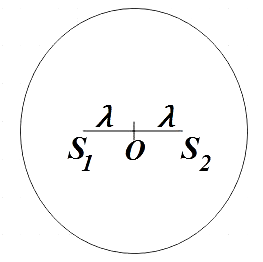
Two coherent light sources ${{S}_{1}}$ and ${{S}_{2}}$ are kept at equal distances $\lambda $ from the centre of circle on the same plane of the circle as shown in figure. In one complete revolution on the circular path, number of maxima observed is ($\lambda $= wavelength of light used)
A. 4
B. 6
C. 8
D. 12
Answer
 Verified
600k+ views
Hint: To begin with you could consider an arbitrary point on the circular path and then find the path difference of the given two sources on that particular point. Now, you could recall the condition for constructive interference and hence get an expression for angular position for maxima in the given circular path. Now find all possible angular positions satisfying the above condition.
Formula used: Condition for constructive interference,
$\Delta x=n\lambda $
Complete step by step answer:
In the question, we are given two coherent light sources which are equidistant from the centre of a circle as shown in the figure. We are asked to find the number of maxima observed after one complete revolution of this circular path.
Let P be some point on the circular path and from the figure above, we see that the distance travelled by the light from source ${{S}_{1}}$ to reach the point P is ${{S}_{1}}P$ and the distance travelled by the light from source ${{S}_{2}}$ to reach the point P is${{S}_{2}}P$. Also, the path difference $\Delta x$ that is the difference in path taken by light to reach P from these two sources is,
$\Delta x={{S}_{1}}Q=\left( {{S}_{1}}P-{{S}_{2}}P \right)$
But,
$\cos \theta =\dfrac{\Delta x}{2\lambda }$
$\Rightarrow \Delta x=2\lambda \cos \theta $ …………………………. (1)
We are asked to find the number of maxima. The maxima is the point where constructive interference takes place for two coherent sources and the condition for constructive interference is that the path difference should be integral multiples of the wavelength. That is,
$\Delta x=n\lambda $ ………………………….. (2)
Where, n is an integer.
Equating (1) and (2),
$\Rightarrow 2\lambda \cos \theta =n\lambda $
$\Rightarrow \cos \theta =\dfrac{n}{2}$
$\Rightarrow \theta ={{\cos }^{-1}}\left( \dfrac{n}{2} \right)$ ………………………… (3)
We know that value of $\cos \theta $ varies from -1 to +1,
$\Rightarrow -1\le \cos \theta \le +1$
$\Rightarrow -1\le \dfrac{n}{2}\le +1$
$\Rightarrow -2\le n\le +2$
Therefore,
$n=0,\pm 1,\pm 2$
For each value of n let us find the angular position $\theta $ from (3).
For $n=0$
$\theta ={{\cos }^{-1}}\left( 0 \right)$
$\theta =90{}^\circ ,270{}^\circ $ ………………………….. (4)
For $n=\pm 1$
$\theta ={{\cos }^{-1}}\left( \dfrac{\pm 1}{2} \right)$
$\theta =60{}^\circ ,120{}^\circ ,240{}^\circ ,300{}^\circ $ ……………………….. (5)
For $n=\pm 2$
$\theta ={{\cos }^{-1}}\left( \pm \dfrac{2}{2} \right)={{\cos }^{-1}}\left( \pm 1 \right)$
$\theta =0{}^\circ ,180{}^\circ $ …………………………. (6)
Therefore, we have found a total of 8 maxima in the given circular path, they are,
$0{}^\circ ,60{}^\circ ,90{}^\circ ,120{}^\circ ,180{}^\circ ,240{}^\circ ,270{}^\circ ,300{}^\circ $
Hence, in one complete revolution on the circular path, the number of maxima that can be observed are 8.
So, the correct answer is “Option C”.
Note: You should remember that the term n in the condition for constructive interference is an integer. So n cannot be a fraction or anything else but integer. We see that $\theta =360{}^\circ $ is also a possible angular position for maxima but that is the same as $0{}^\circ $, so we shouldn’t consider that angular position.
Formula used: Condition for constructive interference,
$\Delta x=n\lambda $
Complete step by step answer:
In the question, we are given two coherent light sources which are equidistant from the centre of a circle as shown in the figure. We are asked to find the number of maxima observed after one complete revolution of this circular path.
Let P be some point on the circular path and from the figure above, we see that the distance travelled by the light from source ${{S}_{1}}$ to reach the point P is ${{S}_{1}}P$ and the distance travelled by the light from source ${{S}_{2}}$ to reach the point P is${{S}_{2}}P$. Also, the path difference $\Delta x$ that is the difference in path taken by light to reach P from these two sources is,
$\Delta x={{S}_{1}}Q=\left( {{S}_{1}}P-{{S}_{2}}P \right)$
But,
$\cos \theta =\dfrac{\Delta x}{2\lambda }$
$\Rightarrow \Delta x=2\lambda \cos \theta $ …………………………. (1)
We are asked to find the number of maxima. The maxima is the point where constructive interference takes place for two coherent sources and the condition for constructive interference is that the path difference should be integral multiples of the wavelength. That is,
$\Delta x=n\lambda $ ………………………….. (2)
Where, n is an integer.
Equating (1) and (2),
$\Rightarrow 2\lambda \cos \theta =n\lambda $
$\Rightarrow \cos \theta =\dfrac{n}{2}$
$\Rightarrow \theta ={{\cos }^{-1}}\left( \dfrac{n}{2} \right)$ ………………………… (3)
We know that value of $\cos \theta $ varies from -1 to +1,
$\Rightarrow -1\le \cos \theta \le +1$
$\Rightarrow -1\le \dfrac{n}{2}\le +1$
$\Rightarrow -2\le n\le +2$
Therefore,
$n=0,\pm 1,\pm 2$
For each value of n let us find the angular position $\theta $ from (3).
For $n=0$
$\theta ={{\cos }^{-1}}\left( 0 \right)$
$\theta =90{}^\circ ,270{}^\circ $ ………………………….. (4)
For $n=\pm 1$
$\theta ={{\cos }^{-1}}\left( \dfrac{\pm 1}{2} \right)$
$\theta =60{}^\circ ,120{}^\circ ,240{}^\circ ,300{}^\circ $ ……………………….. (5)
For $n=\pm 2$
$\theta ={{\cos }^{-1}}\left( \pm \dfrac{2}{2} \right)={{\cos }^{-1}}\left( \pm 1 \right)$
$\theta =0{}^\circ ,180{}^\circ $ …………………………. (6)
Therefore, we have found a total of 8 maxima in the given circular path, they are,
$0{}^\circ ,60{}^\circ ,90{}^\circ ,120{}^\circ ,180{}^\circ ,240{}^\circ ,270{}^\circ ,300{}^\circ $
Hence, in one complete revolution on the circular path, the number of maxima that can be observed are 8.
So, the correct answer is “Option C”.
Note: You should remember that the term n in the condition for constructive interference is an integer. So n cannot be a fraction or anything else but integer. We see that $\theta =360{}^\circ $ is also a possible angular position for maxima but that is the same as $0{}^\circ $, so we shouldn’t consider that angular position.
Recently Updated Pages
Master Class 12 Business Studies: Engaging Questions & Answers for Success

Master Class 12 Biology: Engaging Questions & Answers for Success
Master Class 12 Chemistry: Engaging Questions & Answers for Success
Class 12 Question and Answer - Your Ultimate Solutions Guide
Master Class 11 Social Science: Engaging Questions & Answers for Success
Master Class 11 English: Engaging Questions & Answers for Success
Trending doubts
Which are the Top 10 Largest Countries of the World?
Draw a labelled sketch of the human eye class 12 physics CBSE
Differentiate between homogeneous and heterogeneous class 12 chemistry CBSE
Sulphuric acid is known as the king of acids State class 12 chemistry CBSE
Why is the cell called the structural and functional class 12 biology CBSE
Which is the correct genotypic ratio of mendel dihybrid class 12 biology CBSE