




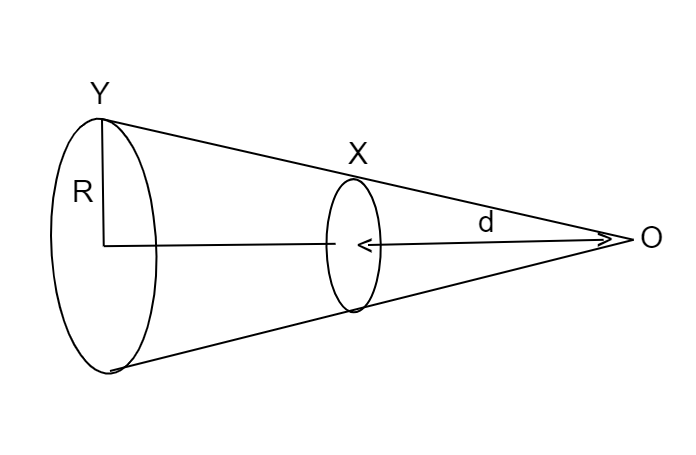
Two circular coils $ X $ and $ Y $ have equal number of turns and carry equal currents in the same sense and subtend the same solid angle at point $ \left( O \right) $ . If the smaller coil $ X $ is midway between $ O $ and $ Y $ , then if we represent magnetic induction due to bigger coil $ Y $ at $ O $ as $ {B_Y} $ , and that due to smaller coil $ X $ at $ O $ as $ {B_X} $ , then
A. $ \dfrac{{{B_Y}}}{{{B_X}}} = 1 $
B. $ \dfrac{{{B_Y}}}{{{B_X}}} = 2 $
C. $ \dfrac{{{B_Y}}}{{{B_X}}} = \dfrac{1}{2} $
D. $ \dfrac{{{B_Y}}}{{{B_X}}} = \dfrac{1}{4} $
Answer
 Verified
529.5k+ views
Hint: In this question, we are given two coils carrying the same current and having the same number of turns. As they subtend the same solid angle at point $ O $ and the smaller coil is midway between the larger coil and point $ O $ . By using geometry we can say, Radius of the larger coil is twice the radius of smaller coil and we can find out the magnetic field due to coil at a distance $ x $ using the formula $ B = \dfrac{{{\mu _0}NI{R^2}}}{{2{{\left( {{R^2} + {x^2}} \right)}^{3/2}}}} $
Magnetic field due at the axis of a circular current-carrying coil, $ B = \dfrac{{{\mu _0}NI{R^2}}}{{2{{\left( {{R^2} + {x^2}} \right)}^{3/2}}}} $
Where $ B $ is the magnetic field at the axis
$ R $ is the radius of the coil
$ I $ is the current carried by the coil
$ N $ is the number of turns in the coil
$ x $ is the distance from the center of the coil.
Complete step by step answer:
We are given two coils $ X $ and $ Y $ having an equal number of turns $ N $ and carrying an equal amount of current $ I $
Distance of centre of coil $ X $ from the point $ O $ is $ d $
As coil $ X $ is midway between $ Y $ and $ O $ ,
Distance of centre of coil $ Y $ and $ O $ is $ 2d $
Let radius of coil $ Y $ be $ R $ and radius of coil $ X $ be $ r $
Both the coils subtend same angle at point $ O $ thus,
$ \dfrac{r}{d} = \dfrac{R}{{2d}} $
$ \Rightarrow R = 2r $
Now, the magnetic field at point $ O $ due to bigger coil $ Y $ , $ {B_Y} = \dfrac{{{\mu _0}NI{R^2}}}{{2{{\left( {{R^2} + {{\left( {2d} \right)}^2}} \right)}^{3/2}}}} $
Substituting $ R = 2r $ we get,
$ \Rightarrow {B_Y} = \dfrac{{{\mu _0}NI\left( {4{r^2}} \right)}}{{2{{\left( {4{r^2} + 4{d^2}} \right)}^{3/2}}}} $
$ \Rightarrow {B_Y} = \dfrac{{{\mu _0}NI\left( {4{r^2}} \right)}}{{2 \times 8{{\left( {{r^2} + {d^2}} \right)}^{3/2}}}} $
$ \Rightarrow {B_Y} = \dfrac{{{\mu _0}NI{r^2}}}{{4{{\left( {{r^2} + {d^2}} \right)}^{3/2}}}} $
Magnetic field at point $ O $ due to smaller coil $ X $ , $ {B_X} = \dfrac{{{\mu _0}NI{r^2}}}{{2{{\left( {{r^2} + {d^2}} \right)}^{3/2}}}} $
Therefore, $ \dfrac{{{B_Y}}}{{{B_X}}} = \dfrac{{\dfrac{{{\mu _0}NI{r^2}}}{{4{{\left( {{r^2} + {d^2}} \right)}^{3/2}}}}}}{{\dfrac{{{\mu _0}NI{r^2}}}{{2{{\left( {{r^2} + {d^2}} \right)}^{3/2}}}}}} \Rightarrow \dfrac{1}{2} $
$ \dfrac{{{B_Y}}}{{{B_X}}} = \dfrac{1}{2} $
Hence, the correct option is option C.
Note:
Magnetic field at the center of the coil is maximum and is equal to $ {B_X} = \dfrac{{{\mu _0}NI}}{{2R}} $ . The magnetic field along the axis of the coil keeps on decreasing as we move away from the center of the coil and at far points, $ x \gg R $ magnetic field becomes, $ B = \dfrac{{{\mu _0}NI{R^2}}}{{2{x^3}}} $ .
Magnetic field due at the axis of a circular current-carrying coil, $ B = \dfrac{{{\mu _0}NI{R^2}}}{{2{{\left( {{R^2} + {x^2}} \right)}^{3/2}}}} $
Where $ B $ is the magnetic field at the axis
$ R $ is the radius of the coil
$ I $ is the current carried by the coil
$ N $ is the number of turns in the coil
$ x $ is the distance from the center of the coil.
Complete step by step answer:
We are given two coils $ X $ and $ Y $ having an equal number of turns $ N $ and carrying an equal amount of current $ I $
Distance of centre of coil $ X $ from the point $ O $ is $ d $
As coil $ X $ is midway between $ Y $ and $ O $ ,
Distance of centre of coil $ Y $ and $ O $ is $ 2d $
Let radius of coil $ Y $ be $ R $ and radius of coil $ X $ be $ r $
Both the coils subtend same angle at point $ O $ thus,
$ \dfrac{r}{d} = \dfrac{R}{{2d}} $
$ \Rightarrow R = 2r $
Now, the magnetic field at point $ O $ due to bigger coil $ Y $ , $ {B_Y} = \dfrac{{{\mu _0}NI{R^2}}}{{2{{\left( {{R^2} + {{\left( {2d} \right)}^2}} \right)}^{3/2}}}} $
Substituting $ R = 2r $ we get,
$ \Rightarrow {B_Y} = \dfrac{{{\mu _0}NI\left( {4{r^2}} \right)}}{{2{{\left( {4{r^2} + 4{d^2}} \right)}^{3/2}}}} $
$ \Rightarrow {B_Y} = \dfrac{{{\mu _0}NI\left( {4{r^2}} \right)}}{{2 \times 8{{\left( {{r^2} + {d^2}} \right)}^{3/2}}}} $
$ \Rightarrow {B_Y} = \dfrac{{{\mu _0}NI{r^2}}}{{4{{\left( {{r^2} + {d^2}} \right)}^{3/2}}}} $
Magnetic field at point $ O $ due to smaller coil $ X $ , $ {B_X} = \dfrac{{{\mu _0}NI{r^2}}}{{2{{\left( {{r^2} + {d^2}} \right)}^{3/2}}}} $
Therefore, $ \dfrac{{{B_Y}}}{{{B_X}}} = \dfrac{{\dfrac{{{\mu _0}NI{r^2}}}{{4{{\left( {{r^2} + {d^2}} \right)}^{3/2}}}}}}{{\dfrac{{{\mu _0}NI{r^2}}}{{2{{\left( {{r^2} + {d^2}} \right)}^{3/2}}}}}} \Rightarrow \dfrac{1}{2} $
$ \dfrac{{{B_Y}}}{{{B_X}}} = \dfrac{1}{2} $
Hence, the correct option is option C.
Note:
Magnetic field at the center of the coil is maximum and is equal to $ {B_X} = \dfrac{{{\mu _0}NI}}{{2R}} $ . The magnetic field along the axis of the coil keeps on decreasing as we move away from the center of the coil and at far points, $ x \gg R $ magnetic field becomes, $ B = \dfrac{{{\mu _0}NI{R^2}}}{{2{x^3}}} $ .
Recently Updated Pages
Master Class 12 Economics: Engaging Questions & Answers for Success

Master Class 12 English: Engaging Questions & Answers for Success
Master Class 12 Social Science: Engaging Questions & Answers for Success
Master Class 12 Maths: Engaging Questions & Answers for Success
Master Class 12 Physics: Engaging Questions & Answers for Success
Master Class 12 Business Studies: Engaging Questions & Answers for Success
Trending doubts
Which are the Top 10 Largest Countries of the World?
Draw a labelled sketch of the human eye class 12 physics CBSE
Differentiate between homogeneous and heterogeneous class 12 chemistry CBSE
Sulphuric acid is known as the king of acids State class 12 chemistry CBSE
Why is the cell called the structural and functional class 12 biology CBSE
Draw ray diagrams each showing i myopic eye and ii class 12 physics CBSE