




Two circles touch externally. The sum of their areas is \[130\pi \] sq.cm. and the distance between their centers is 14 cm. Find the radii of the circles.
A) 11cm and 3cm
B) 1cm and 3cm
C) 11cm and 13cm
D) None of these
Answer
 Verified
593.7k+ views
Hint:
Here, we have to find the radii of the circles. With the given conditions, we can find the radii of the circles by using the area of the circles. First we will use the area of the circle formula to find an equation and the distance between their centers formula to find an equation for either of the radius. Then we will substitute the equation of the radius in the equation we derived from the area of circles formula, after which we will obtain the value of one radius. We will then substitute the radius of one circle in the equation of the radius to obtain the radius of the other circle.
Formula Used:
We will use the following formula:
1) When two circle touch externally then the distance between their centers \[ = \] sum of their radii
\[\left| {{C_1}{C_2}} \right| = {r_1} + {r_2}\] where \[{r_1},{r_2}\] are the radii of two circles
2) Area of the circle is given by \[A = \pi {r^2}\] where \[r\] is the radius of the circle.
3) The square of the difference of two numbers is given by \[{\left( {a - b} \right)^2} = {a^2} + {b^2} - 2ab\].
Complete step by step solution:
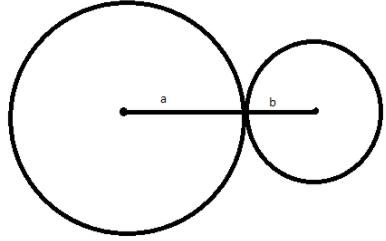
Let us consider the radius of the two circles are \[a\]and \[b\] cm.
Now we will find the distance between the centers of two circles.
The distance between their centers \[ = a + b\]
We are given that the distance between their centers is 14 cm.
Substituting the value of distance, we get
\[ \Rightarrow a + b = 14\]
Rewriting the above equation, we get
\[ \Rightarrow b = 14 - a\] …………………………………………\[\left( 1 \right)\]
By using the area of the circles formula, the sum of their areas with the radius of the two circles as \[a\]and \[b\]cm, we get
\[ \Rightarrow \] Sum of their areas \[ = \pi {a^2} + \pi {b^2}\]
Substituting the value of sum of areas, we get
\[ \Rightarrow \pi {a^2} + \pi {b^2} = 130\pi \]
\[ \Rightarrow \pi \left( {{a^2} + {b^2}} \right) = 130\pi \]
Cancelling the similar term on both the sides, we have
\[ \Rightarrow {a^2} + {b^2} = 130\] …………………………………………\[\left( 2 \right)\]
Substituting equation \[\left( 1 \right)\] in equation \[\left( 2 \right)\], we have
\[ \Rightarrow {a^2} + {\left( {14 - a} \right)^2} = 130\]
Now simplifying the above equation using the identity \[{\left( {a - b} \right)^2} = {a^2} + {b^2} - 2ab\], we get
\[ \Rightarrow {a^2} + {a^2} + 196 - 28a = 130\]
Rewriting the equation and adding the terms, we have
\[ \Rightarrow 2{a^2} + 66 - 28a = 0\]
Dividing both sides by 2, we get
\[ \Rightarrow {a^2} + 33 - 14a = 0\]
By Factorization method, we get
\[ \Rightarrow {a^2} - 11a - 3a + 33 = 0\]
\[ \Rightarrow a(a - 11) - 3(a - 11) = 0\]
Again factoring the equation, we get
\[ \Rightarrow \left( {a - 11} \right)\left( {a - 3} \right) = 0\]
\[ \Rightarrow a = 3,11\]
Now we will find the value of \[b\] when \[a = 3\]. Therefore, we get
\[b = 14 - 3 = 11\]
Now we will find the value of \[b\] when \[a = 11\]. Therefore, we get
\[b = 14 - 11 = 3\]
Therefore, the radius of two circles is 11cm and 3 cm.
Hence, option A is the correct option.
Note:
We have to find the radius of two circles. A radius is a straight line from the center of a circle to the circumference of a circle. If there are two or more of radii, then they are referred to as radii. All radii in a circle will be the same length. A radius can be a line from any point on the circumference to the center of the circle. If we put two radii together, edge to edge, going through the center of a circle, we would get a diameter.
Here, we have to find the radii of the circles. With the given conditions, we can find the radii of the circles by using the area of the circles. First we will use the area of the circle formula to find an equation and the distance between their centers formula to find an equation for either of the radius. Then we will substitute the equation of the radius in the equation we derived from the area of circles formula, after which we will obtain the value of one radius. We will then substitute the radius of one circle in the equation of the radius to obtain the radius of the other circle.
Formula Used:
We will use the following formula:
1) When two circle touch externally then the distance between their centers \[ = \] sum of their radii
\[\left| {{C_1}{C_2}} \right| = {r_1} + {r_2}\] where \[{r_1},{r_2}\] are the radii of two circles
2) Area of the circle is given by \[A = \pi {r^2}\] where \[r\] is the radius of the circle.
3) The square of the difference of two numbers is given by \[{\left( {a - b} \right)^2} = {a^2} + {b^2} - 2ab\].
Complete step by step solution:
Let us consider the radius of the two circles are \[a\]and \[b\] cm.
Now we will find the distance between the centers of two circles.
The distance between their centers \[ = a + b\]
We are given that the distance between their centers is 14 cm.
Substituting the value of distance, we get
\[ \Rightarrow a + b = 14\]
Rewriting the above equation, we get
\[ \Rightarrow b = 14 - a\] …………………………………………\[\left( 1 \right)\]
By using the area of the circles formula, the sum of their areas with the radius of the two circles as \[a\]and \[b\]cm, we get
\[ \Rightarrow \] Sum of their areas \[ = \pi {a^2} + \pi {b^2}\]
Substituting the value of sum of areas, we get
\[ \Rightarrow \pi {a^2} + \pi {b^2} = 130\pi \]
\[ \Rightarrow \pi \left( {{a^2} + {b^2}} \right) = 130\pi \]
Cancelling the similar term on both the sides, we have
\[ \Rightarrow {a^2} + {b^2} = 130\] …………………………………………\[\left( 2 \right)\]
Substituting equation \[\left( 1 \right)\] in equation \[\left( 2 \right)\], we have
\[ \Rightarrow {a^2} + {\left( {14 - a} \right)^2} = 130\]
Now simplifying the above equation using the identity \[{\left( {a - b} \right)^2} = {a^2} + {b^2} - 2ab\], we get
\[ \Rightarrow {a^2} + {a^2} + 196 - 28a = 130\]
Rewriting the equation and adding the terms, we have
\[ \Rightarrow 2{a^2} + 66 - 28a = 0\]
Dividing both sides by 2, we get
\[ \Rightarrow {a^2} + 33 - 14a = 0\]
By Factorization method, we get
\[ \Rightarrow {a^2} - 11a - 3a + 33 = 0\]
\[ \Rightarrow a(a - 11) - 3(a - 11) = 0\]
Again factoring the equation, we get
\[ \Rightarrow \left( {a - 11} \right)\left( {a - 3} \right) = 0\]
\[ \Rightarrow a = 3,11\]
Now we will find the value of \[b\] when \[a = 3\]. Therefore, we get
\[b = 14 - 3 = 11\]
Now we will find the value of \[b\] when \[a = 11\]. Therefore, we get
\[b = 14 - 11 = 3\]
Therefore, the radius of two circles is 11cm and 3 cm.
Hence, option A is the correct option.
Note:
We have to find the radius of two circles. A radius is a straight line from the center of a circle to the circumference of a circle. If there are two or more of radii, then they are referred to as radii. All radii in a circle will be the same length. A radius can be a line from any point on the circumference to the center of the circle. If we put two radii together, edge to edge, going through the center of a circle, we would get a diameter.
Recently Updated Pages
Master Class 12 Business Studies: Engaging Questions & Answers for Success

Master Class 12 Chemistry: Engaging Questions & Answers for Success
Master Class 12 Biology: Engaging Questions & Answers for Success
Class 12 Question and Answer - Your Ultimate Solutions Guide
Master Class 11 English: Engaging Questions & Answers for Success
Master Class 11 Maths: Engaging Questions & Answers for Success
Trending doubts
Which is more stable and why class 12 chemistry CBSE
Which are the Top 10 Largest Countries of the World?
Draw a labelled sketch of the human eye class 12 physics CBSE
Differentiate between homogeneous and heterogeneous class 12 chemistry CBSE
What are the major means of transport Explain each class 12 social science CBSE
Sulphuric acid is known as the king of acids State class 12 chemistry CBSE