




Two cells of internal resistances ${{r}_{1}}$ and ${{r}_{2}}$ and of same emf are connected in series, across a resistor of resistance R. If the terminal potential difference across the cells of internal resistance ${{r}_{1}}$ is zero, then the value of R is?
$A.\quad R=2({{r}_{1}}+{{r}_{2}})$
$B.\quad R={{r}_{2}}-{{r}_{1}}$
$C.\quad R={{r}_{1}}-{{r}_{2}}$
$D.\quad R=2({{r}_{1}}-{{r}_{2}})$
Answer
 Verified
612.6k+ views
Hint: Making a circuit diagram of the problem will help in understanding the problem better. The Ohm’s law, given by $V=IR$ will be required to solve this problem. The effective current in the circuit given by the ratio of the effective potential in the circuit and the effective resistance in the circuit, that is ${{I}_{eff}}=\dfrac{{{E}_{eff}}}{{{R}_{eff}}}$. The terminal potential of the cell ${{E}_{1}}$ is given by, ${{V}_{ter\min al}}={{E}_{1}}-{{I}_{eff}}{{r}_{1}}$.
Step by step solution:
Let’s start by making a circuit diagram of the problem.
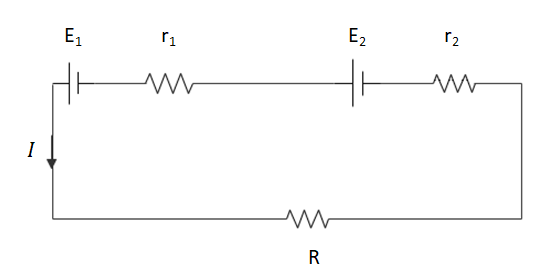
As given in the question, we have two cells of emf ${{E}_{1}}$ and ${{E}_{2}}$ having internal resistances of ${{r}_{1}}$ and ${{r}_{2}}$ respectively. These emf’s are connected in series to an external resistance R.
To find the effective current flowing through the circuit, we will use the Ohm’s law, that is $V=IR$. Hence, in this case the Ohm’s law becomes, ${{E}_{eff}}={{E}_{1}}+{{E}_{2}}={{I}_{eff}}({{R}_{eff}})$.
The ${{R}_{eff}}$ is given by the net series resistance in the circuit. Therefore ${{R}_{eff}}$ is, ${{R}_{eff}}={{r}_{1}}+{{r}_{2}}+R$.
Therefore, substituting in this value in the previous equation, we get, ${{E}_{1}}+{{E}_{2}}={{I}_{eff}}({{r}_{1}}+{{r}_{2}}+R)\Rightarrow {{I}_{eff}}=\dfrac{{{E}_{1}}+{{E}_{2}}}{{{r}_{1}}+{{r}_{2}}+R}$.
As given in the problem, both the cells have the same emf, hence ${{E}_{1}}$ =${{E}_{2}}$=$E$.
Therefore, the equation becomes, ${{I}_{eff}}=\dfrac{2E}{{{r}_{1}}+{{r}_{2}}+R}$. This is the effective current value in the circuit.
We know that the terminal voltage across the cell ${{E}_{1}}$is zero. The terminal potential across the cell ${{E}_{1}}$is given by, ${{V}_{ter\min al}}={{E}_{1}}-{{I}_{eff}}{{r}_{1}}\Rightarrow 0={{E}_{1}}-{{I}_{eff}}{{r}_{1}}\Rightarrow {{E}_{1}}={{I}_{eff}}{{r}_{1}}$.
Therefore, substituting in the value of effective current into the above equation we get, $E=\dfrac{2E}{{{r}_{1}}+{{r}_{2}}+R}({{r}_{1}})\Rightarrow {{r}_{1}}+{{r}_{2}}+R=2{{r}_{1}}\Rightarrow R={{r}_{1}}-{{r}_{2}}$.
Hence, the resistance value of the external resistance $R={{r}_{1}}-{{r}_{2}}$.
So, option C is correct here.
Note: The terminal voltage is the voltage across the cell with emf ${{E}_{1}}$ can be understood as the potential drop across the cell containing the emf of potential ${{E}_{1}}$ and having internal resistance ${{r}_{1}}$. This terminal voltage will be recorded, if you connect a voltmeter across the two terminals of the cell ${{E}_{1}}$.
Additionally, it must be known every cell has some internal resistance produced during the manufacturing itself. A cell having zero internal resistance is an ideal concept, which doesn’t work in the real world.
Step by step solution:
Let’s start by making a circuit diagram of the problem.
As given in the question, we have two cells of emf ${{E}_{1}}$ and ${{E}_{2}}$ having internal resistances of ${{r}_{1}}$ and ${{r}_{2}}$ respectively. These emf’s are connected in series to an external resistance R.
To find the effective current flowing through the circuit, we will use the Ohm’s law, that is $V=IR$. Hence, in this case the Ohm’s law becomes, ${{E}_{eff}}={{E}_{1}}+{{E}_{2}}={{I}_{eff}}({{R}_{eff}})$.
The ${{R}_{eff}}$ is given by the net series resistance in the circuit. Therefore ${{R}_{eff}}$ is, ${{R}_{eff}}={{r}_{1}}+{{r}_{2}}+R$.
Therefore, substituting in this value in the previous equation, we get, ${{E}_{1}}+{{E}_{2}}={{I}_{eff}}({{r}_{1}}+{{r}_{2}}+R)\Rightarrow {{I}_{eff}}=\dfrac{{{E}_{1}}+{{E}_{2}}}{{{r}_{1}}+{{r}_{2}}+R}$.
As given in the problem, both the cells have the same emf, hence ${{E}_{1}}$ =${{E}_{2}}$=$E$.
Therefore, the equation becomes, ${{I}_{eff}}=\dfrac{2E}{{{r}_{1}}+{{r}_{2}}+R}$. This is the effective current value in the circuit.
We know that the terminal voltage across the cell ${{E}_{1}}$is zero. The terminal potential across the cell ${{E}_{1}}$is given by, ${{V}_{ter\min al}}={{E}_{1}}-{{I}_{eff}}{{r}_{1}}\Rightarrow 0={{E}_{1}}-{{I}_{eff}}{{r}_{1}}\Rightarrow {{E}_{1}}={{I}_{eff}}{{r}_{1}}$.
Therefore, substituting in the value of effective current into the above equation we get, $E=\dfrac{2E}{{{r}_{1}}+{{r}_{2}}+R}({{r}_{1}})\Rightarrow {{r}_{1}}+{{r}_{2}}+R=2{{r}_{1}}\Rightarrow R={{r}_{1}}-{{r}_{2}}$.
Hence, the resistance value of the external resistance $R={{r}_{1}}-{{r}_{2}}$.
So, option C is correct here.
Note: The terminal voltage is the voltage across the cell with emf ${{E}_{1}}$ can be understood as the potential drop across the cell containing the emf of potential ${{E}_{1}}$ and having internal resistance ${{r}_{1}}$. This terminal voltage will be recorded, if you connect a voltmeter across the two terminals of the cell ${{E}_{1}}$.
Additionally, it must be known every cell has some internal resistance produced during the manufacturing itself. A cell having zero internal resistance is an ideal concept, which doesn’t work in the real world.
Recently Updated Pages
Master Class 12 Social Science: Engaging Questions & Answers for Success

Master Class 12 Physics: Engaging Questions & Answers for Success
Master Class 12 Maths: Engaging Questions & Answers for Success
Master Class 12 Economics: Engaging Questions & Answers for Success
Master Class 12 Chemistry: Engaging Questions & Answers for Success
Master Class 12 Business Studies: Engaging Questions & Answers for Success
Trending doubts
Which are the Top 10 Largest Countries of the World?
Draw a labelled sketch of the human eye class 12 physics CBSE
Explain the structure of megasporangium class 12 biology CBSE
What are the major means of transport Explain each class 12 social science CBSE
How many chromosomes are found in human ovum a 46 b class 12 biology CBSE
The diagram of the section of a maize grain is given class 12 biology CBSE