




Two capacitors $C_1$ of $4\mu F$ and $C_2$ of $1\mu F$ are connected in series with the battery. If total potential difference across the two capacitors is 200 volts then the ratio of potential difference across capacitor to that across capacitor is:
a) 1:2
b) 2:1
c) 1:4
d) 4:1
Answer
 Verified
558.3k+ views
Hint: The capacitors connected in series will have the same amount of charging current flowing through them. The electrical charge stored in the capacitors will be the same, as the charge stored by a plate of a particular capacitor is equal and opposite to that of the adjacent capacitor plate. The charge stored within the capacitor can be determined by using:
$Q=C\times V$
Complete Solution:
The problem can be depicted by the circuit diagram shown below:
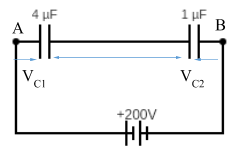
Capacitor connected in series must have same charge, therefore ${{Q}_{Total}}={{Q}_{C1}}={{Q}_{C2}}$
Applying Kirchhoff’s Voltage law in the above circuit will give us:
${{V}_{AB}}={{V}_{C1}}+{{V}_{C2}}=200V$
Hence, Voltage across each capacitor will be:
${{V}_{C1}}=\dfrac{{{Q}_{total}}}{{{C}_{1}}}$ ------(1)
And,
${{V}_{C2}}=\dfrac{{{Q}_{total}}}{{{C}_{2}}}$ ------(2)
Dividing equation 1 by 2 will give us: $\dfrac{{{V}_{C2}}}{{{V}_{C1}}}=\dfrac{{{C}_{1}}}{{{C}_{2}}}$
Putting the values of ${{C}_{1}}$ and ${{C}_{2}}$,
$\dfrac{{{V}_{C2}}}{{{V}_{C1}}}=\dfrac{4}{1}$
Hence, the ratio of potential difference across capacitor ${{C}_{2}}$ to that across capacitor ${{C}_{1}}$ is 4:1.
Note:
Always make sure that what ratio you have been asked for, is that ratio of 1st with respect to 2nd or it is ratio of 2nd with respect to 1st. most of the time both the options are given in the question. We can also find out the ratio by evaluating the total electrical charge which will be stored within the capacitors by evaluating total capacitance using:_
$\dfrac{1}{C}=\dfrac{1}{{{C}_{1}}}+\dfrac{1}{{{C}_{2}}}$
$C=\dfrac{4}{5}\mu F$
Total charge, ${{Q}_{total}}$ =$C\times V=80\mu C$
Hence, Voltage across${{C}_{1}}$ and ${{C}_{2}}$, using equation 1 and 2, will be 20 V and 80 V, respectively, which will give us the ratio of potential difference across ${{C}_{2}}$ to ${{C}_{1}}$ as 4:1.
$Q=C\times V$
Complete Solution:
The problem can be depicted by the circuit diagram shown below:
Capacitor connected in series must have same charge, therefore ${{Q}_{Total}}={{Q}_{C1}}={{Q}_{C2}}$
Applying Kirchhoff’s Voltage law in the above circuit will give us:
${{V}_{AB}}={{V}_{C1}}+{{V}_{C2}}=200V$
Hence, Voltage across each capacitor will be:
${{V}_{C1}}=\dfrac{{{Q}_{total}}}{{{C}_{1}}}$ ------(1)
And,
${{V}_{C2}}=\dfrac{{{Q}_{total}}}{{{C}_{2}}}$ ------(2)
Dividing equation 1 by 2 will give us: $\dfrac{{{V}_{C2}}}{{{V}_{C1}}}=\dfrac{{{C}_{1}}}{{{C}_{2}}}$
Putting the values of ${{C}_{1}}$ and ${{C}_{2}}$,
$\dfrac{{{V}_{C2}}}{{{V}_{C1}}}=\dfrac{4}{1}$
Hence, the ratio of potential difference across capacitor ${{C}_{2}}$ to that across capacitor ${{C}_{1}}$ is 4:1.
Note:
Always make sure that what ratio you have been asked for, is that ratio of 1st with respect to 2nd or it is ratio of 2nd with respect to 1st. most of the time both the options are given in the question. We can also find out the ratio by evaluating the total electrical charge which will be stored within the capacitors by evaluating total capacitance using:_
$\dfrac{1}{C}=\dfrac{1}{{{C}_{1}}}+\dfrac{1}{{{C}_{2}}}$
$C=\dfrac{4}{5}\mu F$
Total charge, ${{Q}_{total}}$ =$C\times V=80\mu C$
Hence, Voltage across${{C}_{1}}$ and ${{C}_{2}}$, using equation 1 and 2, will be 20 V and 80 V, respectively, which will give us the ratio of potential difference across ${{C}_{2}}$ to ${{C}_{1}}$ as 4:1.
Recently Updated Pages
Master Class 12 Economics: Engaging Questions & Answers for Success

Master Class 12 Physics: Engaging Questions & Answers for Success
Master Class 12 English: Engaging Questions & Answers for Success
Master Class 12 Social Science: Engaging Questions & Answers for Success
Master Class 12 Maths: Engaging Questions & Answers for Success
Master Class 12 Business Studies: Engaging Questions & Answers for Success
Trending doubts
Which are the Top 10 Largest Countries of the World?
What are the major means of transport Explain each class 12 social science CBSE
Draw a labelled sketch of the human eye class 12 physics CBSE
Why cannot DNA pass through cell membranes class 12 biology CBSE
Differentiate between insitu conservation and exsitu class 12 biology CBSE
Draw a neat and well labeled diagram of TS of ovary class 12 biology CBSE