




Two amplifiers are connected one after the other in series (cascade). The first amplifier has a voltage gain of 10 and the second has a voltage gain of 20. If the input signal is 0.01 volt, calculate the output ac signal.
Answer
 Verified
615.6k+ views
- Hint: In this question use the given gain that is ${K_1}$ and ${K_2}$ of the two amplifiers, then use the direct relationship between the output voltage, input voltage and the gain of amplifiers in cascade that is ${V_{out}} = \left( {{K_1}{K_2}} \right){V_{in}}$. This will help get the right answer.
Complete step-by-step solution -
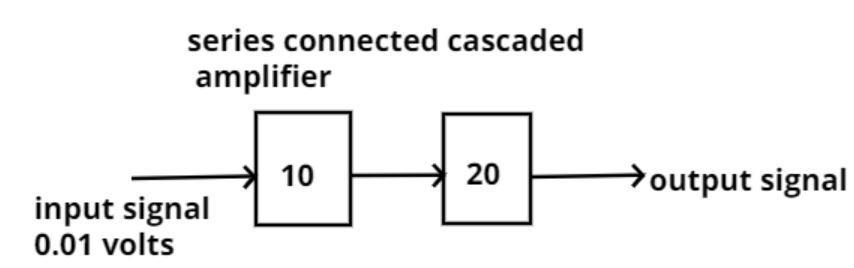
Two amplifiers are connected one after the other in series (cascaded) as shown in the figure.
The first amplifier has a voltage gain of 10 as shown in the figure.
Therefore, ${K_1}$ = 10, where ${K_1}$ is the gain of the first amplifier.
Second amplifier has a voltage gain of 20 as shown in the figure.
Therefore, ${K_2}$ = 20, where ${K_2}$ is the gain of the second amplifier.
It is given that the input signal has the voltage of 0.01 volts.
Therefore, ${V_{in}}$ = 0.01 Volts, where ${V_{in}}$ is the input voltage
Now the output voltage of the given cascaded system is given as
${V_{out}} = \left( {{K_1}{K_2}} \right){V_{in}}$
Where, ${V_{out}}$ = output voltage
Now substitute the values in the above equation we have,
$ \Rightarrow {V_{out}} = \left( {10 \times 20} \right)0.01$
Now simplify this we have,
$ \Rightarrow {V_{out}} = \left( {200} \right)0.01 = 2$ Volts.
So this is the required output voltage of the cascaded series system.
So this is the required answer.
Note – Cascade is somewhat similar to the series combination. In cascade amplifier configuration the gains of the amplifier that are the part of the system gets multiplied. This was the trick point here in this question. Some students may confuse that gains should be added but however this what eventually differentiate between the series resistor combination and the cascade amplifier configuration.
Complete step-by-step solution -
Two amplifiers are connected one after the other in series (cascaded) as shown in the figure.
The first amplifier has a voltage gain of 10 as shown in the figure.
Therefore, ${K_1}$ = 10, where ${K_1}$ is the gain of the first amplifier.
Second amplifier has a voltage gain of 20 as shown in the figure.
Therefore, ${K_2}$ = 20, where ${K_2}$ is the gain of the second amplifier.
It is given that the input signal has the voltage of 0.01 volts.
Therefore, ${V_{in}}$ = 0.01 Volts, where ${V_{in}}$ is the input voltage
Now the output voltage of the given cascaded system is given as
${V_{out}} = \left( {{K_1}{K_2}} \right){V_{in}}$
Where, ${V_{out}}$ = output voltage
Now substitute the values in the above equation we have,
$ \Rightarrow {V_{out}} = \left( {10 \times 20} \right)0.01$
Now simplify this we have,
$ \Rightarrow {V_{out}} = \left( {200} \right)0.01 = 2$ Volts.
So this is the required output voltage of the cascaded series system.
So this is the required answer.
Note – Cascade is somewhat similar to the series combination. In cascade amplifier configuration the gains of the amplifier that are the part of the system gets multiplied. This was the trick point here in this question. Some students may confuse that gains should be added but however this what eventually differentiate between the series resistor combination and the cascade amplifier configuration.
Recently Updated Pages
Basicity of sulphurous acid and sulphuric acid are

Master Class 12 English: Engaging Questions & Answers for Success
Master Class 12 Social Science: Engaging Questions & Answers for Success
Master Class 12 Maths: Engaging Questions & Answers for Success
Master Class 12 Economics: Engaging Questions & Answers for Success
Master Class 12 Physics: Engaging Questions & Answers for Success
Trending doubts
Which are the Top 10 Largest Countries of the World?
Draw a labelled sketch of the human eye class 12 physics CBSE
Which country did Danny Casey play for class 12 english CBSE
Give 10 examples of unisexual and bisexual flowers
Coming together federation is practiced in A India class 12 social science CBSE
Write the formula to find the shortest distance between class 12 maths CBSE