




What is true of polytene chromosomes?
A. They are in permanent prophase
B. They show chiasmata
C. Lateral loops occur at most places.
D. They are bivalent.
Answer
 Verified
501.3k+ views
Hint: Chromosome is the DNA (deoxyribonucleic acid) that consists of genes in it. Chromosomes are of different types in which one is a polytene chromosome that consists of large strands of chromosomes discovered by Balbiani in 1881.
Complete answer:
Chromosomes consist of a long strand of deoxyribonucleic acid in which the genes are present and they play the major role in hereditary features of an organism. Chromosomes are of different types: Lampbrush, Polytene and supernumerary chromosomes.
Polytene chromosomes have very large strands of chromosomes but smaller than the Lampbrush chromosome found in larvae of invertebrates (Drosophila, Chironomus) and salivary glands of insects. The cells undergo successive rounds of DNA duplication but without cell division, this leads to enlargement in cell volume and formation of polytene chromosomes and the condition is called polyteny. The nucleus having polytene chromosomes are much larger than the ordinary chromosomes as well as the chromosome enlarges by 200 times that of a normal chromosome. It was first discovered in 1881 by Balbiani in Chironomus. The chromosome in this condition has two bands one is the dark band and the other is the light band and is formed as the chromosome in some regions are tightly bound and in the other region is loosely bound.
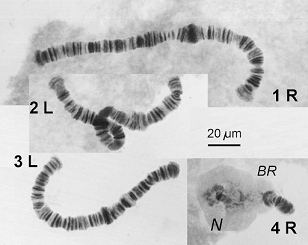
The functions of polytene chromosomes are to carry the genes that are required to conduct the normal functioning of an organism and also have an indirect role in protein synthesis.
Option A: As the polytene chromosomes lack the last step of the cell cycle that is a mitotic division that results in a lack of DNA segregation leads to remaining in permanent prophase. Hence option A is correct.
Option B: Chiasmata is a process through which the homologous chromosomes get segregated, this is not shown by the polytene chromosomes.
Option C: Lampbrush chromosome consists of lateral loops in chromosomes and it resembles beads in a string.
Option D: Bivalent condition is shown when two homologous chromosomes get crossed over each other and the chiasmata get formed at least on one site. So, this is also not true about the polytene chromosome.
Therefore, option A is the correct answer.
Note:
When Polytene chromosomes are discovered in the salivary glands of Drosophila then it is also known as the common salivary gland chromosome but this becomes a misnomer as it was then discovered that it is also found in the nucleus of the somatic cell.
Complete answer:
Chromosomes consist of a long strand of deoxyribonucleic acid in which the genes are present and they play the major role in hereditary features of an organism. Chromosomes are of different types: Lampbrush, Polytene and supernumerary chromosomes.
Polytene chromosomes have very large strands of chromosomes but smaller than the Lampbrush chromosome found in larvae of invertebrates (Drosophila, Chironomus) and salivary glands of insects. The cells undergo successive rounds of DNA duplication but without cell division, this leads to enlargement in cell volume and formation of polytene chromosomes and the condition is called polyteny. The nucleus having polytene chromosomes are much larger than the ordinary chromosomes as well as the chromosome enlarges by 200 times that of a normal chromosome. It was first discovered in 1881 by Balbiani in Chironomus. The chromosome in this condition has two bands one is the dark band and the other is the light band and is formed as the chromosome in some regions are tightly bound and in the other region is loosely bound.
The functions of polytene chromosomes are to carry the genes that are required to conduct the normal functioning of an organism and also have an indirect role in protein synthesis.
Option A: As the polytene chromosomes lack the last step of the cell cycle that is a mitotic division that results in a lack of DNA segregation leads to remaining in permanent prophase. Hence option A is correct.
Option B: Chiasmata is a process through which the homologous chromosomes get segregated, this is not shown by the polytene chromosomes.
Option C: Lampbrush chromosome consists of lateral loops in chromosomes and it resembles beads in a string.
Option D: Bivalent condition is shown when two homologous chromosomes get crossed over each other and the chiasmata get formed at least on one site. So, this is also not true about the polytene chromosome.
Therefore, option A is the correct answer.
Note:
When Polytene chromosomes are discovered in the salivary glands of Drosophila then it is also known as the common salivary gland chromosome but this becomes a misnomer as it was then discovered that it is also found in the nucleus of the somatic cell.
Recently Updated Pages
Master Class 10 Computer Science: Engaging Questions & Answers for Success

Master Class 10 General Knowledge: Engaging Questions & Answers for Success
Master Class 10 English: Engaging Questions & Answers for Success
Master Class 10 Social Science: Engaging Questions & Answers for Success
Master Class 10 Maths: Engaging Questions & Answers for Success
Master Class 10 Science: Engaging Questions & Answers for Success
Trending doubts
Which is more stable and why class 12 chemistry CBSE
Which are the Top 10 Largest Countries of the World?
Draw a labelled sketch of the human eye class 12 physics CBSE
Differentiate between homogeneous and heterogeneous class 12 chemistry CBSE
What are the major means of transport Explain each class 12 social science CBSE
Sulphuric acid is known as the king of acids State class 12 chemistry CBSE