




What is true of Bacillariophyceae?
(a) Epitheca is smaller.
(b) Hypotheca is smaller.
(c) Both epitheca and hypotheca have a small size.
(d) Any of the two can be larger
Answer
 Verified
631.2k+ views
Hint: They are commonly unicellular and free-living but some members form colonies of various shapes like filaments, mucilaginous colonies, etc. Microscopic cells are of different shapes. They may be oval, spherical, triangular, boat-shaped, etc. The plant bodies are either bilateral or radial in symmetry.
Complete answer:
-The diatoms, which belong to Bacillariophyceae and have an external hard and porous layer called frustules.
-These frustules are made up of two parts (also called valves or thecae).
-The smaller theca is called hypothecate.
Additional Information: Diatoms are among the preeminent significant and productive minute ocean creatures and serve straightforwardly or in a roundabout way as nourishment for a few creatures. Diatomaceous earth, a substance made out of fossil diatoms, is utilized in channels, protection, abrasives, paints, and stains and as a stick of base dynamite.
The diatoms might be either unicellular or colonial. The silicified cell film shapes a pillbox-like shell (frustule) made out of covering parts (epitheca and hypotheca) punctured by many-sided and sensitive examples. Food is put away as oil beads, and subsequently, the brilliant earthy colored shade fucoxanthin veils the chlorophyll and carotenoid colors that additionally are available. Diatoms are regularly isolated into two requests on the possibility of symmetry and shape: the round nonmotile Centrales have outspread markings; the extended Pennales, which move with a skimming movement, have pinnate (featherlike) markings.
So the correct answer is ‘Hypotheca is smaller’.
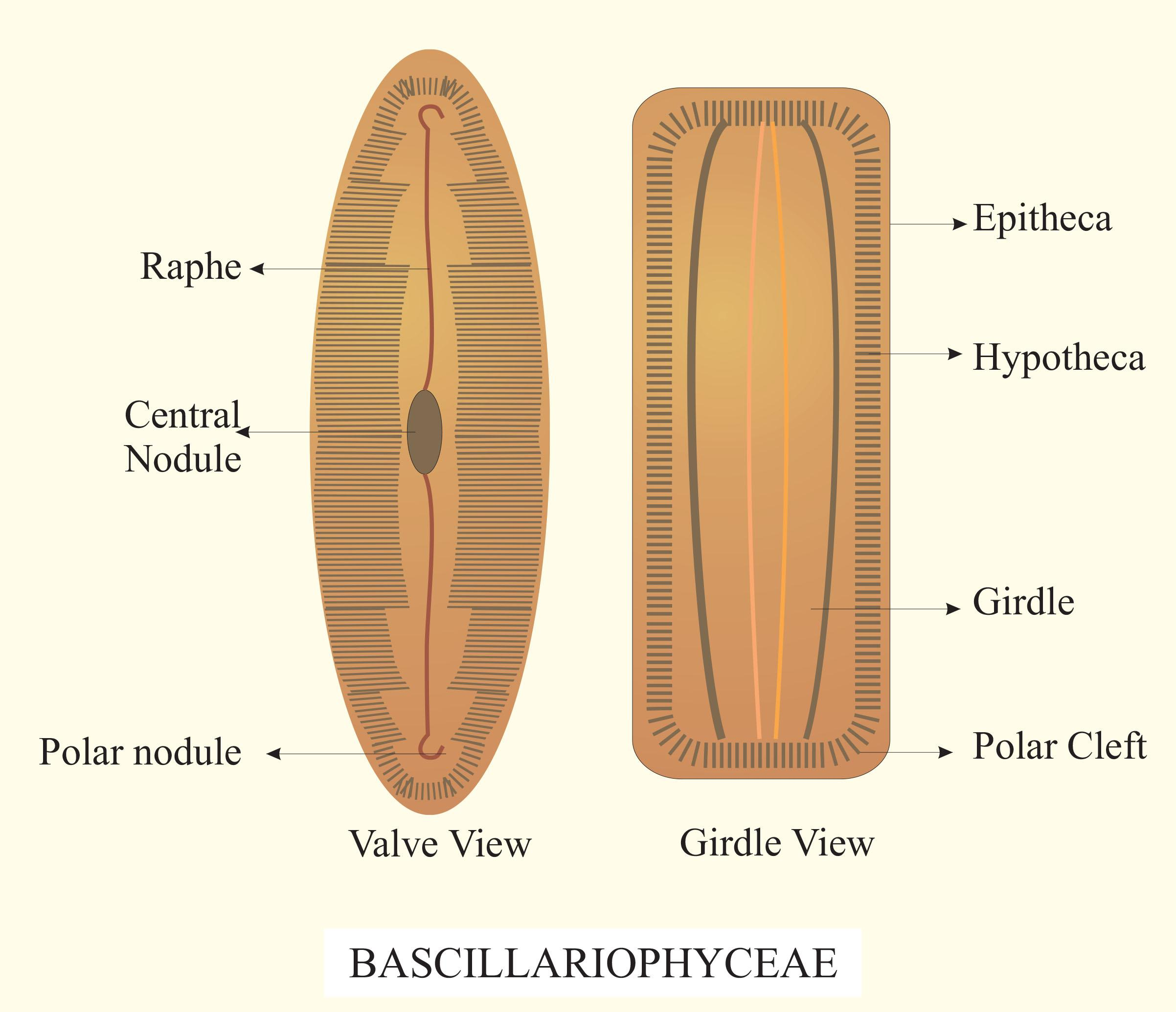
Note: In Bacillariophyceae, reserve food is oil, volutin, and chrysolaminarin. Vegetative multiplication takes place by cellular division, which is extremely common. Some of the cells become considerably reduced in size. The auxospore develops to regain the traditional size and they produce a characteristic spore. Sexual reproduction takes place by isogamy and oogamy.
Complete answer:
-The diatoms, which belong to Bacillariophyceae and have an external hard and porous layer called frustules.
-These frustules are made up of two parts (also called valves or thecae).
-The smaller theca is called hypothecate.
Additional Information: Diatoms are among the preeminent significant and productive minute ocean creatures and serve straightforwardly or in a roundabout way as nourishment for a few creatures. Diatomaceous earth, a substance made out of fossil diatoms, is utilized in channels, protection, abrasives, paints, and stains and as a stick of base dynamite.
The diatoms might be either unicellular or colonial. The silicified cell film shapes a pillbox-like shell (frustule) made out of covering parts (epitheca and hypotheca) punctured by many-sided and sensitive examples. Food is put away as oil beads, and subsequently, the brilliant earthy colored shade fucoxanthin veils the chlorophyll and carotenoid colors that additionally are available. Diatoms are regularly isolated into two requests on the possibility of symmetry and shape: the round nonmotile Centrales have outspread markings; the extended Pennales, which move with a skimming movement, have pinnate (featherlike) markings.
So the correct answer is ‘Hypotheca is smaller’.
Note: In Bacillariophyceae, reserve food is oil, volutin, and chrysolaminarin. Vegetative multiplication takes place by cellular division, which is extremely common. Some of the cells become considerably reduced in size. The auxospore develops to regain the traditional size and they produce a characteristic spore. Sexual reproduction takes place by isogamy and oogamy.
Recently Updated Pages
Which will be the least stable resonating structure class 11 chemistry CBSE

How many 5 digit telephone numbers can be construc-class-11-maths-CBSE
How do you find the angle of the resultant vector class 11 physics CBSE
Draw labelled diagram of the following i Gram seed class 11 biology CBSE
What is the need and importance of classification class 11 biology CBSE
The way in which the sparrows expressed their sorrow class 11 english CBSE
Trending doubts
One Metric ton is equal to kg A 10000 B 1000 C 100 class 11 physics CBSE
1 Quintal is equal to a 110 kg b 10 kg c 100kg d 1000 class 11 physics CBSE
Draw a diagram of nephron and explain its structur class 11 biology CBSE
10 examples of friction in our daily life
Proton was discovered by A Thomson B Rutherford C Chadwick class 11 chemistry CBSE
Bond order ofO2 O2+ O2 and O22 is in order A O2 langle class 11 chemistry CBSE