




Trophic levels in a food chain are formed by
(a) Producers
(b) Consumers
(c) Decomposers
(d) All of the above
Answer
 Verified
639.3k+ views
Hint: A food chain starts with a species that will not eat any other species, and ends in a species which will not be eaten by any other species. The successive stages or steps of the food chain are known as Trophic levels or nutritional levels. The step by step transfer of energy through the successive trophic levels of a food chain is called energy flow. Trophic level is precisely a nutritional status of a species in a food chain. The trophic level of an organism is the position it occupies in a food web.
Complete answer:
In an ecosystem, there is a regular repetition of eating others and being eaten by other processes in a definite linear chain. A chain of organisms through which food energy is transferred from primary producers to Decomposers through all successive levels of consumers is known as a food chain or trophic chain. Trophic levels are successive stages or steps of energy. Usually, there are 4 or 5 trophic levels in a food chain. The first and lowest trophic level of a grazing food chain is represented by producers, the second trophic level by herbivores or primary consumers. The third one by primary carnivores or secondary consumers. The fourth one by secondary carnivores or tertiary consumers.
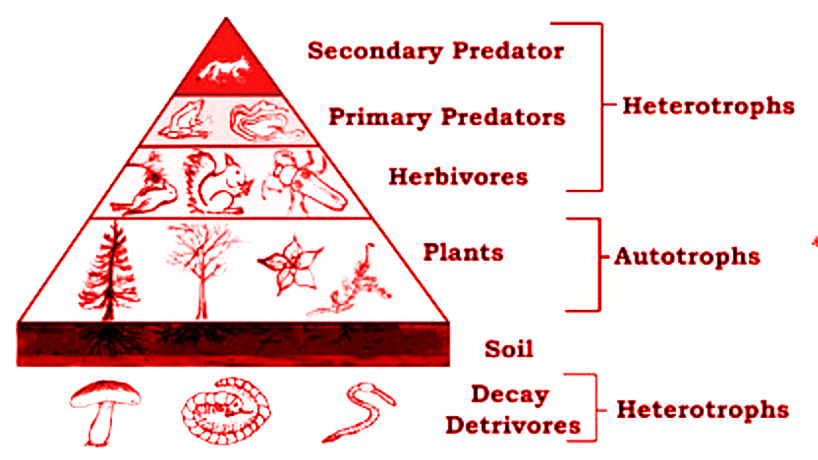
The last one by Decomposers. Carnivorous consumers are generally called predators. The exact trophic level of omnivorous animals is difficult to determine since they are herbivorous as well as carnivorous mixed feeders subsisting on plant food and animal food. Thus the producers, consumers, and Decomposers form the trophic levels in a food chain.
Additional Information:
- Based on organisms of the first trophic level, three major kinds of the food chain can be recognized; grazing, detritus, and auxiliary.
- Grazing is the habit of feeding on grasses, whereas browsing the food chain is the habit of feeding on herbs and shrubs.
- Detritus occurs among the communities of land surface and those on the floor of ponds.
So, the correct answer is All of the above.
Note:
- At each stage of energy transfer in a food chain, a considerable amount of energy is used up and some amount of energy is lost.
- So there is a progressive decrease in the quantity of energy transferred from one trophic level to the next. The first trophic level is represented by producers, last by Decomposers, and the intermediate one by successive levels of consumers.
- Of the intermediate levels the first one is represented by the herbivores, and the others by successive levels of carnivores. During the transfer of food energy from one trophic level to the next, nearly $74\%$ - $90\%$ of the energy store is lost.
Complete answer:
In an ecosystem, there is a regular repetition of eating others and being eaten by other processes in a definite linear chain. A chain of organisms through which food energy is transferred from primary producers to Decomposers through all successive levels of consumers is known as a food chain or trophic chain. Trophic levels are successive stages or steps of energy. Usually, there are 4 or 5 trophic levels in a food chain. The first and lowest trophic level of a grazing food chain is represented by producers, the second trophic level by herbivores or primary consumers. The third one by primary carnivores or secondary consumers. The fourth one by secondary carnivores or tertiary consumers.
The last one by Decomposers. Carnivorous consumers are generally called predators. The exact trophic level of omnivorous animals is difficult to determine since they are herbivorous as well as carnivorous mixed feeders subsisting on plant food and animal food. Thus the producers, consumers, and Decomposers form the trophic levels in a food chain.
Additional Information:
- Based on organisms of the first trophic level, three major kinds of the food chain can be recognized; grazing, detritus, and auxiliary.
- Grazing is the habit of feeding on grasses, whereas browsing the food chain is the habit of feeding on herbs and shrubs.
- Detritus occurs among the communities of land surface and those on the floor of ponds.
So, the correct answer is All of the above.
Note:
- At each stage of energy transfer in a food chain, a considerable amount of energy is used up and some amount of energy is lost.
- So there is a progressive decrease in the quantity of energy transferred from one trophic level to the next. The first trophic level is represented by producers, last by Decomposers, and the intermediate one by successive levels of consumers.
- Of the intermediate levels the first one is represented by the herbivores, and the others by successive levels of carnivores. During the transfer of food energy from one trophic level to the next, nearly $74\%$ - $90\%$ of the energy store is lost.
Recently Updated Pages
Which of the following graphs shows the variation of class 12 physics CBSE

Draw a labelled diagram of the human male reproductive class 12 biology CBSE
Describe the experiment to compare the emf of two cells class 12 physics CBSE
What is standard hydrogen electrode
What is conventional current and electric current class 12 physics CBSE
2Bromopentane is treated with an alcoholic KOH solution class 12 chemistry CBSE
Trending doubts
Draw a labelled sketch of the human eye class 12 physics CBSE
Which are the Top 10 Largest Countries of the World?
Differentiate between homogeneous and heterogeneous class 12 chemistry CBSE
Draw ray diagrams each showing i myopic eye and ii class 12 physics CBSE
Which is the correct genotypic ratio of mendel dihybrid class 12 biology CBSE
What is the Full Form of PVC, PET, HDPE, LDPE, PP and PS ?