




Trace the curve $y={{x}^{3}}$.
Answer
 Verified
637.8k+ views
Hint: To trace a graph, first check its domain and range. Then find its intercepts with the coordinate axes. Net check for symmetry and if the curve is asymptotic or not. Next check its derivative to find its increasing or decreasing nature. Finally, find its second derivative to check for any points of inflection.
Complete step-by-step answer:
We have to trace the curve $y={{x}^{3}}$ .
We will first check its domain and range. Since $x$ and $y$ are real numbers, we have
$x\in \mathbb{R}$ and $y\in \mathbb{R}$, the domain and range both stretch over all real numbers.
Now we will find the intercepts with the coordinate axes.
When $x=0$, we get $y=0$.
When $y=0$, we get $x=0$.
$\begin{align}
& y={{x}^{3}} \\
& x=0 \\
& y=0 \\
\end{align}$
This means that the curve passes through the origin.
Now, let us check its symmetry.
Substitute x by -x , we will get ${{y}_{1}}=-{{x}^{3}}=-y$
So $y={{x}^{3}}$ satisfies the property that $f\left( -x \right)=-f\left( x \right)$ .
So it is an odd function and is symmetric about the origin.
Now let us check if the function is asymptotic or not.
When $x\to \infty ,y\to \infty $ and vice versa.
So the function is not asymptotic.
Now, let us check its derivative:
$\dfrac{dy}{dx}=3{{x}^{2}}$
Since \[3{{x}^{2}}>0\forall x\]
Hence, \[\dfrac{dy}{dx}>0\forall x\]
Hence, the graph is monotonically increasing and will intersect the axes at the origin only.
Now, let us check its second derivative:
\[\dfrac{{{d}^{2}}y}{d{{x}^{2}}}=6x\]
\[6x=0\] for \[x=0\] . At \[x=0\], we have \[y=0\] .
So, \[\left( 0,0 \right)\] is the point of inflection.
Using all this information, we draw the following graph:
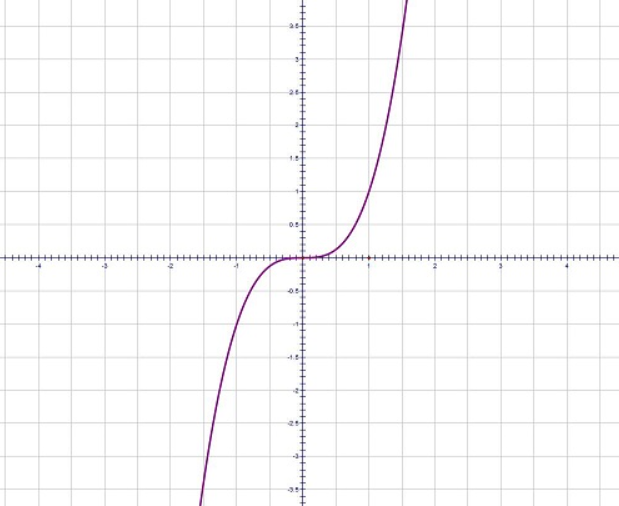
Note: Notice that when $x>0,y>0$ and when $x<0,y<0$ . So the curve will lie only in the quadrants 1 and 3. We can also find the intervals where $\dfrac{{{d}^{2}}y}{d{{x}^{2}}}>0$ or $\dfrac{{{d}^{2}}y}{d{{x}^{2}}}<0$ to check for the nature of curvature in the interval.
Complete step-by-step answer:
We have to trace the curve $y={{x}^{3}}$ .
We will first check its domain and range. Since $x$ and $y$ are real numbers, we have
$x\in \mathbb{R}$ and $y\in \mathbb{R}$, the domain and range both stretch over all real numbers.
Now we will find the intercepts with the coordinate axes.
When $x=0$, we get $y=0$.
When $y=0$, we get $x=0$.
$\begin{align}
& y={{x}^{3}} \\
& x=0 \\
& y=0 \\
\end{align}$
This means that the curve passes through the origin.
Now, let us check its symmetry.
Substitute x by -x , we will get ${{y}_{1}}=-{{x}^{3}}=-y$
So $y={{x}^{3}}$ satisfies the property that $f\left( -x \right)=-f\left( x \right)$ .
So it is an odd function and is symmetric about the origin.
Now let us check if the function is asymptotic or not.
When $x\to \infty ,y\to \infty $ and vice versa.
So the function is not asymptotic.
Now, let us check its derivative:
$\dfrac{dy}{dx}=3{{x}^{2}}$
Since \[3{{x}^{2}}>0\forall x\]
Hence, \[\dfrac{dy}{dx}>0\forall x\]
Hence, the graph is monotonically increasing and will intersect the axes at the origin only.
Now, let us check its second derivative:
\[\dfrac{{{d}^{2}}y}{d{{x}^{2}}}=6x\]
\[6x=0\] for \[x=0\] . At \[x=0\], we have \[y=0\] .
So, \[\left( 0,0 \right)\] is the point of inflection.
Using all this information, we draw the following graph:
Note: Notice that when $x>0,y>0$ and when $x<0,y<0$ . So the curve will lie only in the quadrants 1 and 3. We can also find the intervals where $\dfrac{{{d}^{2}}y}{d{{x}^{2}}}>0$ or $\dfrac{{{d}^{2}}y}{d{{x}^{2}}}<0$ to check for the nature of curvature in the interval.
Recently Updated Pages
Master Class 12 Business Studies: Engaging Questions & Answers for Success

Master Class 12 Biology: Engaging Questions & Answers for Success
Master Class 12 Chemistry: Engaging Questions & Answers for Success
Class 12 Question and Answer - Your Ultimate Solutions Guide
Master Class 11 Social Science: Engaging Questions & Answers for Success
Master Class 11 English: Engaging Questions & Answers for Success
Trending doubts
Which is more stable and why class 12 chemistry CBSE
Which are the Top 10 Largest Countries of the World?
Draw a labelled sketch of the human eye class 12 physics CBSE
Differentiate between homogeneous and heterogeneous class 12 chemistry CBSE
What are the major means of transport Explain each class 12 social science CBSE
Sulphuric acid is known as the king of acids State class 12 chemistry CBSE