




$T_i$ plasmid used for making transgenic plants belong to
(a)Clostridium
(b)Saccharomyces
(c)Agrobacterium
(d)Escherichia
Answer
 Verified
594.9k+ views
Hint: $T_i$ plasmid (tumor-inducing) having tumor-inducing genes (T-DNA) is present in gram-negative soil bacteria which causes crown gall disease. This gram-negative soil bacteria is used for indirect gene delivery systems.
Complete answer:
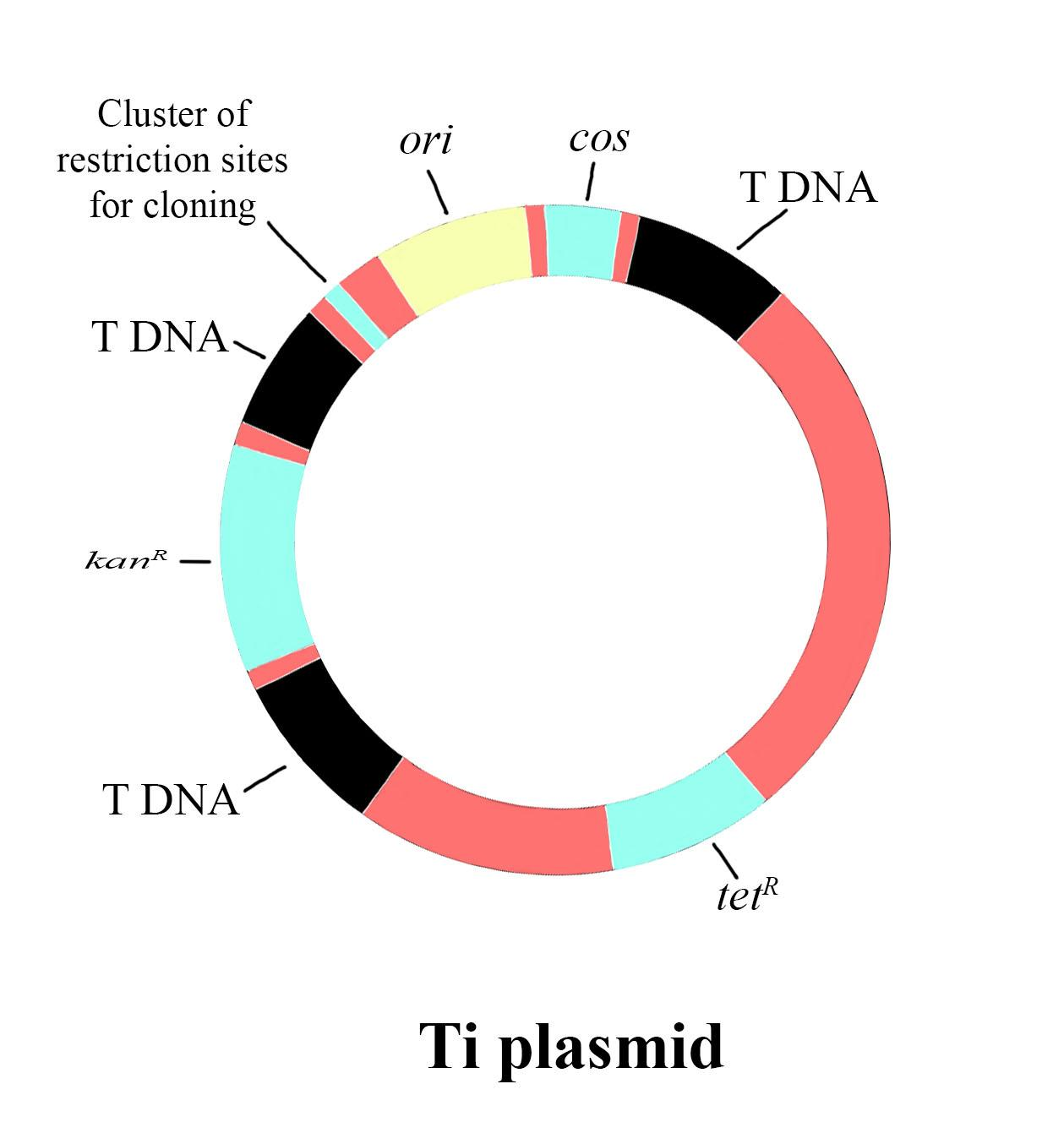
-Agrobacterium tumefaciens forms an efficient delivery system for genetic transformation in plants. These bacteria harbor a large plasmid called $T_i$ plasmid (tumor-inducing) having tumor-inducing genes (T-DNA) and other genes involved in the integration of T-DNA into the host genome.
-Wounded plants secrete a sap with a high content of phenolic compounds that serve as chemical attractants for Agrobacterium and stimulate the expression of vir genes.
-It results in infection of plants by Agrobacterium, insertion of T-DNA region at a random site in the host genome, and proliferation of plant cells to form crown gall growth.
Additional Information: - T-DNA region: It is a region of $T_i$ plasmid which contains genes from the induction of tumors. It is flanked by 25 bp direct repeat sequences on both sides. These repeats are called the Left border (LB) and the Right border (RB).
-The different genes present in this region are – iaaM and iaaH genes - responsible for the synthesis of indole acetic acid (an auxin),
-ipt gene is responsible for the synthesis of an enzyme isopentenyl adenine (a cytokinin)
-tml gene is another gene involved in the formation of tumors.
-Opine biosynthesis genes lead to the synthesis of opines.
-An expression cassette of T-DNA is developed including the gene of interest flanked by promoter and terminator sequences to drive expression and marker genes to facilitate selection of transformed plants by tracking introduced genes in the host plant.
So, the correct answer is ‘Agrobacterium’.
Note: -Insertion of the cassette into the T-DNA region of the binary vector/co-integrated vector is carried out.
-Transformation of the above expression vector into Agrobacterium Is done.
-Explants are obtained from plants that are to be transformed. They are wounded and then co-cultured for a brief period for Agrobacterium infection. This is done using tissue culture methods.
Complete answer:
-Agrobacterium tumefaciens forms an efficient delivery system for genetic transformation in plants. These bacteria harbor a large plasmid called $T_i$ plasmid (tumor-inducing) having tumor-inducing genes (T-DNA) and other genes involved in the integration of T-DNA into the host genome.
-Wounded plants secrete a sap with a high content of phenolic compounds that serve as chemical attractants for Agrobacterium and stimulate the expression of vir genes.
-It results in infection of plants by Agrobacterium, insertion of T-DNA region at a random site in the host genome, and proliferation of plant cells to form crown gall growth.
Additional Information: - T-DNA region: It is a region of $T_i$ plasmid which contains genes from the induction of tumors. It is flanked by 25 bp direct repeat sequences on both sides. These repeats are called the Left border (LB) and the Right border (RB).
-The different genes present in this region are – iaaM and iaaH genes - responsible for the synthesis of indole acetic acid (an auxin),
-ipt gene is responsible for the synthesis of an enzyme isopentenyl adenine (a cytokinin)
-tml gene is another gene involved in the formation of tumors.
-Opine biosynthesis genes lead to the synthesis of opines.
-An expression cassette of T-DNA is developed including the gene of interest flanked by promoter and terminator sequences to drive expression and marker genes to facilitate selection of transformed plants by tracking introduced genes in the host plant.
So, the correct answer is ‘Agrobacterium’.
Note: -Insertion of the cassette into the T-DNA region of the binary vector/co-integrated vector is carried out.
-Transformation of the above expression vector into Agrobacterium Is done.
-Explants are obtained from plants that are to be transformed. They are wounded and then co-cultured for a brief period for Agrobacterium infection. This is done using tissue culture methods.
Recently Updated Pages
Master Class 12 Business Studies: Engaging Questions & Answers for Success

Master Class 12 Chemistry: Engaging Questions & Answers for Success
Master Class 12 Biology: Engaging Questions & Answers for Success
Class 12 Question and Answer - Your Ultimate Solutions Guide
Master Class 11 English: Engaging Questions & Answers for Success
Master Class 11 Maths: Engaging Questions & Answers for Success
Trending doubts
Which is more stable and why class 12 chemistry CBSE
Which are the Top 10 Largest Countries of the World?
Draw a labelled sketch of the human eye class 12 physics CBSE
Differentiate between homogeneous and heterogeneous class 12 chemistry CBSE
What are the major means of transport Explain each class 12 social science CBSE
Sulphuric acid is known as the king of acids State class 12 chemistry CBSE