




Three resistors are connected in series across a 12V battery. The first resistor has a value of $1\Omega $, the second has a voltage drop of 4V, and the third has a power dissipation of 12W. Then, the value of the circuit current is
A) $2A$
B) $6A$
C) Either $2A$ or $6A$
D) None of the above
Answer
 Verified
630.6k+ views
Hint: Ohm's law and power dissipated by the circuit expression used to solve the problem. Initially, the equivalent voltage across the resistance is calculated for a serious combination from using a given power value. Then current flow across the circuit is deduced by a quadratic equation.
Formula used:
The expression for finding the power is $P = VI$, Where $P$ is the power dissipated, $V$ is voltage and $I$ is the current.
According to the ohm's law, the expression for finding the voltage across the resistor is $V = IR$, Where $R$ is the resistance.
Complete step by step answer:
Let us first write the information given in the question.
$V = 12V,{R_1} = 1\Omega , {V_2} = 4V, {P_3} = 12W$
We have to find the current through the circuit.
The corresponding circuit diagram is similar to the following circuit.
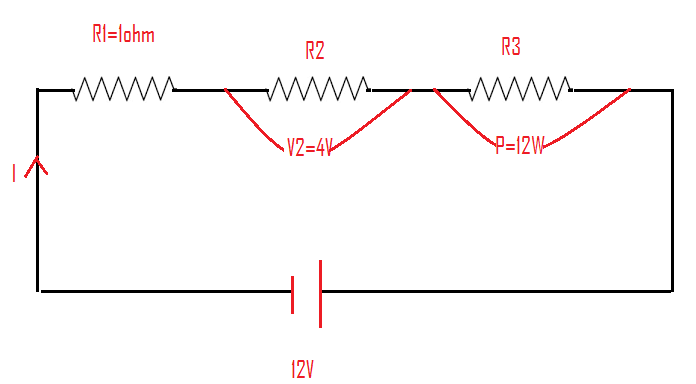
Let us now write the expression for the total voltage of the circuit.
\[V = {V_1} + {V_2} + {V_3}\]
Let us substitute the values in the above expression using $P = VI$ and $V = IR$
\[\Rightarrow 12 = I \times 1 + 4 + \dfrac{{12}}{I}\]
Let us now simplify the expression.
\[\Rightarrow 12I = {I^2} + 4I + 12 \Rightarrow {I^2} - 8I + 12 = 0\]
Let us use the middle term splitting to find the values of current.
\[\Rightarrow {I^2} - 6I - 2I + 12 = 0\]
Let us take the common terms from the first two and last two terms.
\[\Rightarrow I(I - 6) - 2(I - 6) = 0\]
Again, take common (I - 6) from the above terms.
\[\Rightarrow (I - 6)(1 - 2) = 0\]
Let us further solve for two values of current.
$I - 6 = 0 \Rightarrow I = 6A$ OR $I - 2 = 0 \Rightarrow I = 2A$
$\therefore $ The value of the current in the circuit is either 6A or 2A. Hence, the correct option is (C) is correct.
Note:
In series combination, the current is the same through every resistor but voltage varies. Hence, effective resistance is the sum total of all the resistors in the circuit.
In a parallel combination current is different through every resistor but voltage is the same across all the resistors as they are connected to the common potential difference. Hence, effective resistance is not just the sum of all resistors instead effective resistance gets reduced using the following formula.
$\dfrac{1}{{{R_{effective}}}} = \dfrac{1}{{{R_1}}} + \dfrac{1}{{{R_2}}}$
Where ${{\text{R}}_{\text{1}}}$ is the resistance of the first circuit and ${{\text{R}}_2}$ is the resistance of second circuit.
Formula used:
The expression for finding the power is $P = VI$, Where $P$ is the power dissipated, $V$ is voltage and $I$ is the current.
According to the ohm's law, the expression for finding the voltage across the resistor is $V = IR$, Where $R$ is the resistance.
Complete step by step answer:
Let us first write the information given in the question.
$V = 12V,{R_1} = 1\Omega , {V_2} = 4V, {P_3} = 12W$
We have to find the current through the circuit.
The corresponding circuit diagram is similar to the following circuit.
Let us now write the expression for the total voltage of the circuit.
\[V = {V_1} + {V_2} + {V_3}\]
Let us substitute the values in the above expression using $P = VI$ and $V = IR$
\[\Rightarrow 12 = I \times 1 + 4 + \dfrac{{12}}{I}\]
Let us now simplify the expression.
\[\Rightarrow 12I = {I^2} + 4I + 12 \Rightarrow {I^2} - 8I + 12 = 0\]
Let us use the middle term splitting to find the values of current.
\[\Rightarrow {I^2} - 6I - 2I + 12 = 0\]
Let us take the common terms from the first two and last two terms.
\[\Rightarrow I(I - 6) - 2(I - 6) = 0\]
Again, take common (I - 6) from the above terms.
\[\Rightarrow (I - 6)(1 - 2) = 0\]
Let us further solve for two values of current.
$I - 6 = 0 \Rightarrow I = 6A$ OR $I - 2 = 0 \Rightarrow I = 2A$
$\therefore $ The value of the current in the circuit is either 6A or 2A. Hence, the correct option is (C) is correct.
Note:
In series combination, the current is the same through every resistor but voltage varies. Hence, effective resistance is the sum total of all the resistors in the circuit.
In a parallel combination current is different through every resistor but voltage is the same across all the resistors as they are connected to the common potential difference. Hence, effective resistance is not just the sum of all resistors instead effective resistance gets reduced using the following formula.
$\dfrac{1}{{{R_{effective}}}} = \dfrac{1}{{{R_1}}} + \dfrac{1}{{{R_2}}}$
Where ${{\text{R}}_{\text{1}}}$ is the resistance of the first circuit and ${{\text{R}}_2}$ is the resistance of second circuit.
Recently Updated Pages
Master Class 12 Business Studies: Engaging Questions & Answers for Success

Master Class 12 Chemistry: Engaging Questions & Answers for Success
Master Class 12 Biology: Engaging Questions & Answers for Success
Class 12 Question and Answer - Your Ultimate Solutions Guide
Master Class 11 English: Engaging Questions & Answers for Success
Master Class 11 Social Science: Engaging Questions & Answers for Success
Trending doubts
Which are the Top 10 Largest Countries of the World?
Draw a labelled sketch of the human eye class 12 physics CBSE
Differentiate between homogeneous and heterogeneous class 12 chemistry CBSE
Differentiate between Pyramid of energy and pyramid class 12 biology CBSE
Why is the cell called the structural and functional class 12 biology CBSE
Draw the diagram of the pyramid of energy Explain In class 12 biology CBSE